

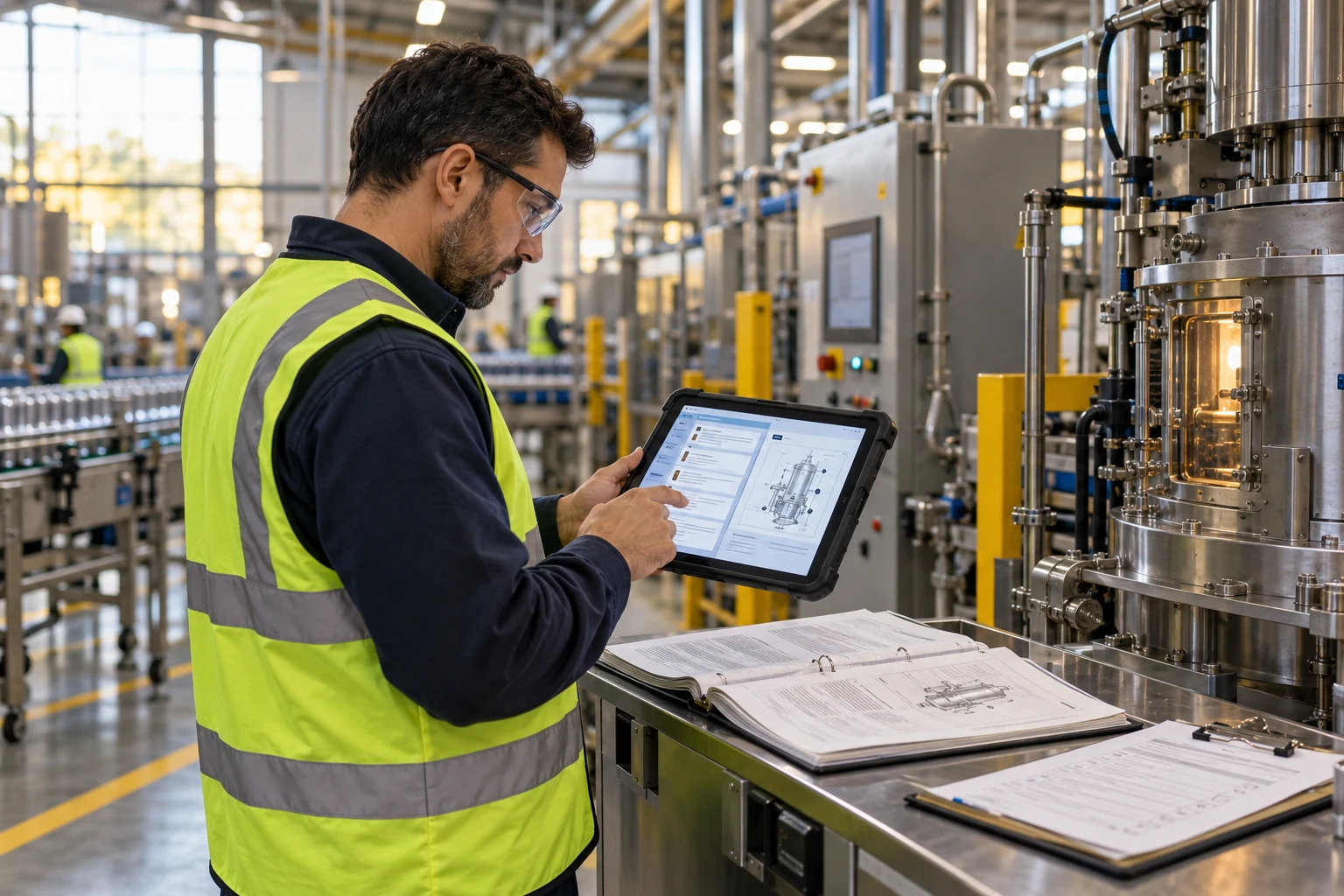
Manufacturing is one of the environments where retrieval-augmented generation can provide substantial value, and where poorly designed retrieval can create serious problems.
Factories accumulate equipment manuals, standard operating procedures, engineering drawings, maintenance histories, work orders, quality records, supplier documents, incident reports, and decades of operational knowledge. Much of this information exists, but getting the right piece of it to an engineer or technician at the right moment can be difficult.
RAG gives large language models a way to retrieve that proprietary information before producing an answer. A maintenance technician could ask why a specific machine is showing a fault code and receive information grounded in the correct service manual, relevant maintenance records, and approved troubleshooting procedures rather than relying entirely on the model's training data.
The challenge is that manufacturing RAG cannot be treated as ordinary document search. Equipment versions matter. Procedures change. Tables and diagrams carry important information. Plant systems such as ERP, MES, PLM, QMS, and CMMS may need to participate in retrieval. In safety-sensitive workflows, presenting the wrong procedure confidently may be worse than returning no answer at all.
The following companies bring different combinations of RAG engineering, manufacturing expertise, enterprise integration, multimodal AI, data engineering, and production deployment.
Manufacturing RAG Companies at a Glance
| Company | Best Fit | Notable Strength |
|---|---|---|
| SoftServe | Industrial copilots and multimodal manufacturing knowledge | RAG across manuals, production data, images, and tables |
| Addepto | Complex industrial and automotive knowledge systems | Agentic RAG, knowledge graphs, technical-document intelligence |
| IBM Consulting | Large global manufacturers | Enterprise AI governance, industrial data, and RAG at scale |
| LeewayHertz | Manufacturing AI and machinery-support applications | AI agents, troubleshooting, plant-system integration |
| SoluLab | Manufacturers building custom industrial RAG applications | Manufacturing-specific RAG and GraphRAG |
| Keyhole Software | Enterprises modernizing legacy manufacturing systems | Architect-led RAG and enterprise application integration |
| Morton Technologies | Focused manufacturing knowledge and service tools | Permission-aware, evaluation-driven RAG |
| Nyx Wolves | Manufacturers with structured data or private deployment needs | Production RAG over SQL and proprietary manufacturing data |
1. SoftServe
Best for: Industrial copilots, technician assistance, and multimodal manufacturing RAG
SoftServe has one of the clearest manufacturing-specific RAG offerings among larger technology consultancies.
Its Gen AI Industrial Assistant uses retrieval-augmented generation to connect an LLM to proprietary company documentation alongside historical and real-time production information. The system is designed to make digitized manuals, guidelines, and production knowledge accessible through a natural-language interface, including voice interaction for shop-floor environments.
That approach addresses a practical manufacturing problem: technicians rarely want to search a 500-page manual while diagnosing equipment.
SoftServe also offers multimodal RAG technology that processes text, images, and tables together. The company specifically identifies manufacturing as one of the industries where this architecture can be applied.
Multimodal retrieval matters because industrial documentation frequently depends on more than prose. A maintenance procedure may contain a diagram showing component location, a specification table containing allowable values, and explanatory text describing the sequence of work.
Why SoftServe stands out
SoftServe is particularly relevant for manufacturers developing knowledge systems around equipment manuals, maintenance guidance, production troubleshooting, worker assistance, quality documentation, or other industrial content where multiple information formats need to be understood together.
It is also a good fit when the RAG project forms part of a broader industrial AI program rather than an isolated chatbot.
2. Addepto
Best for: Industrial organizations with fragmented technical knowledge and complex engineering documents
Addepto combines manufacturing AI consulting with RAG, knowledge graphs, data engineering, and generative AI.
Its published industrial and automotive work includes an agentic RAG platform designed to retrieve information from complex unstructured engineering materials such as engine damage reports, flowcharts, technical documentation, and engineering diagrams while maintaining data-security controls.
That is closer to the reality of manufacturing knowledge than a simple PDF question-answering system.
Industrial information frequently contains relationships that matter as much as individual passages: a component belongs to an assembly, an assembly is installed on particular equipment versions, an engineering change modifies a specification, and a maintenance procedure applies only under certain operating conditions.
Addepto also positions RAG as a way to make operational materials such as maintenance logs, CAD-related documentation, procedures, and other institutional knowledge easier for frontline teams to query.
Why Addepto stands out
Addepto is a strong candidate when manufacturing knowledge is distributed across many formats and systems rather than sitting in one organized document repository.
It is particularly worth evaluating for engineering knowledge assistants, automotive documentation, maintenance intelligence, root-cause-analysis support, quality knowledge systems, and situations where knowledge-graph relationships could improve retrieval.
3. IBM Consulting
Best for: Large manufacturers building governed enterprise AI platforms
IBM brings a combination of consulting, enterprise AI technology, manufacturing experience, hybrid-cloud capabilities, and governance that is difficult for smaller RAG specialists to match.
IBM's manufacturing guidance explicitly describes RAG as a way to connect generative AI with internal manufacturing data without continually retraining the underlying model. It highlights applications involving quality procedures, calibration and inspection protocols, plant documentation, operating manuals, SOPs, logbooks, and incident information.
IBM also frames manufacturing GenAI as an enterprise capability rather than a collection of disconnected pilots. Its suggested progression moves from controlled AI use cases to grounding systems in internal documentation and structured plant data, and eventually toward agentic workflows across operational systems.
That distinction matters for global manufacturers.
A company operating dozens of plants may need one governed architecture that handles identity, document permissions, plant-specific knowledge, multilingual information, model monitoring, and integrations with existing data platforms.
Why IBM stands out
IBM Consulting makes the most sense when RAG sits inside a larger transformation involving enterprise data, manufacturing operations, supply chains, hybrid infrastructure, governance, or multiple AI use cases.
A smaller manufacturer that only needs a focused maintenance assistant may find a specialist development firm more practical.
4. LeewayHertz
Best for: Machinery troubleshooting and AI agents connected to manufacturing workflows
LeewayHertz combines generative AI, AI agents, custom development, and manufacturing consulting.
One particularly relevant example is its work on an LLM-powered machinery troubleshooting application for a Fortune 500 manufacturing company. The application integrates machinery information with changing safety policies so users can retrieve relevant troubleshooting guidance and equipment-handling instructions.
Its manufacturing AI practice also covers production, quality, maintenance, supply chain, procurement, and engineering workflows, with potential integrations across ERP, MES, PLM, QMS, CMMS, warehouse, and other operational systems.
That makes LeewayHertz interesting for companies moving beyond conversational search.
A maintenance assistant, for example, could retrieve documentation but also connect that information to a work order, equipment state, inspection result, or approval workflow.
Why LeewayHertz stands out
LeewayHertz is particularly suitable when RAG needs to work alongside AI agents or manufacturing process automation.
Potential projects include machinery troubleshooting, maintenance copilots, supplier intelligence, engineering-document assistants, contract and procurement review, quality investigation, and production exception handling.
For automated workflows, manufacturers should define carefully which actions AI can perform independently and which require human approval.
5. SoluLab
Best for: Custom manufacturing RAG applications and advanced retrieval architectures
SoluLab explicitly includes manufacturing within its RAG development offering.
Its manufacturing use cases focus on centralizing technical manuals, operating procedures, and production knowledge so users can retrieve information across facilities.
The company has also described more advanced manufacturing architectures involving adaptive retrieval and GraphRAG. Its approach can use temporal weighting to prefer newer technical information and graph relationships to connect entities such as equipment components and maintenance schedules.
Those techniques address two common weaknesses in basic RAG.
First, similarity alone does not guarantee that a retrieved document is current. A discontinued 2022 maintenance manual could be semantically almost identical to the current procedure.
Second, manufacturing questions often involve relationships. Knowing that a hydraulic pump appears in a document is less useful than understanding which machine it belongs to, which maintenance schedule applies to it, and which failure records reference the same component.
Why SoluLab stands out
SoluLab is worth considering for technical-document search, manufacturing knowledge management, industrial copilots, ERP or MES-connected AI, equipment assistance, and projects where standard vector retrieval may eventually need graph or adaptive retrieval.
Its broader application-development capability is also useful when the RAG system needs a custom web, mobile, or enterprise interface.
6. Keyhole Software
Best for: Manufacturers that need RAG integrated into existing enterprise software
Keyhole Software is less manufacturing-specific than some firms on this list, but its enterprise RAG engineering approach can be attractive to manufacturers dealing with legacy applications and complicated software estates.
The company builds secure RAG systems connected to internal knowledge, documents, and enterprise systems and emphasizes evaluation, monitoring, access control, and production integration rather than stopping at proofs of concept.
Its published RAG methodology covers ingestion, chunking, embeddings, retrieval optimization, vector infrastructure, and governance controls. Keyhole also has a broader legacy-modernization practice, which can be relevant for manufacturers whose operational information remains embedded in older applications rather than modern knowledge platforms.
Why Keyhole Software stands out
Consider Keyhole when your manufacturing RAG project is fundamentally an integration and modernization problem.
For example, the company may be a stronger fit where AI needs to work with existing Java or .NET applications, legacy databases, internal document systems, identity infrastructure, and operational software rather than being developed as an independent SaaS product.
Manufacturers should still verify experience with their specific ERP, MES, PLM, CMMS, or plant architecture during vendor evaluation.
7. Morton Technologies
Best for: Focused manufacturing knowledge systems that require strong permissions and evaluation
Morton Technologies operates RAGDevelopment.com and focuses specifically on production RAG and enterprise AI.
Its manufacturing offering describes applications using machine logs, quality reports, sensor information, maintenance records, manuals, and operational knowledge for troubleshooting, maintenance, quality, supply-chain support, and workforce assistance.
More importantly, its RAG development methodology treats retrieval quality as an engineering problem.
The company describes support for hybrid retrieval, reranking, source citations, document-level authorization, golden evaluation datasets, automated testing, observability, and controlled document lifecycles.
Those capabilities are highly relevant to manufacturing because a useful system must be able to distinguish "similar information" from "applicable information."
A procedure may be technically related to a query but belong to the wrong machine model, facility, revision, or production process.
Why Morton Technologies stands out
Morton is worth evaluating for manufacturers seeking a focused RAG specialist rather than a large digital-transformation consultancy.
Good fits include internal engineering assistants, service knowledge systems, equipment troubleshooting, manufacturing document intelligence, and applications where traceable sources and permission-aware retrieval matter.
8. Nyx Wolves
Best for: Manufacturers working with structured operational data or private RAG deployments
Nyx Wolves provides an interesting alternative because its manufacturing work includes production systems built over structured databases rather than only document libraries.
The company describes a deployment for a Bahrain manufacturer where users can ask questions in Arabic or English and have the system translate those requests into database queries against five years of operational data before generating a readable response.
It also documents a RAG deployment for a pharmaceutical manufacturer that keeps proprietary research data inside a controlled infrastructure rather than sending it to external model APIs.
This highlights an important distinction.
Not all manufacturing knowledge should be embedded into a vector database. Questions involving quantities, sales totals, production metrics, inventories, or other structured values may require SQL or API queries. A mature RAG application may route different questions to different retrieval tools.
Why Nyx Wolves stands out
Nyx Wolves may be suitable for manufacturers that need to combine conversational AI with SQL databases, ETL pipelines, private documents, multilingual interaction, or controlled deployment.
It is also worth considering when data sovereignty is a major requirement.
What Makes Manufacturing RAG Harder Than Ordinary Enterprise Search?
Manufacturing documents have operational context that generic RAG systems can easily lose.
A basic retrieval engine finds information that looks semantically similar to a user's question. Manufacturing systems often need additional rules before that information becomes usable.
Consider a technician asking:
"What is the torque specification for the drive assembly?"
A semantic search engine might find three excellent passages. But they may describe three different equipment generations.
The correct RAG system needs to understand more than similarity. It may need the machine model, serial number, configuration, facility, component revision, active engineering change, and effective procedure date before deciding which passage belongs in the answer.
Equipment metadata should participate in retrieval
Important metadata can include equipment model, serial number, plant, production line, part number, document revision, supplier, product configuration, effective date, and approval state.
Filtering on these attributes can prevent a system from returning a technically relevant but operationally incorrect document.
SOP version control cannot be an afterthought
Manufacturers regularly revise work instructions, quality procedures, maintenance processes, and safety documentation.
A RAG system may contain both old and new versions because historical records are valuable. That does not mean both versions should have equal priority during operational retrieval.
Current procedures should be clearly distinguished from archived information.
Manufacturing data is often multimodal
Technical information may live inside engineering drawings, diagrams, images, scanned documents, tables, and forms.
SoftServe's multimodal RAG work is one example of addressing this issue by processing images, text, and tables together rather than treating all knowledge as plain paragraphs.
Plant systems may contain more useful context than documents
Maintenance knowledge can exist in a CMMS. Equipment status may come from MES or telemetry platforms. Product structure may come from PLM. Material and purchasing information may live in ERP.
LeewayHertz's manufacturing architecture, for example, explicitly considers ERP, MES, PLM, QMS, and CMMS systems as part of AI-enabled manufacturing workflows.
A strong development partner should determine whether each source belongs in a vector index, relational query, API call, knowledge graph, or another retrieval mechanism.
The Best Manufacturing RAG Use Cases
The most valuable implementations usually solve a specific information bottleneck rather than attempting to create a universal "factory chatbot."
One practical use is maintenance troubleshooting. The system can combine equipment manuals, past incidents, work-order history, and approved procedures to help technicians locate relevant information faster.
Another is SOP and work-instruction retrieval, where operators ask questions in natural language and receive the currently approved procedure with links or citations to the source.
Engineering knowledge management is useful when product information is spread across technical documentation, change records, reports, and experienced employees.
Quality investigation support can bring together inspection instructions, nonconformance reports, historical corrective actions, specifications, and product information.
Supplier and procurement intelligence can retrieve supplier documentation, contract information, quality records, certifications, and internal procedures.
Training and frontline support can give newer employees easier access to approved operational knowledge without forcing them to know exactly which file or system contains the answer.
One important distinction is predictive maintenance. RAG itself does not predict mechanical failure simply because it can read maintenance documents. Prediction usually requires sensor analysis, anomaly detection, time-series models, or other analytical methods. RAG can then add context by retrieving service manuals, similar incidents, corrective actions, or procedures related to an identified anomaly.
How to Choose a RAG Development Company for Manufacturing
The strongest vendor is not necessarily the one with the most impressive chatbot demonstration.
A manufacturing team should evaluate whether a provider understands how retrieval fits the physical operation.
Ask how the proposed system will distinguish one machine model from another. Find out how expired SOPs are handled. Test whether tables, diagrams, and scanned technical material survive ingestion accurately. Determine how frequently indexes are refreshed when engineering documents change.
Integration deserves equal attention.
If the answer requires information from SAP, Oracle, a CMMS, an MES platform, a PLM environment, or a production database, ask the vendor to explain exactly how that source will participate in retrieval.
Then evaluate the difficult cases.
Give the system two conflicting procedures. Ask about a model that has three manual revisions. Request information the user is not authorized to see. Ask a question for which no reliable answer exists.
A production RAG application should not only demonstrate that it can answer questions. It should demonstrate that it knows which evidence is applicable, which evidence is permitted, and when it should refuse to answer.
Which Manufacturing RAG Company Is the Best Fit?
SoftServe is particularly strong when frontline industrial assistance and multimodal information are central to the project.
Addepto deserves consideration for sophisticated engineering knowledge, industrial documentation, knowledge graphs, and agentic RAG.
IBM Consulting fits large global manufacturers that need RAG inside a governed enterprise AI and data strategy.
LeewayHertz is a compelling option for machinery troubleshooting and manufacturing workflows that combine retrieval with AI agents.
SoluLab fits companies building custom manufacturing RAG products, particularly where advanced techniques such as GraphRAG may be useful.
Keyhole Software can be a strong choice when the difficult part is integrating RAG with established enterprise applications and legacy technology.
Morton Technologies suits focused projects where retrieval quality, permissions, citations, and evaluation are primary requirements.
Nyx Wolves is worth considering for structured manufacturing data, multilingual use cases, or deployments where proprietary information needs tighter infrastructure control.
The final choice should come from testing vendors against your actual manufacturing data, not generic demonstrations.
A provider that retrieves beautiful answers from a clean sample PDF may still struggle with a real plant environment containing overlapping manuals, undocumented abbreviations, scanned legacy records, conflicting revisions, table-heavy documents, old software, and equipment that has been modified several times since installation.