


If you are searching “what is testing in Zillexit software,” the simple answer is that testing means checking the software to make sure it works correctly, meets its requirements, handles expected situations, and identifies problems that should be fixed.
Testing may cover individual pieces of code, complete features, connections between different parts of the software, performance, security, usability, and the overall user experience.
There is also an important point to understand about Zillexit. Public information about the software is limited, and online descriptions are not always consistent. Because of this, it is better to explain testing in Zillexit software using standard software testing principles rather than assume that Zillexit has specific proprietary testing tools or features that have not been clearly documented.
What Does Testing in Zillexit Software Mean?
Testing in Zillexit software can be understood as the process of checking whether different parts of the software behave the way they are supposed to. A tester may compare the actual result of an action with the expected result. If both match, the test may pass. If they do not match, the difference may indicate a defect or another issue that needs investigation.
For example, imagine a software feature that allows a user to log in.
Testing could check whether:
- valid login details work correctly;
- incorrect details are rejected;
- required fields cannot be left empty;
- error messages are clear;
- user sessions behave correctly;
- the feature works on supported devices or browsers;
- the system remains responsive under expected usage.
This shows why software testing is much broader than simply looking for obvious bugs.
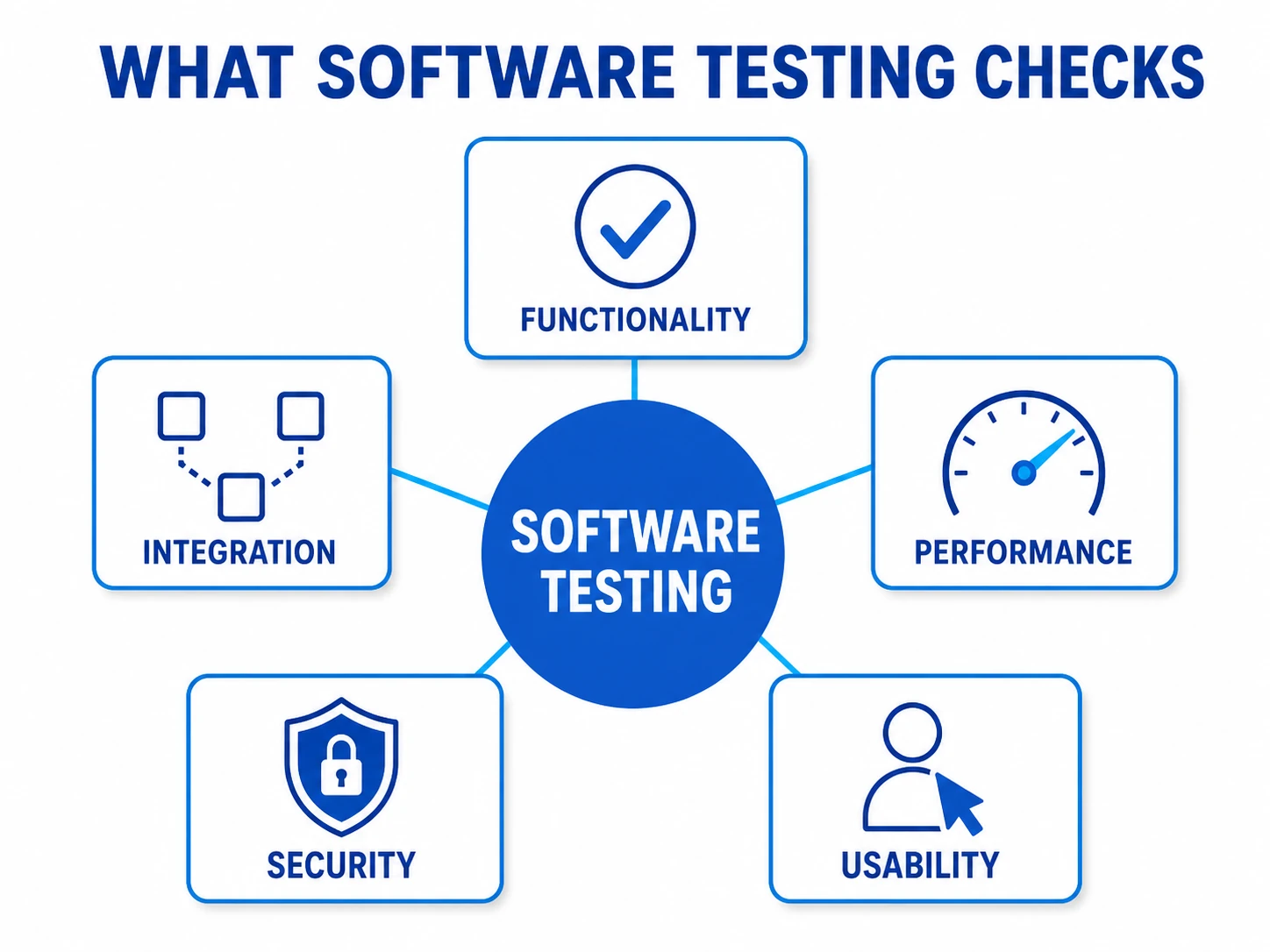
What Does Software Testing Actually Check?
Testing tries to answer several important questions about a software product.
Does the Software Do What It Is Supposed to Do?
Every feature should have an intended purpose. If a requirement says that clicking a particular button should save information, testing checks whether that action actually produces the expected result. A feature that looks good but does not perform its intended task correctly still has a problem.
Do Different Parts Work Together?
Modern applications usually contain many connected components. A login screen, for example, may interact with authentication services, databases, APIs, and account-management systems. Each component might work correctly on its own but fail when connected to another component. Integration testing helps find these problems.
Can the Software Handle Realistic Usage?
Software also needs to perform properly under realistic conditions.
Testing may look at:
- loading speed;
- response time;
- stability;
- resource usage;
- simultaneous users;
- large amounts of data;
- repeated actions.
This helps teams understand whether the system can support its intended use.
Is Important Information Protected?
Security is another important part of testing. Security testing may examine authentication, authorization, input validation, session handling, permissions, and other controls designed to protect the system and its information. The exact tests depend on the type of application and the risks involved.
Can People Use the Software Easily?
A feature may technically work while still being difficult to understand. Testing can therefore look at whether users can:
- find important controls;
- understand instructions;
- complete tasks;
- recover from mistakes;
- read error messages;
- navigate the interface easily.
This is particularly important in modern SEO-friendly web design, where technical performance and user experience both contribute to the quality of a website.
Why Is Testing Important in Zillexit Software?
Testing helps development teams understand software quality before users encounter problems themselves. Its purpose is not simply to collect as many bugs as possible.
Instead, testing helps teams identify risks, verify requirements, evaluate important workflows, and make better decisions about whether a product is ready to release.
It Finds Problems Earlier
Finding a defect before release usually gives the team an opportunity to investigate and correct it before many users encounter it. Early testing can also make troubleshooting easier because developers are working closer to the code or feature that was recently changed.
It Checks Whether Requirements Are Met
Software is normally created to solve specific problems or perform specific tasks. Testing checks whether those requirements have actually been implemented correctly.
It Protects the User Experience
Errors, confusing interfaces, slow pages, broken buttons, and unexpected behavior can frustrate users. Testing gives teams an opportunity to discover these problems before they become common user complaints.
It Supports Safer Software Updates
Software continues changing after its first release. New features, fixes, integrations, and design changes can affect parts of the system that previously worked. Testing helps teams check those changes before making them available more widely.
It Helps Reduce Release Risk
No testing process can guarantee that software will never have another bug. However, effective testing provides useful evidence about what has been checked, what problems remain, and how much risk may be involved in releasing the software.
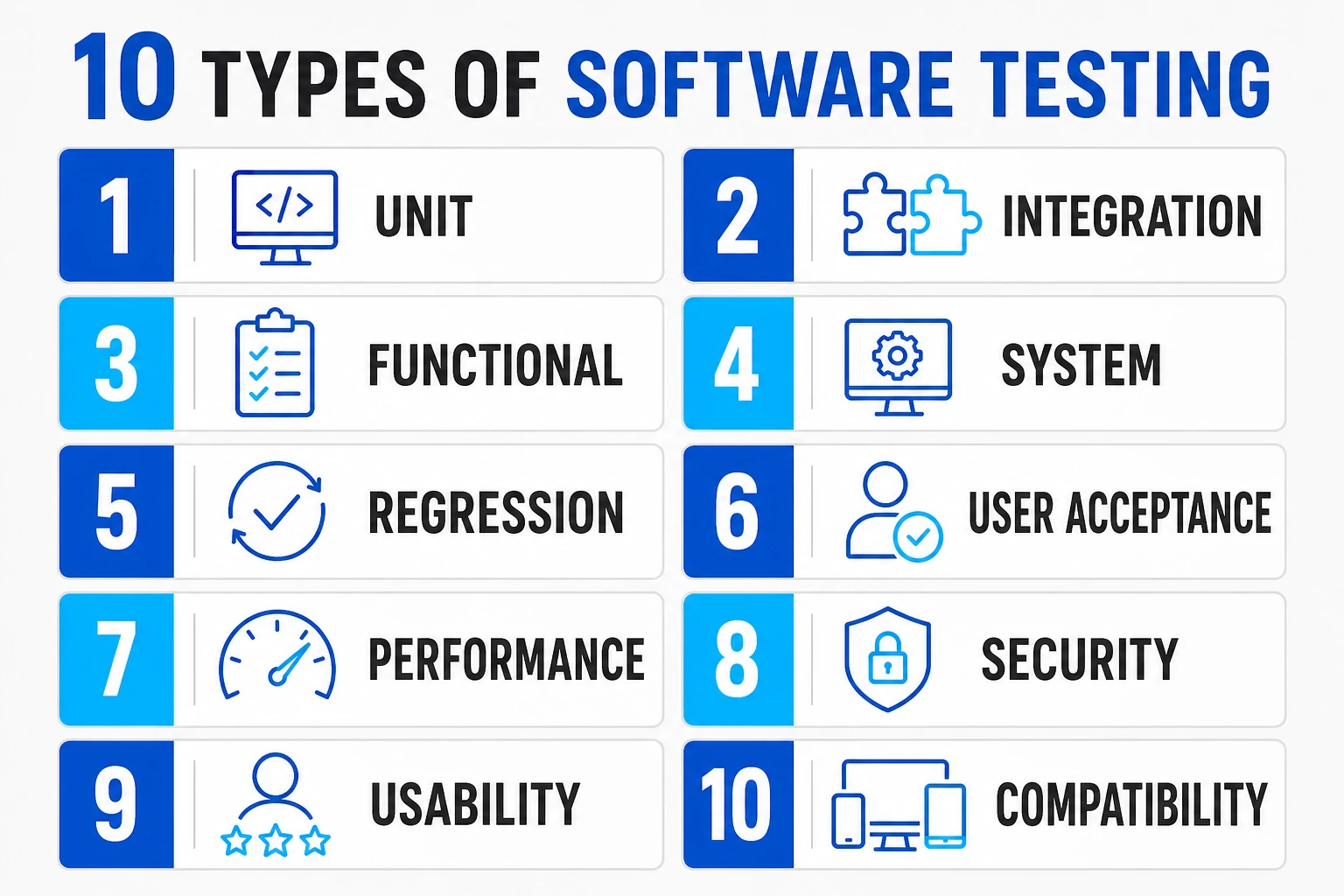
Main Types of Testing in Zillexit Software
Different types of software testing answer different questions. Understanding their roles makes the overall testing process much easier to follow.
1. Unit Testing
Main question: Does this small piece of code work correctly?
Unit testing focuses on small testable parts of an application, such as functions, methods, classes, or components. For example, a developer might test a function responsible for checking whether an email address follows the required format.
Unit tests are especially useful during development because they can catch problems close to the code where they were created. Component-based applications are one reason testing individual pieces of software is important.
Modern React.js development, for example, commonly organizes interfaces into reusable components that can be developed and evaluated separately before being combined into larger workflows.
2. Integration Testing
Main question: Do connected parts of the software work properly together?
Integration testing focuses on communication between components. Imagine that one part of an application collects information while another stores it in a database. Both components could work independently, yet their connection could fail. Integration testing helps identify these problems.
It can examine connections between:
- application components;
- databases;
- APIs;
- external services;
- authentication systems;
- payment services;
- internal modules.
3. Functional Testing
Main question: Does the feature perform the required function?
Functional testing evaluates software behavior against defined requirements. Suppose a user requests a password reset.
A functional test may check whether the correct process begins after the user submits the required information. It focuses mainly on what the software does rather than how the underlying code was written.
4. System Testing
Main question: Does the complete software system work correctly?
System testing evaluates the application after its major components have been connected. Instead of checking one small function, testers examine complete workflows and the behavior of the system as a whole.
This may include:
- account creation;
- login;
- navigation;
- forms;
- dashboards;
- notifications;
- integrations;
- user permissions.
5. Regression Testing
Main question: Did a recent change break something that previously worked?
Regression testing is extremely important when software is updated. Imagine that developers correct an issue in one feature.
The fix solves the original problem, but it could unintentionally affect another part of the application.Regression testing reruns relevant existing tests to check whether previously working functionality still behaves correctly after a change.
6. User Acceptance Testing
Main question: Does the software meet real business or user requirements?
User Acceptance Testing is commonly shortened to UAT. Instead of focusing mainly on individual pieces of code, UAT looks at whether the complete solution is suitable for its intended purpose. Business stakeholders or representative users may test important workflows and decide whether the system meets agreed requirements.
7. Performance Testing
Main question: How does the software behave under expected demand? Software may work perfectly during simple testing but become slow when many requests occur at the same time. Performance testing can evaluate:
- speed;
- response time;
- stability;
- resource usage;
- scalability;
- behavior under load.
Performance requirements should reflect how the application is actually expected to be used.
8. Security Testing
Main question: Are the software's security controls working correctly? Security testing looks for weaknesses that could affect the confidentiality, integrity, or availability of information and functionality. Depending on the application, testing may cover:
- authentication;
- authorization;
- session management;
- user permissions;
- input validation;
- sensitive information;
- error handling;
- business logic.
Security testing should be considered throughout development rather than only immediately before release.
9. Usability Testing
Main question: Can users easily complete their tasks? Usability testing focuses on the experience of using the software. A tester may look at whether:
- navigation is understandable;
- buttons are easy to identify;
- instructions are clear;
- forms are easy to complete;
- errors explain what went wrong;
- common tasks can be completed efficiently.
Software can be technically correct and still provide a poor experience, which is why usability should not be ignored.
10. Compatibility Testing
Main question: Does the software work in all environments it is expected to support? Users may access software through different devices, browsers, screen sizes, and operating systems. Compatibility testing checks whether those differences create problems.
This is particularly relevant to website projects. For example, a Webflow development project may still need browser, mobile, layout, content-management, form, and interaction testing before launch.
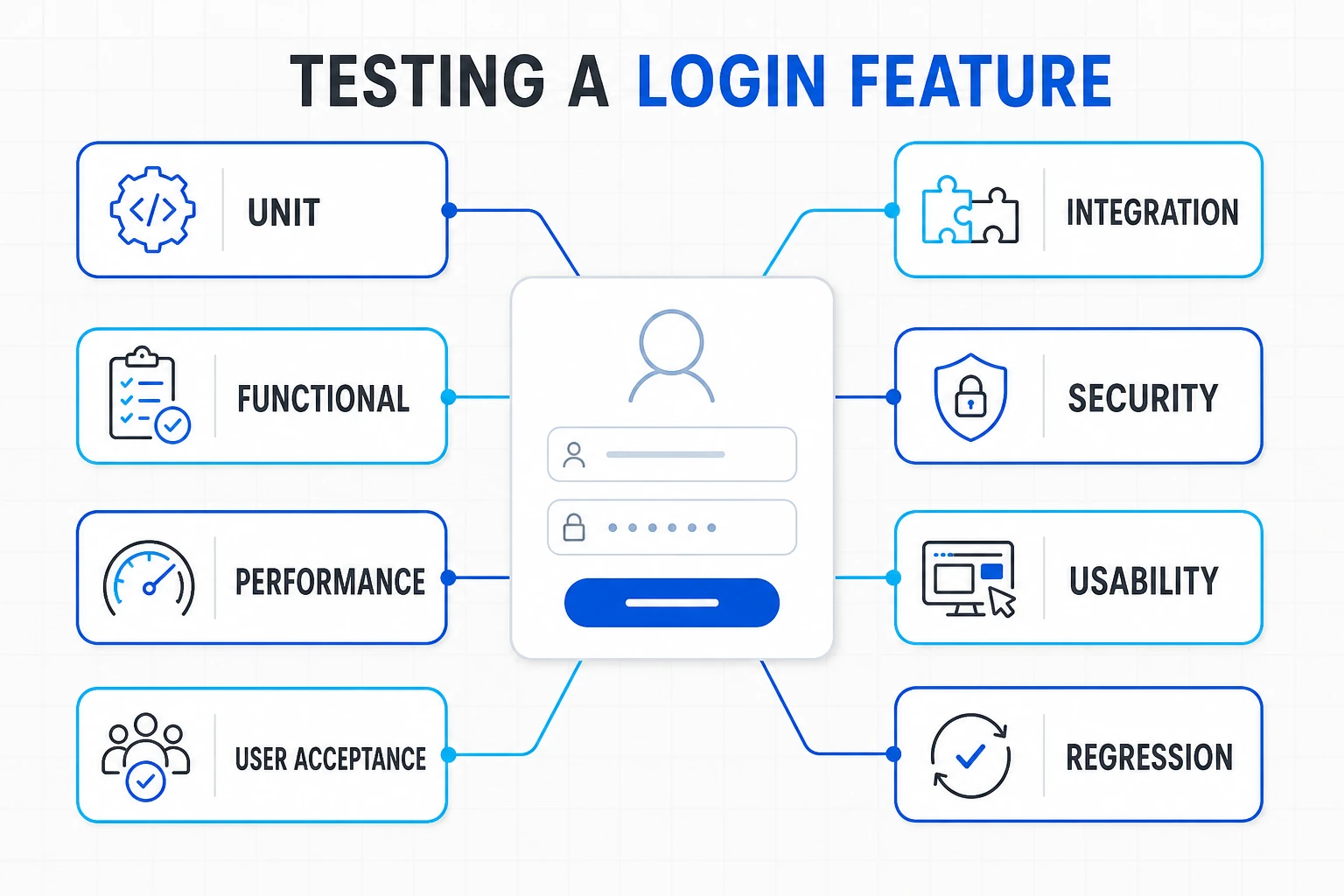
A Simple Example of How Different Tests Work Together
Imagine a software application has a user login feature.
Here is how several types of testing could work together.
Unit testing:
Check individual functions responsible for validating input.
Integration testing:
Check whether the login system communicates correctly with other required components.
Functional testing:
Verify that correct login details produce the expected result.
Security testing:
Evaluate relevant authentication, session, authorization, and input-handling controls.
Performance testing:
Check how the login workflow behaves under realistic demand.
Usability testing:
Make sure the fields, instructions, and error messages are easy to understand.
User acceptance testing:
Confirm that the complete login process meets the agreed requirement.
Regression testing:
After the login system is changed, rerun relevant tests to make sure previously working functionality has not been affected.
This example shows why there is no single test that can answer every question about software quality.
How Does the Zillexit Software Testing Process Work?
The exact testing process depends on the software team, project, technology, and risk level. However, a typical software testing process follows several basic stages.
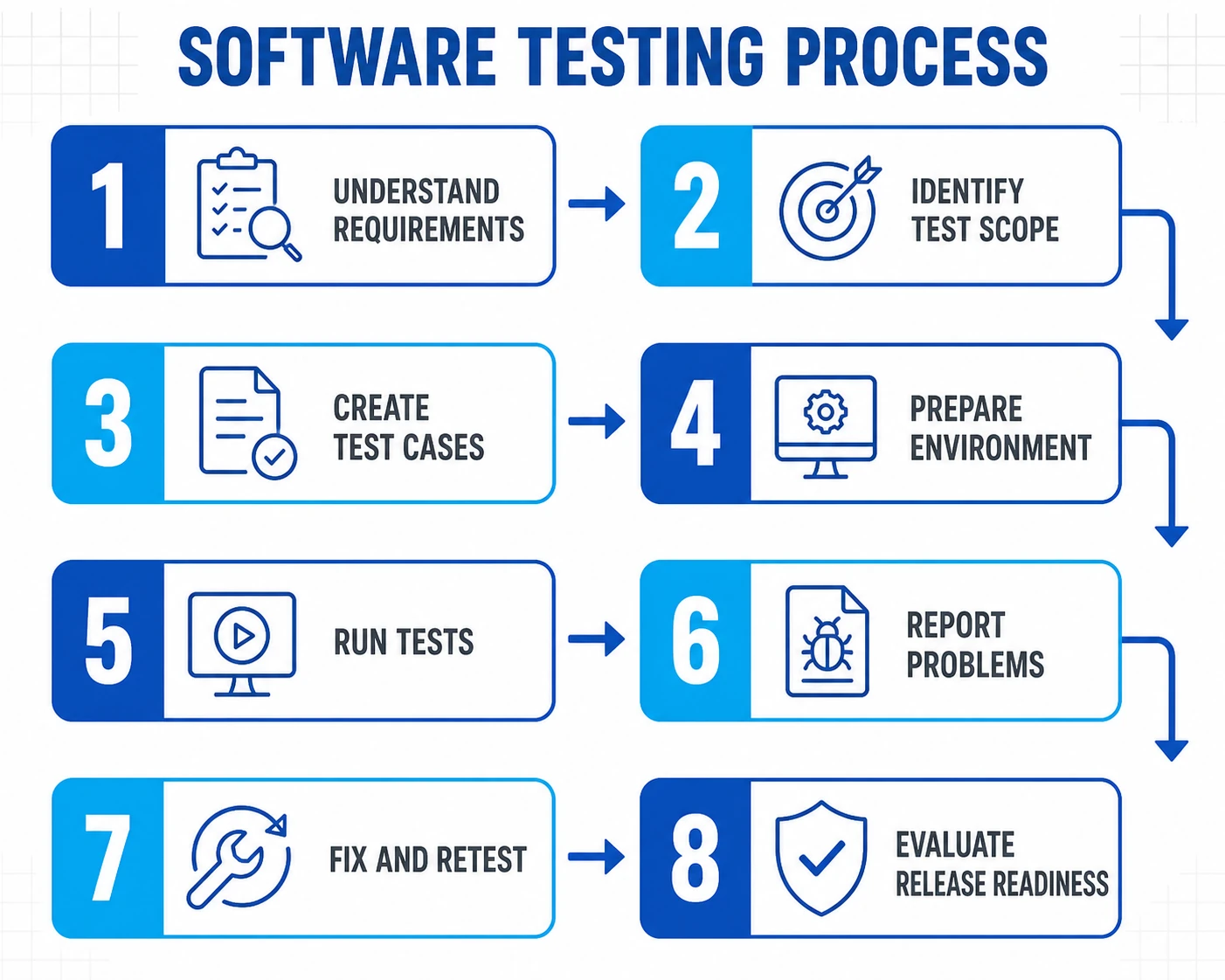
Step 1: Understand the Requirements
Before testers can determine whether software works correctly, they first need to understand what it is supposed to do. Requirements may describe:
- expected features;
- user workflows;
- business rules;
- security requirements;
- performance expectations;
- supported platforms.
Clear requirements make it easier to create meaningful tests.
Step 2: Identify What Needs to Be Tested
The team then determines which areas require testing and which ones carry the highest risk. Important features may receive more attention than low-risk functionality.
Teams may consider:
- business importance;
- frequency of use;
- complexity;
- security risk;
- previous defects;
- number of integrations;
- impact of failure.
Step 3: Create Test Cases
Test cases describe situations the team wants to evaluate. A basic test case may include:
- test objective;
- starting condition;
- input;
- steps;
- expected result;
- actual result;
- pass or fail status.
Test cases help make testing more repeatable and organized.
Step 4: Prepare the Test Environment
The team needs an environment where testing can be performed safely. This may involve preparing:
- application versions;
- databases;
- test accounts;
- configurations;
- test data;
- browsers or devices;
- connected services.
The environment should be suitable for the type of test being performed.
Step 5: Run the Tests
Testers or automated systems perform the planned tests. They compare the actual behavior of the software with the expected result. If the two do not match, the issue is investigated.
Step 6: Report Problems
When testers identify a defect, they should provide enough information for developers to understand what happened. A useful bug report may contain:
- a clear title;
- steps to reproduce the issue;
- expected behavior;
- actual behavior;
- relevant screenshots;
- browser or device details;
- severity;
- additional technical information.
Clear reports can make problems easier to reproduce and fix.
Step 7: Fix and Retest
After developers make a change, testers check the problem again. This confirms whether the fix actually solved it. Relevant regression tests may also be performed to make sure the change did not affect other parts of the system.
Step 8: Evaluate Release Readiness
Finally, the team reviews the testing results.
They may ask:
- Have important requirements been tested?
- Are critical defects still open?
- Have important security concerns been addressed?
- Have fixes been retested?
- Have the most important workflows passed?
- Has appropriate regression testing been completed?
- Are the remaining risks acceptable?
Testing gives stakeholders information they can use when making the release decision.
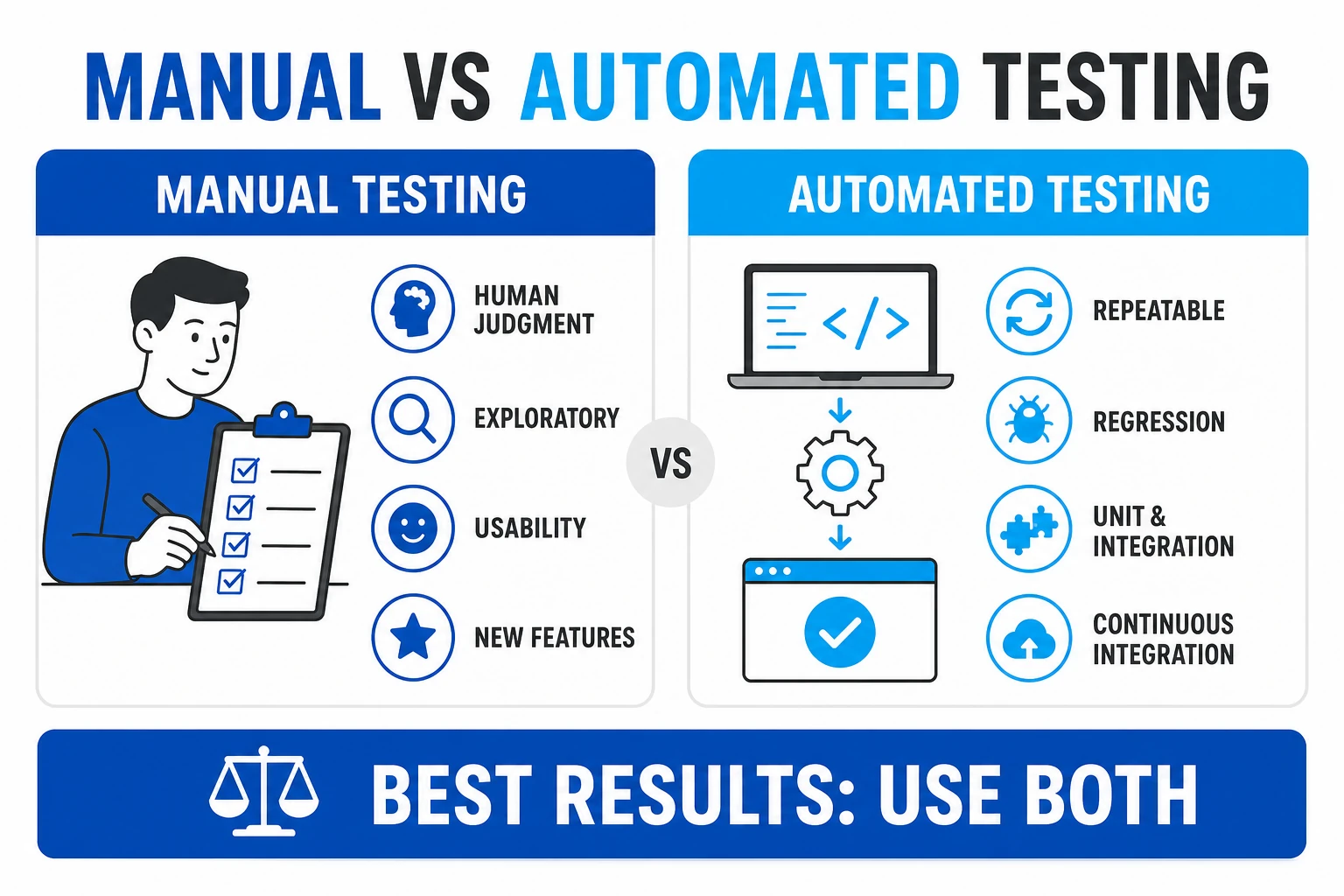
Manual Testing vs. Automated Testing
Software testing can be performed manually, automatically, or through a combination of both approaches. Neither method is automatically better in every situation.
Manual Testing
Manual testing means a person directly interacts with the application and evaluates its behavior. It can be useful for:
- exploratory testing;
- usability testing;
- new features;
- unusual situations;
- rapidly changing interfaces;
- tests requiring human judgment.
A human tester may notice confusing behavior that an automated test would not recognize as a problem.
Automated Testing
Automated testing uses software or scripts to execute checks. It is often useful for:
- unit tests;
- integration tests;
- repeated regression tests;
- stable workflows;
- large test collections;
- continuous integration pipelines.
Automation allows the same checks to be repeated frequently and consistently. However, automation also requires development and maintenance. The goal should not be to automate everything. Teams should automate tests where automation provides real value.
Data teams apply the same principle when using ETL testing to verify that faster pipelines still produce complete and accurate results.
What Is the Difference Between Software Testing and Quality Assurance?
Software testing and Quality Assurance, or QA, are closely connected, but the terms do not mean exactly the same thing. Software testing focuses on evaluating software and identifying problems or differences between expected and actual behavior. Quality Assurance is broader. QA can include:
- development processes;
- standards;
- reviews;
- documentation;
- testing practices;
- quality planning;
- defect prevention;
- process improvement.
A simple way to remember the difference is: Testing evaluates the product, while QA helps improve the process used to create a quality product. The responsibilities can still overlap within real development teams.
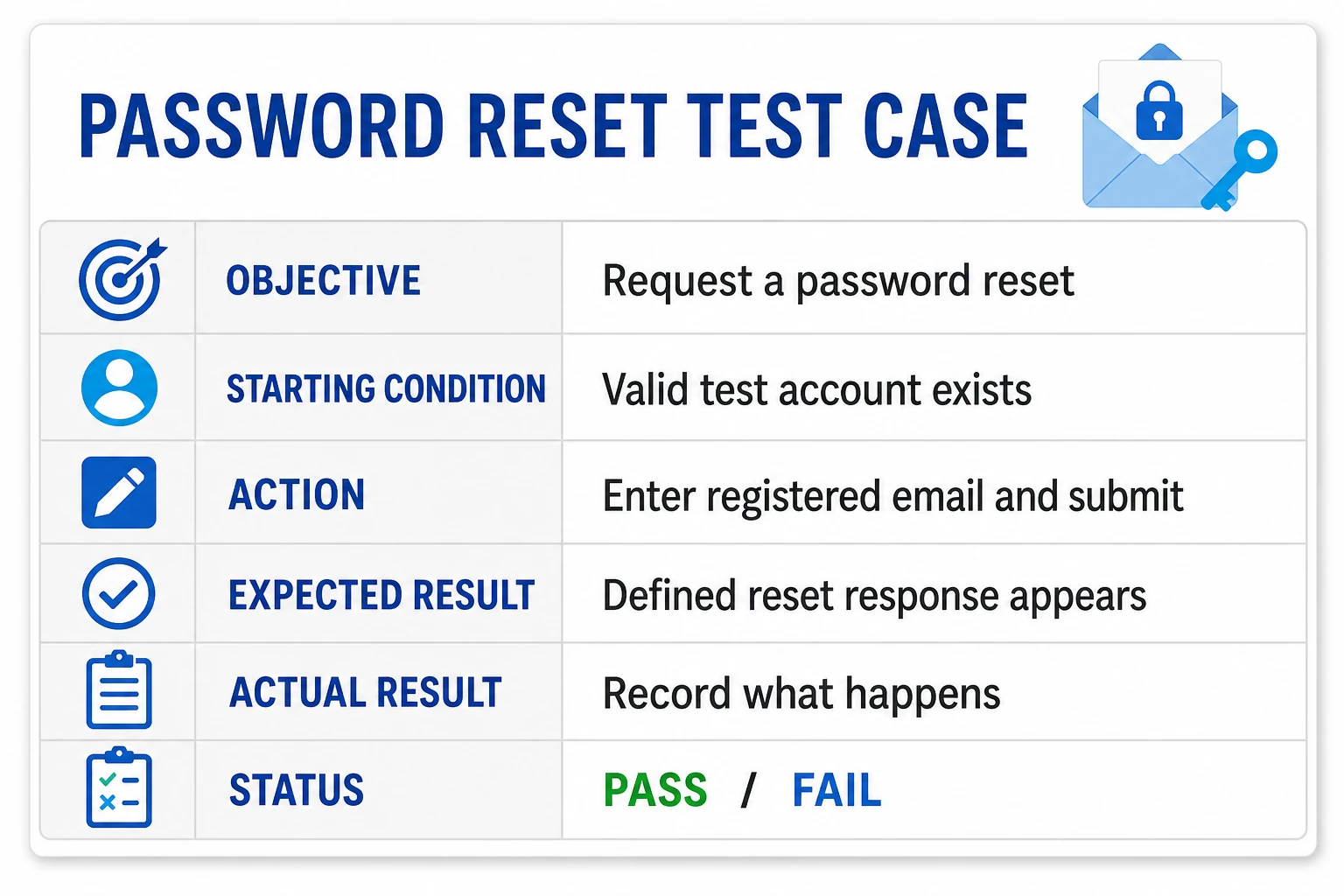
What Does a Good Software Test Case Look Like?
Consider a simple password-reset example.
Objective
Check whether a registered user can request a password reset correctly.
Starting Condition
A valid test account already exists.
Action
Enter the registered email address and submit the password-reset request.
Expected Result
The software responds according to the defined password-reset requirement.
Actual Result
Record what actually happens.
Status
Mark the test as pass or fail depending on whether the actual behavior matches the expected behavior. Good test cases should be clear enough that another qualified tester can understand what was checked.
Common Software Testing Mistakes
Even a team that performs a lot of testing can make mistakes in the way testing is planned.
Testing Too Late
Testing only after most development has finished can delay useful feedback. Finding problems earlier can make them easier to investigate.
Testing Only Successful Scenarios
Users do not always enter perfect information or follow the expected path. Testing should include suitable negative and boundary scenarios as well as successful ones.
Ignoring Regression Testing
Fixing one feature can unintentionally affect another. Skipping regression testing increases the chance that old functionality will break without being noticed.
Using Unrealistic Test Conditions
Tests are less useful when the environment, data, or workload has little connection with actual expected use.
Ignoring Security
Security should not be treated as something to examine only after the rest of the application is complete.Important security requirements should be considered throughout development and testing.
Automating Everything
Automation is useful, but it is not free. Automated tests need to be written, maintained, updated, and interpreted.Human testing remains valuable when judgment, exploration, and usability matter.
Trusting Unverified Software Claims
A final mistake is assuming that every online description of a software product is accurate. This is particularly relevant when information about a platform is limited. Similar issues can occur with other emerging software topics. Pixel Logic IT's guide explaining why Genboostermark software is so popular also notes that public descriptions of lesser-known software can be inconsistent.
For Zillexit, it is therefore better to separate established software-testing principles from claims about proprietary features unless those claims can be confirmed through reliable product documentation.
Does Passing All Tests Mean the Software Has No Bugs?
No. Passing a test tells the team that the software behaved as expected under the conditions covered by that test. It does not prove that every possible combination of:
- inputs;
- user behavior;
- devices;
- configurations;
- network conditions;
- integrations;
- data;
- future changes
has been tested. That is why software testing is better understood as a way to reduce uncertainty and manage risk, not as a guarantee of perfection.
How Do You Know When Testing Is Complete?
There is rarely a point when a team can confidently say every possible situation has been tested. Instead, testing usually ends based on predefined goals and acceptable risk. A team might consider testing sufficient when:
- critical features have been checked;
- important requirements are covered;
- major defects have been resolved;
- serious security issues have been addressed;
- important regression tests pass;
- stakeholders accept the remaining known risks.
The amount of testing required depends on the software. A simple informational website does not carry the same risk as financial, healthcare, or safety-critical software.