
Imagine asking ChatGPT a short question and getting a detailed answer that fills several pages. To you, it is one question and one response. But behind the scenes, the AI is processing hundreds or even thousands of small pieces of information.
Those pieces are called AI tokens. If you have seen terms like token limit, input tokens, or 1 million tokens while using an AI tool, you might wonder what they actually mean. The meaning of AI tokens is simple: they are small units of information that artificial intelligence models process. A token can be a complete word, part of a word, or a punctuation mark. Understanding tokens helps explain how tools like ChatGPT work. It also makes AI usage limits and pricing much easier to understand.
What Are AI Tokens?
An AI token is a small piece of text or data that an artificial intelligence model uses when processing information. Instead of working directly with complete sentences as humans do, language models divide text into smaller units called tokens. These pieces allow the model to process the information and generate a response. A token does not always represent one word. It might be:
- A complete word, such as "book"
- Part of a longer word
- A punctuation mark, such as a comma
- A sequence of characters or symbols
For example, a common word like "house" might be represented by one token. A longer or less common word may require several tokens. The exact result depends on the AI model being used.
A Simple Example of AI Tokens
Consider this sentence:
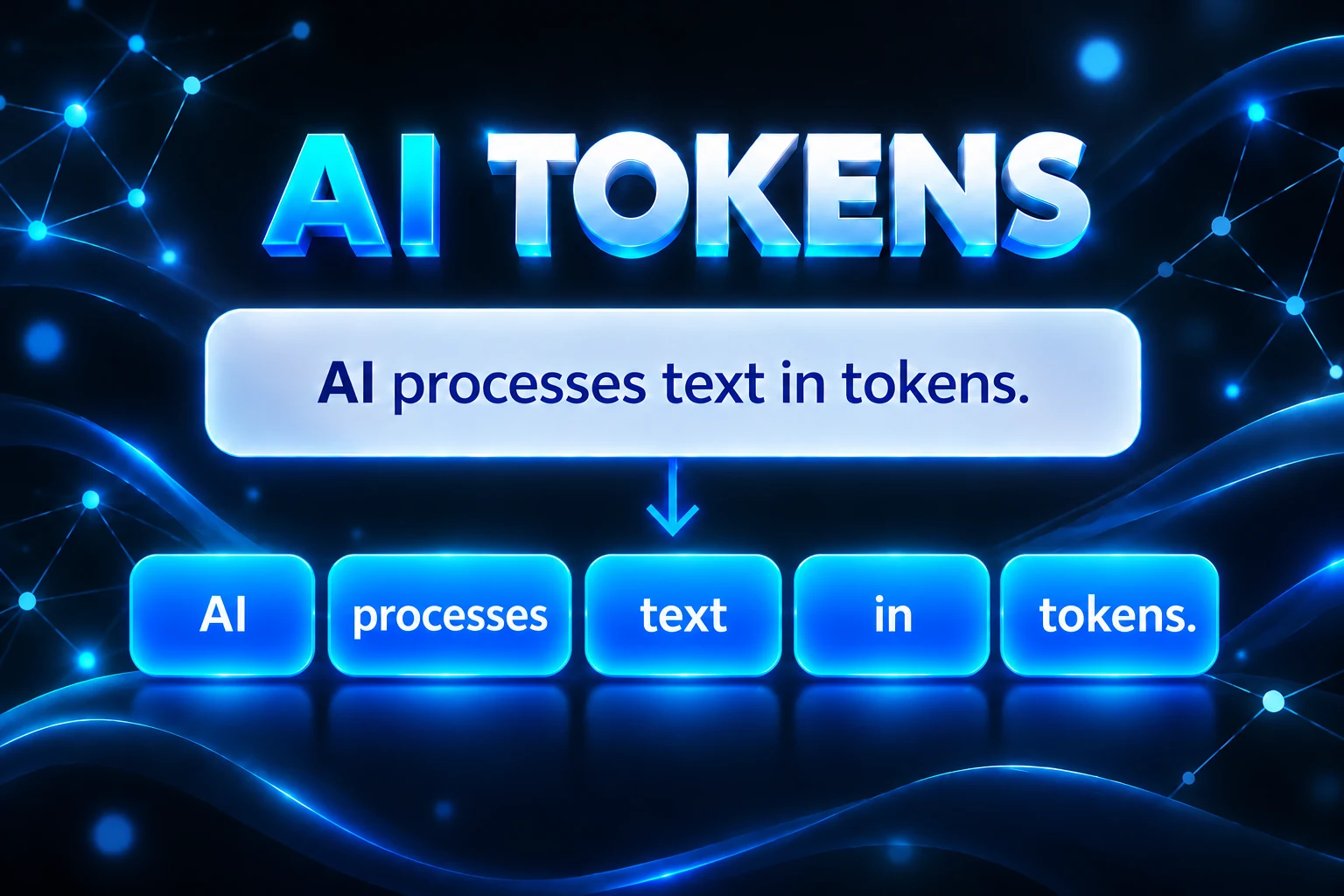
I love learning about AI.
A tokenizer might divide it into pieces resembling:
I | love | learning | about | AI | .
In this illustration, the spaces before certain words are included in their tokens. This is only an example of how tokenization may look. Different AI models can divide the same sentence differently. The important point is that AI processes text as a sequence of tokens rather than treating every sentence as one complete unit.
How Do AI Tokens Work?
AI tokens are created through a process called tokenization. Tokenization happens when text is divided into smaller pieces that a language model can process. Let's say you type:
"Explain how solar panels work."
Here is what generally happens.
Step 1: You enter your question. You type a message into an AI chatbot. This message is called a prompt.
Step 2: The text becomes tokens. A tokenizer divides your prompt into smaller units. Each token is associated with a numerical ID from the model's vocabulary.
Step 3: The AI processes the tokens. The model uses the numerical representations of those tokens to work with the meaning and context of your question.
Step 4: The AI generates a response. The model predicts and generates output tokens one after another.
Step 5: The response becomes readable text. The generated tokens are converted into the words and sentences displayed on your screen. This process happens whenever you ask a language model to explain something or help you write content.
Why Does AI Use Tokens Instead of Whole Words?
Human language contains an enormous number of words. New words appear regularly, and people use different spellings or technical terms. If an AI model relied only on complete words, it would need an extremely large vocabulary and would struggle with unfamiliar expressions.
Tokens provide a more flexible solution. A model can represent common words as single units and divide unfamiliar words into smaller pieces. This allows language models to handle new terms and different languages without needing a separate entry for every possible word.
How Many Words Are in an AI Token?
One of the most common questions about AI tokens is how many words they represent. For ordinary English text, a useful estimate is:
1 token ≈ 4 characters, or about 0.75 words.
According to OpenAI's official token guidance, approximately 100 tokens represent 75 English words. Here is a quick comparison.
Swipe the table sideways to compare all columns.
| AI tokens | Approximate English words |
|---|---|
| 100 tokens | 75 words |
| 500 tokens | 375 words |
| 1,000 tokens | 750 words |
| 2,000 tokens | 1,500 words |
| 5,000 tokens | 3,750 words |
| 10,000 tokens | 7,500 words |
These numbers are estimates, not exact conversions. For instance, an article containing 1,000 English words might use around 1,300 tokens, depending on its wording and formatting. Different languages may require a different number of tokens to express the same information.
Code, unusual names, URLs and special characters can also change token counts. This is why a tokenizer is more reliable than a simple word counter when you need accurate results.
What Are the Different Types of AI Tokens?
Not all tokens play the same role in an AI conversation. When looking at AI usage reports, you may encounter several categories.
1. Input Tokens
Input tokens are the tokens sent to an AI model. These can include your question, instructions and relevant conversation history. For example, if you ask an AI tool to summarize a long document, the document and your instructions contribute to its input tokens. Longer inputs generally require more tokens.
2. Output Tokens
Output tokens are the tokens generated by the AI model. If you ask for a short definition, the response may use relatively few output tokens. If you request a detailed report, the answer can require thousands of tokens. Input and output tokens are commonly priced differently when using AI through a developer API.
3. Cached Tokens
Some AI services can reuse parts of previously processed input. When supported, this is called prompt caching. Cached input tokens may be charged at a different rate, depending on the provider and model. Caching can be useful for applications that repeatedly send the same instructions or reference material.
4. Reasoning Tokens
Some AI models use additional internal processing to solve difficult problems. That internal work may consume reasoning tokens. These tokens are not necessarily visible in the final answer. They can still contribute to usage and billing, depending on the service. This explains why two answers of similar length do not always consume the same amount of AI resources.
Why Do AI Tokens Matter?
Tokens are more than a technical detail. They influence what an AI model can process and how much a developer may pay to use it.
Tokens Determine How Much Information AI Can Handle
Every language model has limits on how much information it can work with at once. One important limit is called the context window. A context window is the amount of information, measured in tokens, that a model can consider during a request.
Imagine a hypothetical AI model with an 8,000-token context window. Your question, instructions and relevant conversation history take up some of that space. The model must also operate within its output restrictions. If you upload a document that is too large, the application may need to shorten it, divide it into sections or reject the request. The exact behavior depends on the model and application.
Tokens Affect AI Pricing
Many AI developers pay for model access based on token usage. A short request that generates a brief response usually uses fewer tokens than a long request that produces a detailed answer.
For example, an AI-powered customer support service processing thousands of conversations each day can accumulate significant token usage. Understanding the difference between input and output tokens helps developers estimate these costs.
Tokens Influence Response Length and Speed
AI language models generate text token by token. Producing a longer response generally requires more generation steps than producing a shorter response on the same model. This can affect how quickly an answer appears. However, response speed also depends on the model, server load and the complexity of the request. A higher token count does not automatically mean a better answer.
How Much Do AI Tokens Cost?
There is no universal price for an AI token. The cost depends on the provider, model and type of usage. Developer APIs commonly publish rates for every million input and output tokens. Here is a hypothetical example to make the calculation easier to understand. Suppose an AI model charges:
- $2 per million input tokens
- $8 per million output tokens
You send a request containing 2,000 input tokens. The model generates a response containing 500 output tokens. The estimated cost would be:
Swipe the table sideways to compare all columns.
| Usage | Calculation | Cost |
|---|---|---|
| Input | 2,000 ÷ 1,000,000 × $2 | $0.004 |
| Output | 500 ÷ 1,000,000 × $8 | $0.004 |
| Total | $0.008 |
That is less than one US cent for the request. If an application processed 1,000 identical requests, the estimated total would be $8. These are illustrative rates, not current prices from a particular company. Real charges may also include cached input, reasoning usage or other features. Always check the provider's official pricing page before preparing a budget.
Do ChatGPT Users Pay for Tokens?
Using ChatGPT through its website or mobile app is different from using the OpenAI API. Regular users can access ChatGPT through available free or paid plans, which have their own usage rules. Users exploring features such as a ChatGPT watermark should also understand that ChatGPT’s standard plans and API services operate differently. They are not generally presented with a separate per-token bill for each ordinary ChatGPT message. Developers using the API have a separate billing arrangement, which can include token-based charges. So, even though both experiences rely on tokens, the way customers pay can be different.
How to Count and Reduce AI Token Usage
You do not need to guess how many tokens your text contains. Several AI providers offer tools for checking token counts.
How to Count AI Tokens
One useful option is OpenAI's Tokenizer. You can enter text and inspect how a supported tokenizer divides it into smaller pieces. This is a practical way to understand why token counts differ from ordinary word counts.
If you are using a developer API, you can also inspect the usage information returned after a request. For more accurate budgeting, use the tokenizer or counting endpoint associated with your chosen model. Remember that counting plain text alone may not capture all the tokens used by a complete request containing tools, files or other content.
Simple Ways to Use Fewer Tokens
You can often reduce unnecessary token usage without making your prompts difficult to understand.
Write clear prompts. Explain what you need without adding unrelated information.
Avoid repeating instructions. If your application sends the same information repeatedly, review whether all of it is necessary.
Share relevant material. When asking AI to analyze a long document, provide the important sections when possible.
Choose a suitable response length. If you only need a definition, you can ask for a concise explanation.
Review conversation history. Long conversations may contain old information that is no longer helpful. Some applications resend relevant history with each request.
Check actual usage. For business applications, measuring real input and output tokens is better than relying on word-count estimates. The aim is not to make every prompt extremely short. A clear instruction that gets the right answer is more valuable than a shorter prompt that causes repeated mistakes.
Can Images and Audio Use AI Tokens?
Yes. Tokens are not limited to written text. Modern AI systems can process images, audio and video alongside text. For example, when you upload an image and ask an AI model to describe it, the system must represent that visual information in a form it can process. The method depends on the model. Some multimodal models use image patches or other representations rather than ordinary word-like tokens.
Audio and video can also contribute to token usage through model-specific processing methods. Google's Gemini token documentation explains that its token counting can include text and multimodal information. However, the simple four-characters-per-token estimate used for English text does not apply directly to images or audio.
AI Tokens vs. Cryptocurrency Tokens
The phrase "AI tokens" can have another meaning, especially in cryptocurrency discussions. In the context of language models, tokens are pieces of information processed by an AI system. In cryptocurrency, AI tokens generally refer to blockchain-based digital assets associated with AI-related projects. These assets may be used to access services, reward participants or support activities within a blockchain network. Here is the difference:
Swipe the table sideways to compare all columns.
| AI model tokens | AI cryptocurrency tokens |
|---|---|
| Units of information processed by AI | Digital assets associated with AI projects |
| Used in prompts and model responses | Used within blockchain ecosystems |
| Help measure processing and API usage | May be tradable on cryptocurrency markets |
| Not investment assets | Can involve investment and market risks |
If someone talks about ChatGPT token limits, they mean AI model tokens. If someone discusses buying an AI token on a cryptocurrency exchange, they mean something different. Understanding this distinction can prevent confusion.