
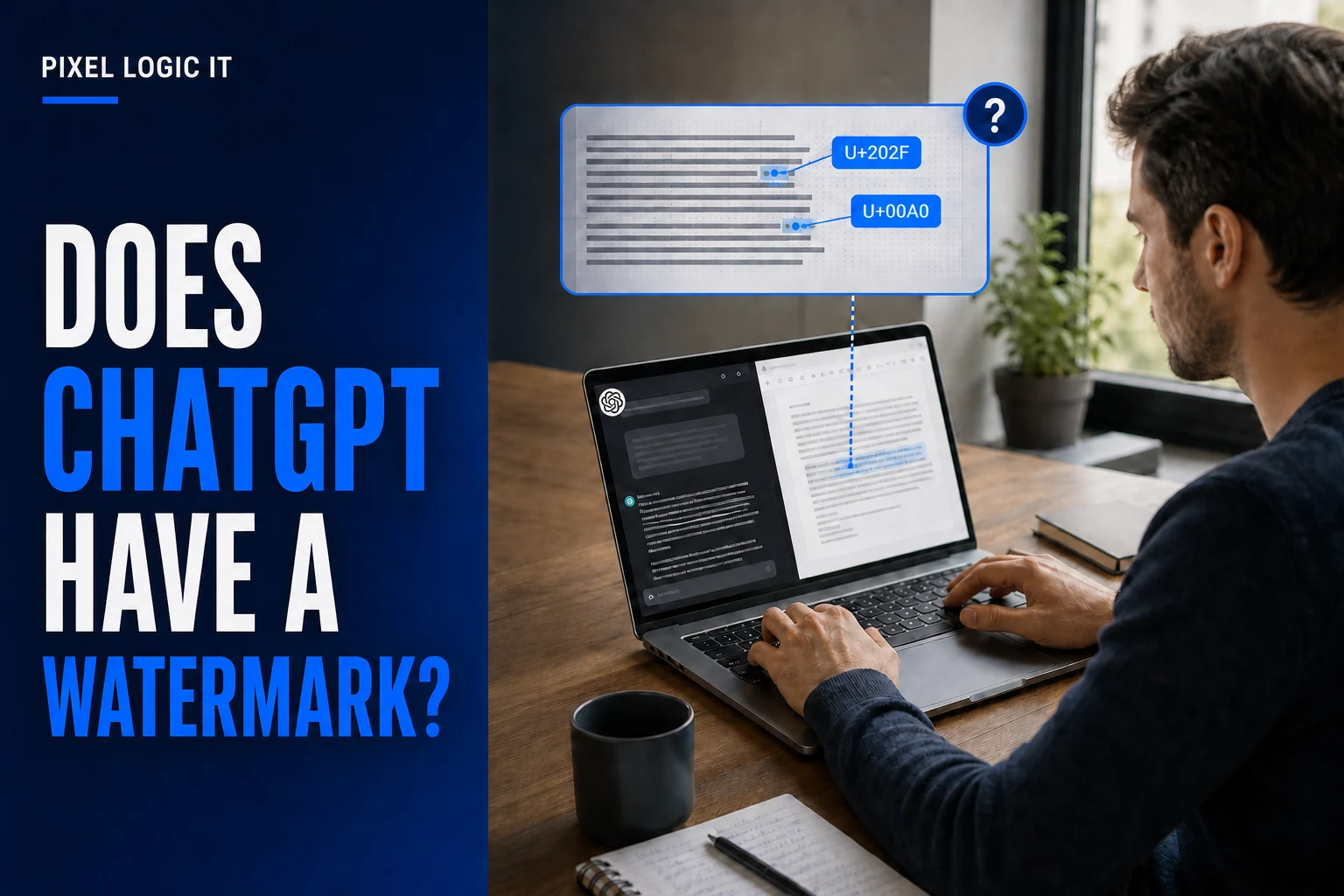
You copy a paragraph from ChatGPT, paste it into a document, and then notice an unusual space, a long dash, or a strange formatting mark. Does that mean ChatGPT secretly watermarked the text?
Not necessarily. As of August 2, 2026, there is no publicly confirmed universal watermark embedded in ordinary ChatGPT text. OpenAI has developed and researched text-watermarking methods, but its public documentation has not announced that such a watermark is active in every standard ChatGPT response. ChatGPT-generated media is a different matter. Supported images created with OpenAI tools can include C2PA Content Credentials and invisible SynthID watermarks. Supported generated audio can also contain a SynthID signal. Ordinary text is not listed among the currently supported content types in OpenAI’s provenance documentation. The confusion comes from the fact that people use the word “watermark” to describe several very different things. Let’s separate them.
The Quick Answer
| Question | Answer |
|---|---|
| Does every ChatGPT text response contain a confirmed secret watermark? | No publicly confirmed universal text watermark has been announced. |
| Has OpenAI developed text-watermarking technology? | Yes. OpenAI has researched and considered a statistical text-watermarking method. |
| Can copied ChatGPT text contain unusual Unicode or formatting characters? | Yes, depending on the text, interface, browser, editor, and copy-and-paste process. |
| Do unusual characters prove ChatGPT wrote the text? | No. The same characters can come from many ordinary digital sources. |
| Do AI detectors rely on a secret ChatGPT watermark? | Generally, no. They usually estimate authorship from linguistic and statistical patterns. |
| Do ChatGPT-generated images have provenance signals? | Supported images can include C2PA metadata and SynthID watermarks. |
| Can a detector result prove academic dishonesty? | No. A detector score should not be treated as conclusive proof by itself. |
What Exactly Counts as a Watermark?
A watermark is a signal added to content so its source or origin can be identified later. With digital content, that signal can take several forms.
Visible watermarks
A visible watermark is the easiest type to understand. It may be a logo, label, badge, or phrase such as “AI-generated.”
Anyone looking at the image or video can see it. Ordinary ChatGPT text does not automatically display a visible label saying it was generated by AI.
Metadata and Content Credentials
Metadata is information attached to a digital file. It can describe how the file was created, which tool produced it, and what changes were made. C2PA Content Credentials are a standardized form of provenance metadata. OpenAI uses C2PA alongside SynthID in supported generated images.
However, metadata can sometimes disappear when a file is compressed, converted, edited, screenshotted, or uploaded to a platform that removes it. Ordinary copied text is different from an image file. When you copy a paragraph into a plain-text field, most file-level metadata is not carried along with it.
Hidden Unicode characters
Unicode is a standard that allows computers to represent letters, symbols, punctuation, emoji, and characters from writing systems around the world.
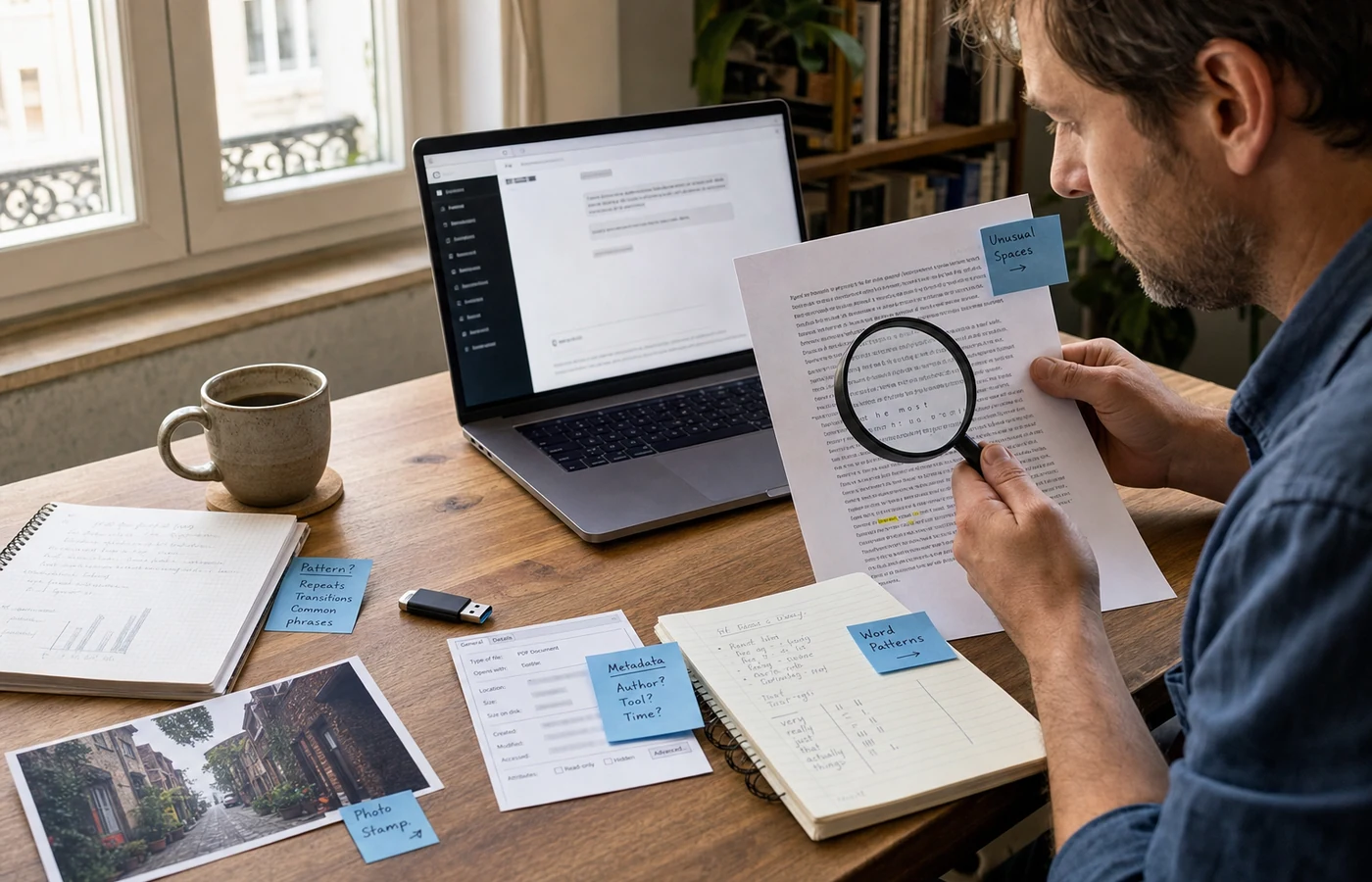
Some Unicode characters are difficult or impossible to see. Examples include:
- Zero-width spaces
- Non-breaking spaces
- Word joiners
- Directional formatting marks
- Soft hyphens
- Narrow no-break spaces
These characters have legitimate purposes. A non-breaking space can keep a number and its unit on the same line. A directional mark can help software correctly display text containing both left-to-right and right-to-left languages.
Finding one does not prove that ChatGPT secretly marked the passage. Hidden or unusual characters can be introduced by a website, PDF, browser extension, word processor, messaging app, translation service, content management system, or clipboard.
Statistical text watermarks
A true model-level text watermark works differently.
Large language models generate text one token at a time. A token can be a word, part of a word, or punctuation mark. A statistical watermarking system subtly influences which acceptable tokens the model chooses. For example, the system might quietly favor one secret group of tokens over another. The finished passage still reads normally, but a detector with the correct key can examine a sufficiently long sample and look for the statistical pattern. Researchers have demonstrated that this kind of watermark can be added without placing visible codes between words.
This is not the same as inserting zero-width characters into copied text.
Does ChatGPT Currently Watermark Ordinary Text?
OpenAI has developed and researched a text-watermarking method, but there is no public confirmation that a universal version is deployed in every ordinary ChatGPT text response.
In an August 2024 update, OpenAI said its teams had developed a text-watermarking method and continued to consider it while researching alternatives. The company reported that the method could be accurate and resistant to limited changes, but it was more vulnerable to extensive transformations such as translation or rewriting with another model. OpenAI also raised two broader concerns.
First, even a low false-positive rate can lead to many incorrect classifications when a system is applied to enormous volumes of text.
Second, watermarking could disproportionately affect people such as non-native English speakers who legitimately use AI to improve their writing.
Reports in The Wall Street Journal and The Verge also described an internally developed system that OpenAI had not publicly released at the time.
OpenAI’s newer public provenance materials focus on deployed signals for images and audio. They do not currently document an equivalent universal signal for ordinary ChatGPT prose.
That does not mean OpenAI will never introduce one. Product features, regulations, and technical standards continue to develop. It means only that a universal ChatGPT text watermark should not be presented as a confirmed current fact without an official deployment announcement.
Why Do People Find Unusual Characters in ChatGPT Text?
The watermark rumor grew partly because users found unusual spaces and formatting in text copied from certain AI interfaces.
Those characters can be real. The conclusion people draw from them is often the problem.
Copying text is more complicated than it looks
When you copy from a webpage, your clipboard may store several versions of the selected content:
- Plain text
- HTML
- Rich-text formatting
- Links
- List formatting
- Directional information
- Typography and spacing instructions
The destination application then decides which version to use. Pasting into Notepad may produce a different result from pasting the same content into Microsoft Word, Google Docs, WordPress, or an email editor.
A strange character may therefore come from the surrounding interface or clipboard process rather than from a deliberate model-level watermark.
Zero-width spaces are not unique to ChatGPT
A zero-width space is an invisible character that software can use to mark a possible line break or word boundary.
It may also appear because of:
- Text copied from a PDF
- Webpage formatting
- Emoji sequences
- Multilingual text
- Browser extensions
- Document conversion
- Content pasted between editors
- Deliberate insertion by a person or another program
Even when an invisible character appears in ChatGPT output, its presence alone cannot reliably identify the source.
An em dash is not a secret AI code
The em dash is a visible punctuation mark. Human writers, newspapers, books, editors, and publishing software have used it for generations.
ChatGPT may use em dashes frequently in some writing styles, but punctuation preference is not a secure watermark. The same applies to phrases such as “it is important to note,” carefully balanced paragraphs, predictable conclusions, or repeated three-part lists.
These may make writing feel formulaic, but they do not operate like a cryptographic signature.
Can Copied ChatGPT Text Be Traced Back to You?
There is no public OpenAI documentation stating that ordinary copied ChatGPT text contains your name, email address, account number, or conversation ID as an embedded text watermark. Based on the publicly described systems, a normal pasted paragraph should not be assumed to carry an account-identifying code. This is an inference from OpenAI’s available provenance materials, which describe supported image and audio signals but not user-specific identifiers in ordinary text.
However, two different issues should not be confused:
- Information maintained by an online service
- Information embedded inside the copied paragraph
A service may maintain records according to its settings, terms, and privacy policies. That does not automatically mean the words you copy carry an invisible account ID into every external document.
The safest statement is that there is no publicly documented universal account-tracing watermark in ordinary copied ChatGPT text.
Are AI Detectors Looking for a ChatGPT Watermark?
Most AI-writing detectors do not need a secret ChatGPT code.
They generally analyze features such as:
- Word predictability
- Sentence variation
- Repetition
- Vocabulary distribution
- Syntactic patterns
- Paragraph structure
- Similarities to known AI-generated samples
The detector then produces an estimate, not a verified record of authorship.
This distinction matters because detection and watermark verification are different tasks.
A watermark detector checks for a deliberately embedded signal using a known method or key. A general AI detector makes a probability-based judgment from the writing itself.
AI detectors can be wrong
OpenAI released an experimental AI-text classifier in 2023 but later withdrew it because of its low accuracy. In OpenAI’s published evaluation, the tool identified only 26% of AI-written samples as likely AI-generated and incorrectly labeled human-written text as AI-generated 9% of the time. OpenAI warned that such classifiers should not be used as the primary basis for important decisions.
Detection tools may have changed since then, but the underlying lesson remains useful: a score is not the same as proof. Short passages are especially difficult to classify because there is less linguistic evidence available. Highly edited AI-assisted writing may look human, while formal or predictable human writing may look machine-generated.
Removing hidden characters does not prove human authorship
Replacing non-breaking spaces with regular spaces can solve formatting problems. It does not transform the actual language, reasoning, or sentence patterns.
Likewise, a passage without hidden Unicode may still be AI-generated, while a human-written passage copied from a PDF may contain several invisible characters.
Character cleaning and authorship detection solve different problems.
Do ChatGPT Images and Audio Contain Watermarks?
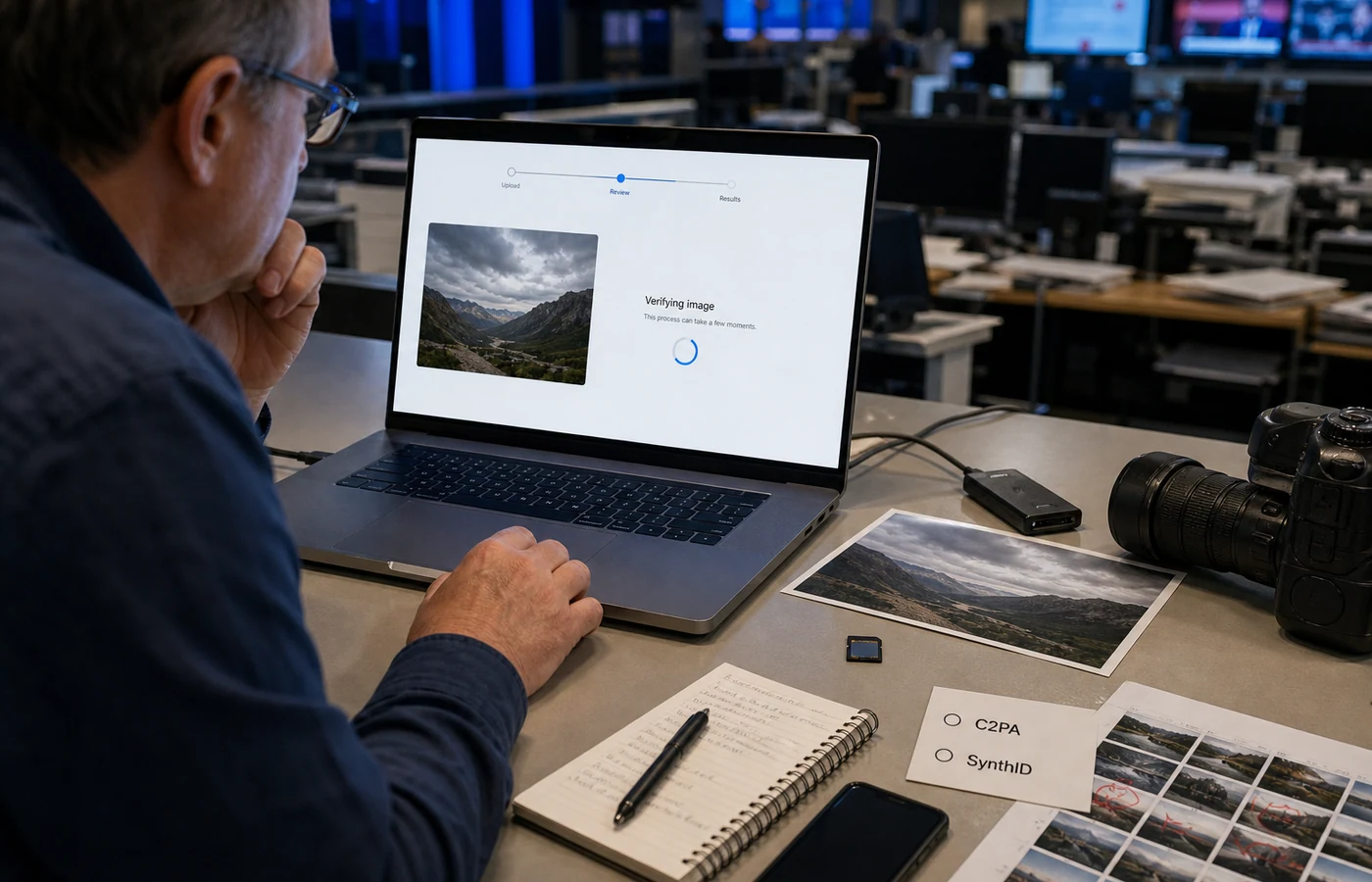
This is where the answer is clearer.
OpenAI currently states that supported images generated with ChatGPT, Codex, and the OpenAI API include:
- C2PA Content Credentials
- SynthID watermarks
Supported OpenAI-generated audio can contain an inaudible SynthID watermark.
SynthID is embedded into supported media itself, while C2PA provides metadata about origin and editing history. The two methods complement each other because metadata may be removed, while an embedded signal may survive some transformations. Still, failure to find a signal does not prove a file was human-made. OpenAI notes that provenance data may be missing because the content came from an unsupported model, an older generation system, a different export path, or a process that removed or weakened the signal.
Can Schools or Employers Detect ChatGPT Use?
A school or employer may investigate AI use, but it is unlikely to rely on one magical watermark hidden in every paragraph.
An investigation may consider:
- AI-detector scores
- Sudden changes in writing quality or style
- Missing or fabricated sources
- Inaccurate claims
- Document version history
- Drafts and research notes
- Whether the writer can explain the argument
- Whether AI use violated a stated policy
None of these alone necessarily proves misconduct.
For example, a student may use ChatGPT for brainstorming while writing the final assignment independently. A professional may use it to improve grammar in a report based entirely on their own research. Whether this is acceptable depends on the relevant policy and how the tool was used.
The responsible approach is not to search for tricks that make AI involvement impossible to detect. It is to understand the material, verify every claim, contribute your own reasoning, and disclose assistance when required.
How to Check Copied Text for Formatting Artifacts
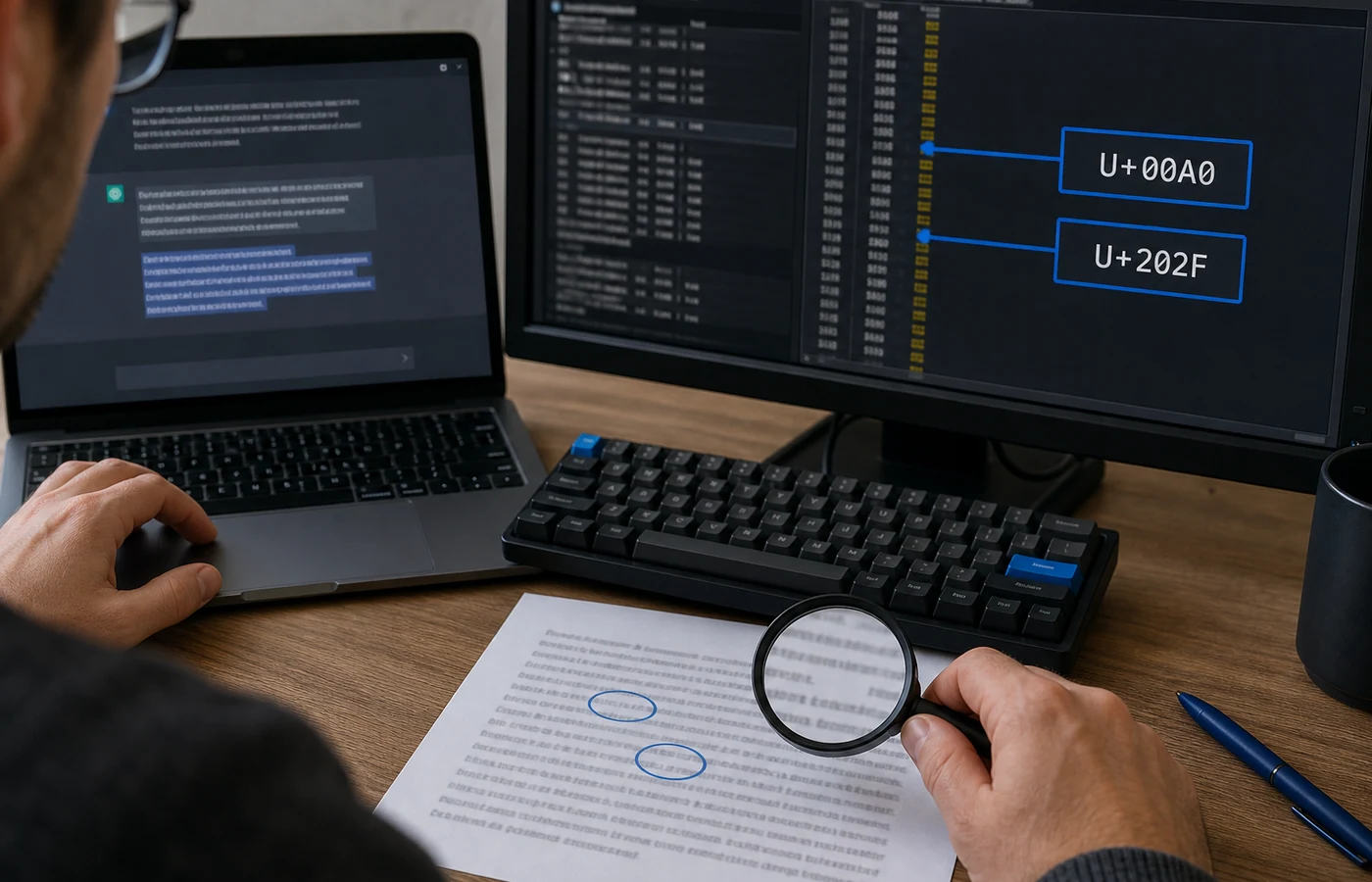
You do not normally need to inspect every ChatGPT response at the character level. It can be useful when copied text causes technical or formatting problems.
Paste as plain text
Pasting as plain text removes much of the HTML and rich formatting carried by a webpage.
Common shortcuts include:
- Windows: Ctrl + Shift + V in supported applications
- macOS: Command + Shift + Option + V in many applications
The exact shortcut depends on the software.
Use a plain-text editor
Paste the text into an application such as Notepad or another plain-text editor before moving it into your final document.
This can remove:
- Font styling
- Embedded links
- HTML list formatting
- Background colors
- Unwanted spacing instructions
It may not remove every Unicode character because some Unicode symbols are valid plain text.
Reveal nonprinting characters
Word processors and code editors may offer an option to reveal spaces, paragraph marks, tabs, or other nonprinting characters.
This is helpful when:
- A URL does not work
- Search and replace misses a word
- A CMS displays strange spacing
- Code or spreadsheet data fails to match
- A line wraps unexpectedly
Replace only what is causing a problem
Do not automatically remove every non-ASCII character. Smart quotes, accented letters, non-Latin scripts, emoji joiners, and directional controls may be necessary.
Normalize a suspicious character only after understanding what it does.
Most importantly, remember that cleaning formatting does not establish who wrote the passage.
A Responsible Workflow for AI-Assisted Writing
Whether or not ChatGPT uses a text watermark, publishing unreviewed AI output creates more immediate risks than hidden characters.
Use the following workflow:
1. Treat the response as a draft
Do not assume an answer is complete, current, or accurate merely because it sounds confident. If you use a content idea generator for brainstorming, treat its suggestions as starting points rather than finished claims.
2. Verify factual claims
Check names, dates, statistics, quotations, product details, laws, medical information, and technical instructions against reliable sources.
3. Rewrite from understanding
Read the draft, confirm that you understand it, and then express the ideas in the structure and voice appropriate for your audience. For commercial web pages, a professional SEO content writing process should preserve search intent without sacrificing accuracy or voice.
The goal is not to disguise AI use. It is to take responsibility for the final work. Before publishing, a readability checker can highlight dense passages that need a clearer rewrite.
4. Add original value
Include your own:
- Experience
- Examples
- Analysis
- Research
- Data
- Screenshots
- Expert comments
- Case studies
- Recommendations
Original value makes the content more useful regardless of which tools helped produce the first draft. Use a word counter to review length and keyword density, but do not let either metric replace editorial judgment.
5. Preserve your sources and drafts
Research notes, outlines, document history, and citations can demonstrate how your work developed. They also make factual corrections easier.
6. Follow the relevant AI policy
Schools, employers, publishers, competitions, and clients may have different disclosure rules. Check the policy before submitting the work.
Does ChatGPT Have a Watermark?
For ordinary text, there is no publicly confirmed universal ChatGPT watermark that secretly identifies every response. OpenAI has researched a statistical text-watermarking method, but its public materials have described the method as something under consideration rather than a universally deployed feature.
Text copied from ChatGPT can contain special Unicode characters or rich-text formatting. Those artifacts may cause technical problems, but they are not reliable proof that ChatGPT wrote the passage. AI detectors usually judge linguistic patterns instead of reading a guaranteed secret marker, and their results can produce false positives. ChatGPT-generated media is different. Supported OpenAI images can contain C2PA Content Credentials and SynthID watermarks, while supported audio may contain SynthID. The practical takeaway is simple: do not panic over a strange space or em dash. Focus on accuracy, original contribution, responsible disclosure, and careful editing.