

You can get SEO clients without cold calling, but the alternative is not to publish a few posts and wait.
A dependable phone-free pipeline usually combines credible proof, trusted introductions, visible expertise, a clear offer, and a sensible qualification process. Some of those activities can create conversations relatively quickly. Others take longer but become more valuable as your reputation and content accumulate.
The practical approach is to choose one relationship-led channel and one compounding channel. Work both consistently, measure the quality of the clients they produce, and turn successful delivery into the next case study, referral, or useful resource.
The short answer
Start with a specific client problem, create evidence that you can solve it, and make that evidence discoverable through referrals, partners, search, communities, or public education. Give interested buyers a small, clear next step and qualify them before investing hours in analysis or proposals.
First, Define What Without Cold Calling Means
People use the phrase in different ways. Clarifying your boundary prevents a phone-free strategy from quietly turning into another form of unwanted outreach.
- No telephone prospecting: you avoid unsolicited calls but may still use carefully targeted email or direct messages.
- No unsolicited selling: you focus on referrals, opt-in enquiries, partner introductions, public expertise, and buyer-initiated conversations.
- Warm relationship building: you contact people who know your work, have interacted with you, or have a relevant shared connection.
Cold email is not a telephone call, but it is still cold outreach when the recipient has not requested contact. The same is true of an unsolicited audit or an immediate sales pitch sent after someone accepts a connection request.
There is nothing automatically unethical about a relevant business call or message. The purpose of this guide is not to declare one channel universally bad. It is to build alternatives for SEO professionals who prefer trust-led, permission-based, or phone-free acquisition.
Why Trust Matters So Much When Selling SEO
SEO is difficult for many buyers to evaluate before they purchase it. They may not know which recommendations matter, how long implementation should take, or whether reported visibility will produce useful enquiries and sales.
The perceived risk can be high because poor work may waste budget, create technical problems, attract irrelevant traffic, or leave the business dependent on reports it does not understand. A buyer may also have been disappointed by a previous provider.
That makes proof and clarity more persuasive than confident claims. Buyers need to understand:
- which business problem you solve;
- what work you actually perform;
- what evidence supports your approach;
- what the client must contribute;
- how progress will be measured;
- what you cannot honestly guarantee.
What Current Agency Research Suggests
There is no controlled study proving one universal way to acquire SEO clients. Industry surveys use different samples and definitions, so their figures should guide questions rather than become promises.
Still, the direction is useful. The 2026 4As survey, based on 2025 agency data, says personal and inbound referrals remained leading sources of opportunity volume and effectiveness. It also connects agency visibility through content, thought leadership, PR, and speaking with pipeline development.
A UK Scaled report found that many participating agencies received referrals only occasionally. Its findings point to a practical gap between having satisfied clients and operating a repeatable referral process.
The 2025 Edelman report, produced with LinkedIn, also found that useful thought leadership can influence people inside a buying group who may never attend an initial sales meeting. This matters for SEO because a marketing lead, finance stakeholder, founder, developer, and legal reviewer may evaluate different parts of the same proposal.
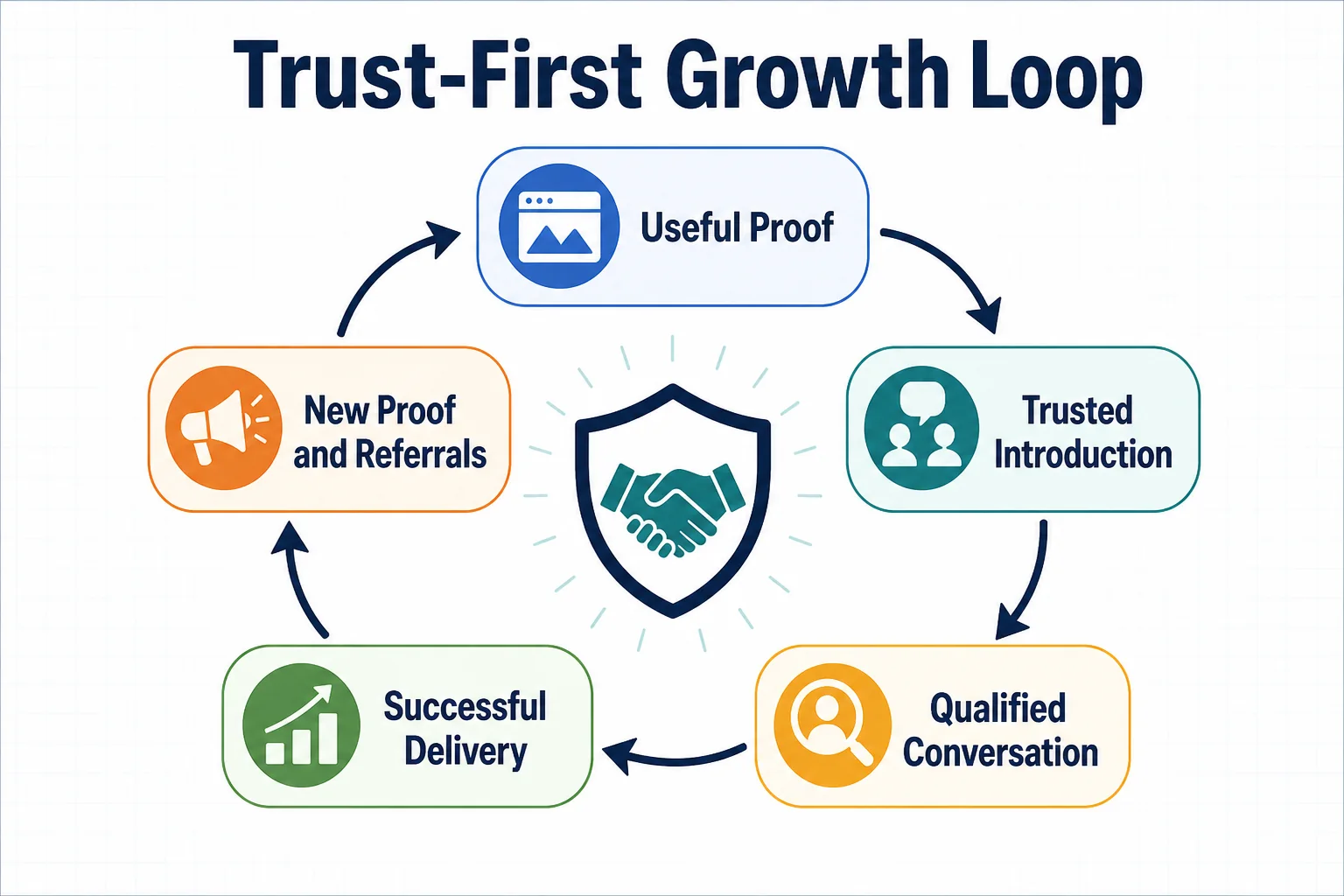
The conclusion is not that referrals or content always win. It is that trust, useful expertise, and relationship pathways deserve to be treated as systems rather than occasional marketing activities.
Use a Two-Lane Client Acquisition System
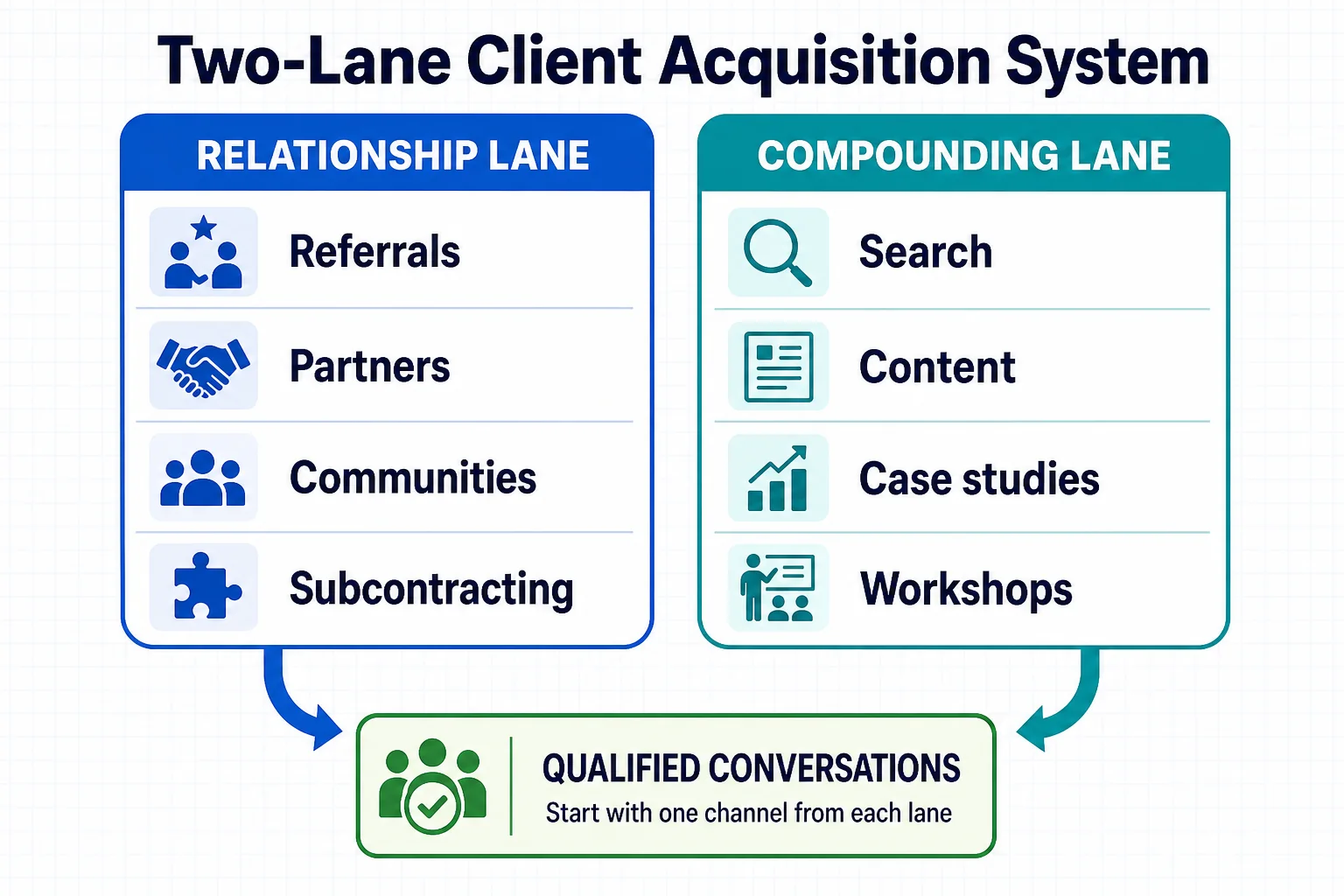
Trying seven channels at once usually creates seven unfinished experiments. A simpler model is to run two lanes together.
Lane 1: relationship-led acquisition
This lane uses trust that already exists or can develop through genuine professional interaction. It includes client referrals, complementary partners, former colleagues, subcontracting, trade associations, and useful participation in communities.
It can produce faster feedback because the prospect receives context from another person or has already observed your expertise.
Lane 2: compounding acquisition
This lane creates assets that can keep introducing your work. It includes your own search visibility, service pages, case studies, buyer-focused articles, workshops, newsletters, videos, and original research.
It often takes longer to show results, but a strong resource can support search discovery, partner conversations, referrals, proposals, and follow-up at the same time.
| Channel | Feedback speed | Proof needed | Compounding value | Main risk |
|---|---|---|---|---|
| Client referrals | Often faster | High | Medium | Unpredictable volume |
| Agency partners | Medium | Medium | High | Partner dependence |
| Subcontracting | Often faster | Medium | Low | Lower margins |
| Marketplaces | Often faster | Low to medium | Low | Price pressure |
| Owned SEO | Slower | Medium | High | Long feedback cycle |
| Public expertise | Medium | Medium | High | Inconsistent effort |
A new freelancer might pair subcontracting with a focused case-study article. An established consultant might pair milestone referrals with a workshop. An agency might pair complementary partnerships with specialist service pages and original research.
Step 1: Choose a Specific Client Problem
A niche is valuable only when it changes how you diagnose, deliver, and measure the work. Adding an industry name to a generic SEO package does not create meaningful specialization.
Define five things:
- Client: which type and size of organization can you serve well?
- Problem: what costly or frustrating search problem do they recognize?
- Service: what bounded work can you deliver confidently?
- Evidence: what can you show without exaggeration?
- Conditions: what access, budget, people, and time are required?
For example, “SEO for healthcare” remains vague when the offer is a generic audit and monthly content. “Local visibility recovery for multi-location dental clinics” points toward a clearer problem, client type, and delivery process.
If you are still validating which problems people search for, a structured keyword research process can connect buyer language with suitable service and educational pages.
Step 2: Build Proof Before Asking for Trust
A useful case study does more than display an upward graph. It helps a buyer judge whether your experience resembles their situation.
Document:
- the starting condition;
- the business objective;
- the work you performed;
- the timeframe;
- the measurement method;
- the result;
- the client's contribution;
- important limitations or other influences.
Do not imply that one ranking change proves every recommendation caused revenue growth. Explain what the evidence supports and what remains uncertain.
What if you have no case studies?
Create a small, documentable result instead of inventing authority. You could improve an owned website, complete a narrowly scoped paid pilot, subcontract for a reputable provider, or help a permitted nonprofit with a defined issue.
Choose work with a visible baseline and constrained outcome, such as repairing indexation, improving a location-page system, cleaning up duplicate listings, or testing one product category. Obtain permission before naming a client or sharing private data.
Step 3: Create a Milestone-Based Referral System
Do not ask for a referral simply because thirty days have passed. Ask after a moment that gives the client a genuine reason to feel confident introducing you.
Suitable moments include:
- completing a successful pilot;
- resolving an important technical problem;
- documenting an agreed business result;
- receiving positive feedback;
- renewing or expanding a healthy engagement.
Make the request specific and easy to act on:
Do you know one other business dealing with this problem? I can prepare a short summary you can forward.
The forwardable summary should explain the problem you solve, the type of business you help, one relevant proof point, and a low-pressure next step. Thank the client for an introduction, respond promptly, and never make the referrer responsible for closing the sale.
Step 4: Build Complementary Partnerships
A good partner already serves the same market but solves a different problem. Possible partners include web designers, developers, PPC specialists, content studios, IT providers, branding firms, fractional marketing leaders, and industry consultants.
Do not open with a vague request to “partner.” Explain:
- the clients you serve;
- the work you accept;
- your current capacity;
- how you scope and communicate;
- the proof you can provide;
- how introductions and handoffs would work.
A partnership is healthy only when it produces suitable, profitable work and protects the client experience. Track quality, margin, retention, and concentration risk, not just the number of introductions.
Step 5: Publish for Buyers, Not Other SEO Professionals
SEO providers often create content about tools, algorithm commentary, and advanced tactics that mainly attracts other practitioners. That content may earn engagement without creating buyer conversations.
Buyer-focused content helps someone evaluate a problem or decision. Useful subjects include:
- whether SEO is commercially suitable for a particular business model;
- why qualified organic leads declined;
- how to prepare for a website migration;
- what an SEO provider needs from an internal team;
- how to connect search performance with enquiries and revenue;
- whether to hire internally, use a consultant, or choose an agency.
Strong content should provide a real decision framework, evidence, limitations, examples, and a sensible next action. It should help even when the reader never becomes a client.
This website's guide on whether a business needs an SEO company is an example of buyer-decision content. It helps a reader evaluate fit before presenting professional help as the answer.
Step 6: Demonstrate Expertise Where Buyers Already Gather
Choose communities according to where your intended clients participate, not where SEO professionals receive the most applause.
Depending on the market, that may include LinkedIn, founder communities, local organizations, trade associations, webinars, podcasts, conferences, specialist forums, or professional groups.
Answer real questions, explain tradeoffs, and share evidence without forcing a sales message into every interaction. One substantial idea can become an article, workshop, checklist, partner briefing, short video, and several community answers. Adapt it to each format rather than copying the same promotional paragraph everywhere.
Should You Use Marketplaces or Subcontracting?
Marketplaces and subcontracting can help newer providers build experience, but they have different economics from direct client work.
Before accepting a project, consider platform fees, pricing pressure, communication overhead, ownership of the relationship, case-study permission, and whether the work matches your intended specialty.
Subcontracting can be especially useful when an established agency needs a specific capability and provides clear scopes, reliable communication, and fair payment. It becomes unhealthy when margins are too low, responsibilities are vague, or you cannot use any resulting experience as evidence.
Use Google Business Profile Only When Eligible
A Google Business Profile can support discovery and reviews for eligible local providers, but it is not available to every SEO business.
Google says online-only businesses without face-to-face customer contact are not eligible. A service-area business may qualify when it travels to customers, while storefront rules require a genuine staffed location. Review the current Google guidance before creating a profile.
Do not use a virtual office, mailbox, or misleading address merely to obtain a local listing. An ineligible profile can create suspension risk and damage trust.
Make the First Engagement Easier to Buy
A full monthly retainer may feel like a large first commitment. A clearly scoped entry offer can help both sides test fit without giving away days of strategy work.
| Entry offer | Suitable when | Important boundary |
|---|---|---|
| Free preview | The prospect is strongly qualified and the review is brief | Two or three prioritized findings |
| Paid diagnostic | The analysis has standalone value | Fixed scope and deliverables |
| Credited diagnostic | Discovery should lead into implementation | Clear credit and expiry terms |
| Pilot project | One bounded problem can be tested | Agreed baseline and success measure |
A free preview should not include a complete keyword strategy, implementation roadmap, forecast, exhaustive technical audit, and unlimited follow-up. Its purpose is to demonstrate prioritization and establish whether a larger engagement deserves consideration.
Qualify SEO Opportunities Before Investing Heavily
More enquiries are not always better. A poor-fit client can consume proposal time, create delivery problems, and leave both sides disappointed.
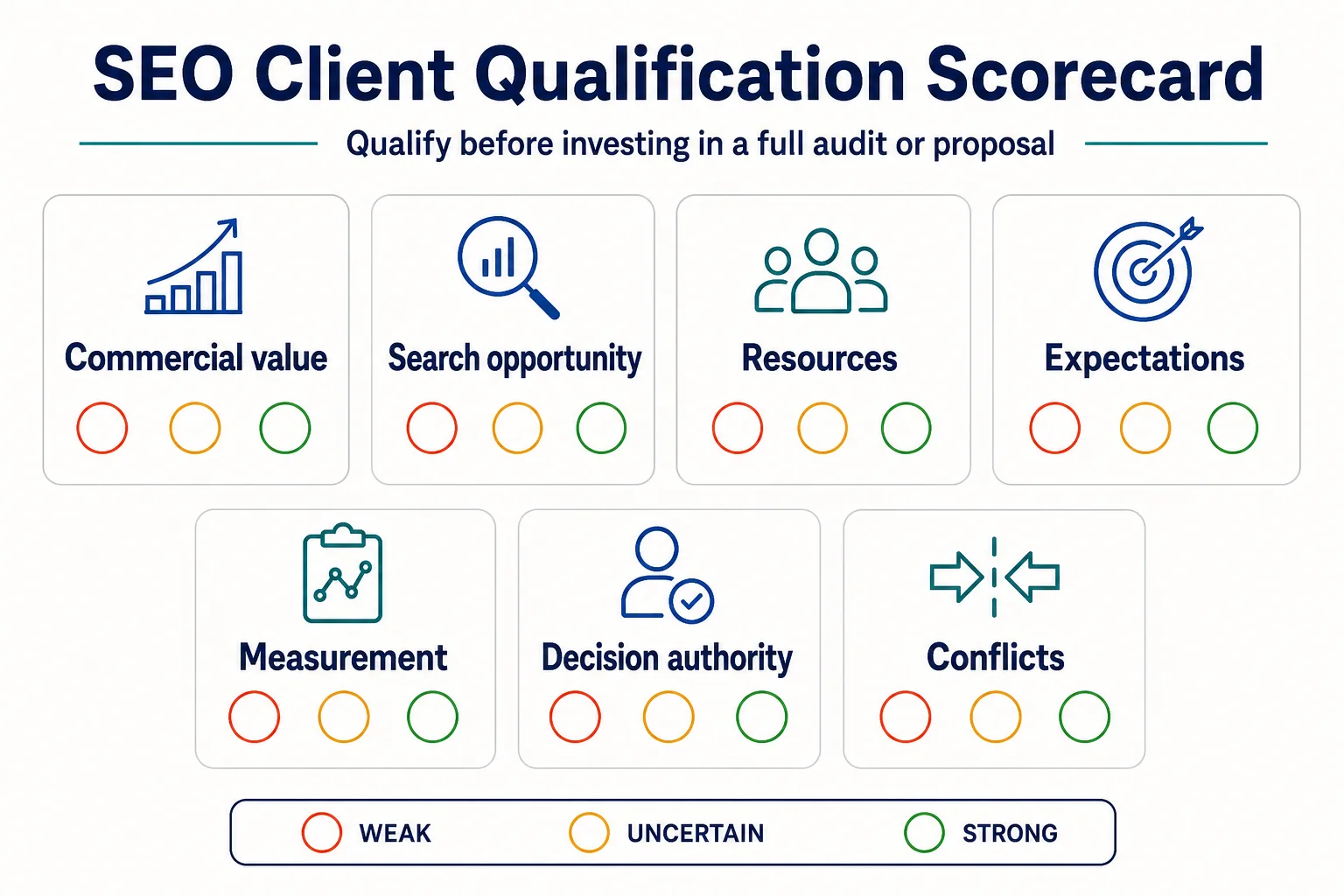
Use a short form or structured first conversation to assess:
- Commercial value: what is a qualified lead or sale worth?
- Search opportunity: do relevant people search for the problem, product, or service?
- Resources: who will approve and implement technical, editorial, and conversion changes?
- Expectations: what result is expected, and is it plausible?
- Measurement: can the team connect analytics with useful business outcomes?
- Authority: is the decision-maker involved?
- Conflicts: are there confidentiality, exclusivity, or competitor concerns?
Decline or redesign work when margins cannot support delivery, access will not be provided, implementation capacity is absent, or success depends on a guarantee you cannot responsibly make.
A Practical 12-Week Starting Plan
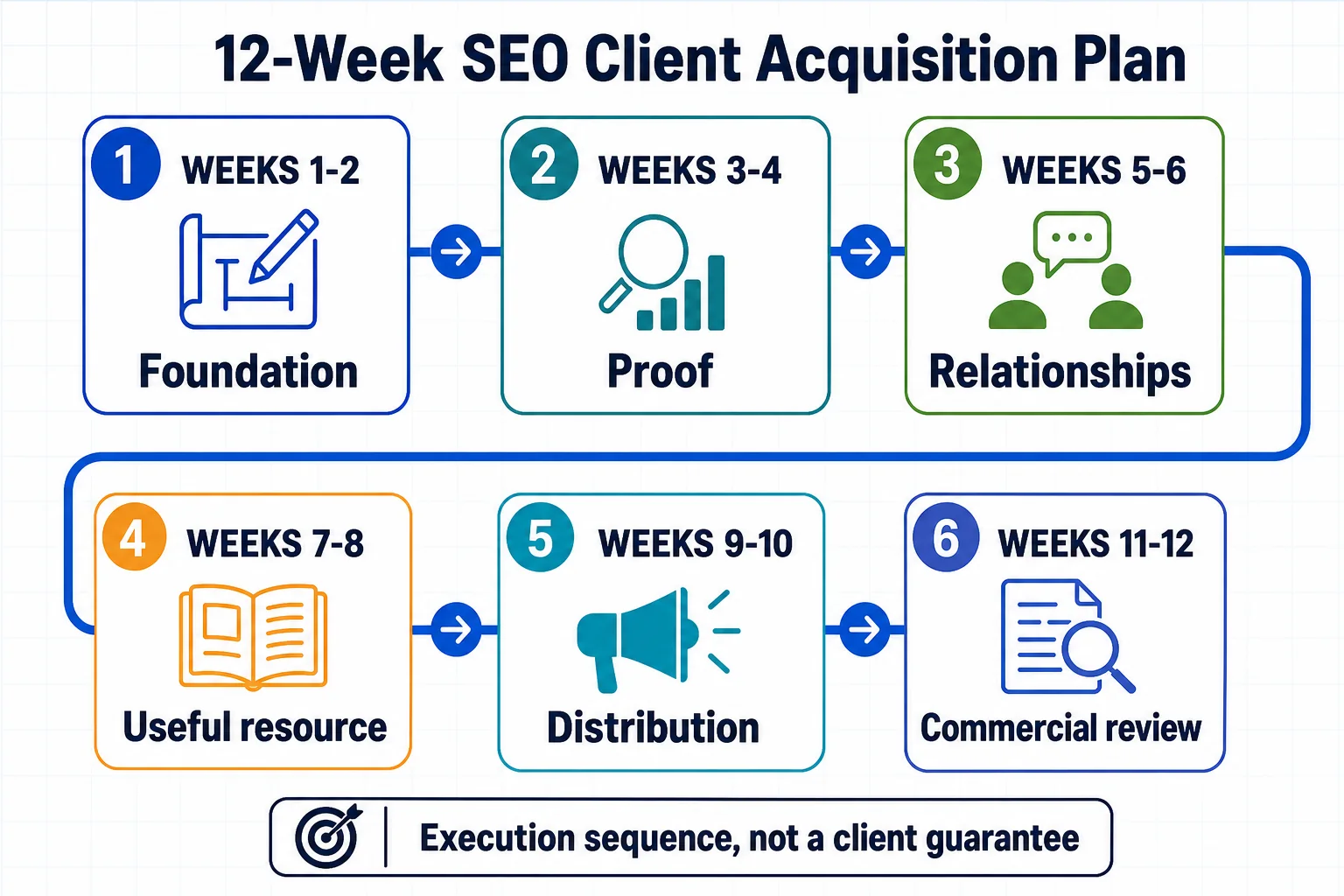
This is an execution sequence, not a promise that a client will arrive within twelve weeks.
Weeks 1 and 2: define the foundation
Choose one client type, one important problem, one bounded offer, and clear qualification rules. Review your service page from the buyer's perspective.
Weeks 3 and 4: create proof
Document one credible result or start a small proof-building project. Make the methodology, timeframe, and limitations clear.
Weeks 5 and 6: activate relationships
Request appropriate milestone referrals and introduce your capability to a small number of complementary partners with a concrete fit statement.
Weeks 7 and 8: publish one useful resource
Answer a serious buyer question using evidence, examples, limitations, and a clear next step. Avoid producing several shallow posts.
Weeks 9 and 10: distribute through relevant channels
Turn the resource into a workshop, partner briefing, community answer, or short post suited to where the intended buyer already participates.
Weeks 11 and 12: review commercial evidence
Study the quality of conversations, improve the entry offer and qualification process, and document any new proof created through delivery.
Measure Profitable Clients, Not Marketing Activity
Followers, impressions, downloads, and raw enquiries may indicate attention. They do not show whether a channel creates suitable, profitable relationships.
Record:
- lead source and assisting touchpoints;
- client and niche fit;
- proof viewed;
- qualification result;
- proposal and close outcome;
- time to close;
- acquisition cost;
- contract value and retained revenue;
- delivery burden and gross margin;
- retention and referral source concentration.
Compare channels over a suitable feedback period. A form change may provide quick evidence. Search content may require a longer observation window. A partner should be judged over relevant opportunities rather than an arbitrary number of days.
A buyer may discover an article, view a case study, receive a partner introduction, and later book through a branded search. Last-click reporting would hide most of that path. The guide to reading an SEO report explains how to connect visibility with conversions and business outcomes.
Common Mistakes to Avoid
Trying every channel at once
Choose one relationship lane and one compounding lane. Add another only after the first activities are being executed and measured consistently.
Publishing only for other SEOs
Industry engagement can be useful, but client acquisition requires content that helps buyers understand their own decisions and risks.
Giving away complete strategies
A useful preview demonstrates judgment. It does not require days of unpaid consulting for every enquiry.
Relying on one referrer or platform
A channel can be productive and still create concentration risk. Build owned proof and visibility alongside relationship sources.
Measuring leads without profitability
A channel that produces many difficult, low-margin projects may be worse than one that creates fewer suitable retainers.
Using an ineligible local profile
Do not create a misleading address or virtual office listing to imitate a local presence your business does not have.
Frequently Asked Questions
How can a beginner get a first SEO client?
Choose a small problem you can solve and document. Use an owned project, a paid pilot, permitted nonprofit work, a marketplace project, or subcontracting to create credible evidence. Avoid pretending to have client results you do not possess.
Can SEO clients be found without any outreach?
It is possible for buyers to discover you through search, content, directories, communities, or recommendations. However, relying entirely on passive discovery usually gives you less control. Relationship building, distribution, and partner communication can remain proactive without becoming cold selling.
Should an SEO consultant offer free audits?
A brief free preview may make sense for a strongly qualified prospect. A full diagnostic should usually have a fixed scope and price, or be credited toward implementation.
Can LinkedIn generate SEO clients?
It can support discovery and trust when the intended buyers use the platform and your contributions address their problems. Connecting and immediately pitching is still unsolicited selling.
How long does inbound acquisition take?
There is no reliable universal timeline. Existing authority, market demand, competition, proof, content quality, distribution, referrals, and offer clarity all affect how quickly useful conversations appear.
Does an online SEO agency qualify for Google Business Profile?
An online-only business without face-to-face customer contact is not eligible under Google's current guidance. Eligible storefront and service-area businesses must follow the relevant location and service rules.
Final Answer
Getting SEO clients without cold calling is possible, but it requires more than avoiding the phone.
Choose a specific problem, build honest proof, operate one relationship-led channel and one compounding channel, offer a sensible first step, and qualify opportunities before investing heavily. Then turn successful delivery into stronger proof, useful content, and appropriate referrals.
The durable alternative to cold calling is not passivity. It is a measurable system that helps the right buyers encounter your expertise with enough context to begin a useful conversation.
Businesses that need a broader acquisition process can review the lead generation service. Providers developing their own search visibility can also explore professional SEO services.