
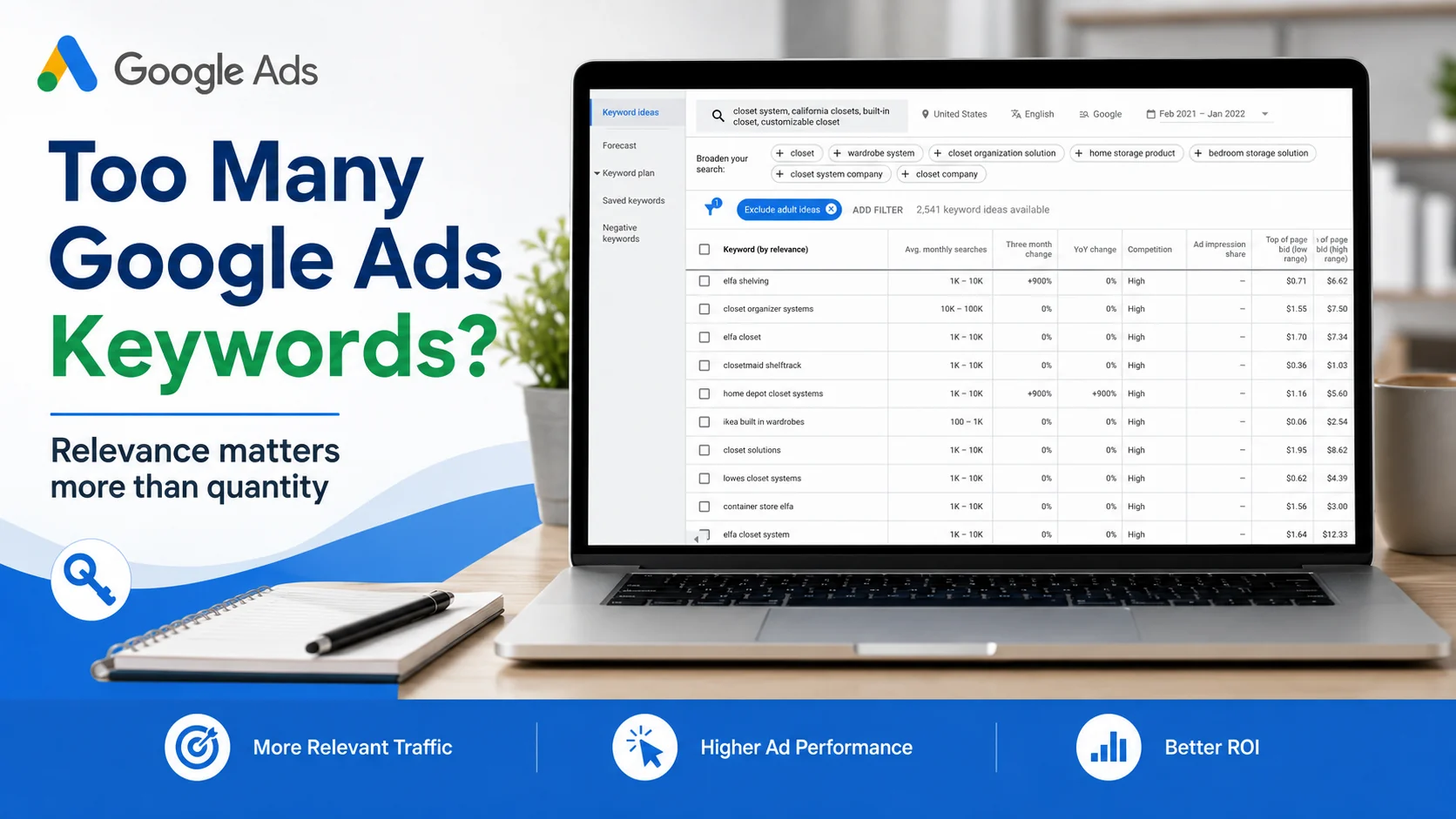
Adding more keywords to a Google Ads campaign can feel like a good idea. More keywords should mean more searches, more clicks, and more customers, right?
Not necessarily.
Adding too many keywords can hurt your Google Ads campaign when those keywords cover different search intents, are poorly organized, or bring in searches that are not relevant to your offer. However, Google does not penalize an account simply because it contains a large number of keywords.
The real question isn't, “How many keywords do I have?”
It is:
“Are these keywords helping me reach the right people with the right ad and landing page?”
That distinction matters because Google Ads keyword matching has changed considerably over the years. Google now understands meaning, intent, and close variations much better than it once did, so advertisers generally don't need huge lists containing every possible version of the same search phrase.
What Happens If You Add Too Many Keywords to Google Ads?
There is no magic number where Google suddenly decides that your campaign has “too many keywords.”
You could have 10 keywords in an ad group and still have a poor setup.
You could also have a larger keyword list that works well because the keywords are closely related and properly organized.
Problems usually begin when the keywords stop sharing the same search intent.
Imagine you own a dental clinic and create one ad group containing these keywords:
- emergency dentist
- dental implants
- teeth whitening
- Invisalign dentist
- pediatric dentist
- root canal treatment
- dentist jobs
- how to whiten teeth at home
All of these contain words related to dentistry, but the people making these searches want very different things.
Someone searching for an emergency dentist may need treatment today.
Someone searching for dental implants is researching a specific service.
A person searching for dentist jobs isn't looking for dental treatment at all.
And someone searching how to whiten teeth at home may simply want information rather than an appointment.
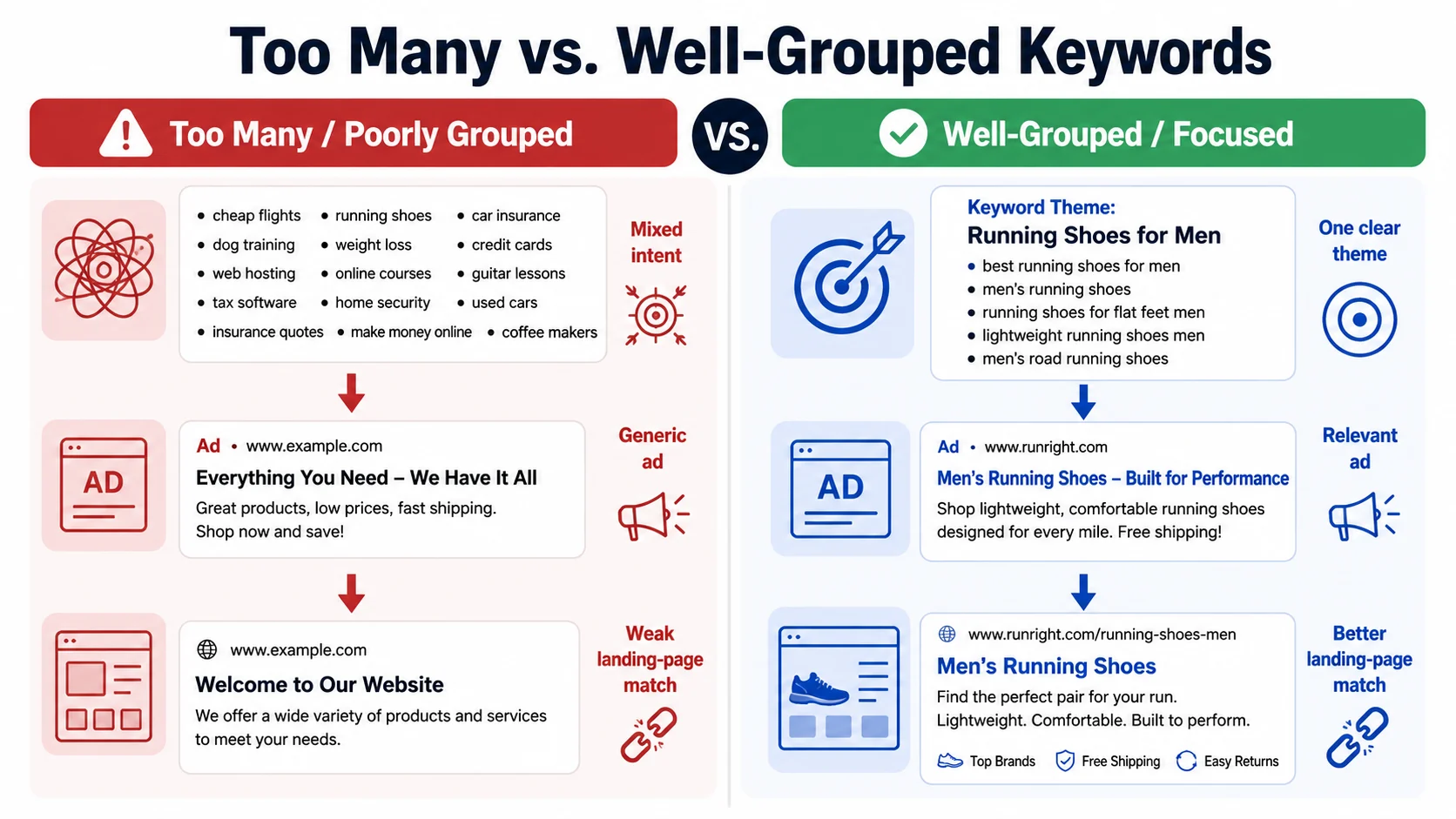
Putting all of those searches into one ad group makes it difficult to create an ad that feels highly relevant to everyone.
That is the real danger of adding too many keywords.
Too Many Keywords vs. Too Many Unrelated Keywords
These are not the same problem.
Suppose your ad group is specifically about emergency dental services and contains:
- emergency dentist
- emergency dental clinic
- urgent dentist
- emergency dental treatment
- emergency dentist near me
- same-day emergency dentist
Those keywords are different, but the intention behind them is very similar.
One strong emergency-dentist ad could reasonably serve these searches, and the same emergency dental landing page could potentially satisfy the people clicking it.
Compare that with:
- emergency dentist
- Invisalign
- dental implants
- teeth whitening
- children's dentist
Now one advertisement has to communicate several completely different services.
You may end up with something generic such as:
Trusted Dental Services | Book an Appointment Today
Compare that with an ad specifically written for the first search:
Emergency Dentist | Same-Day Dental Appointments
The second message is much closer to what the searcher wants.
Google itself recommends grouping keywords into relevant themes and, where necessary, splitting keywords into different ad groups so ads can better match people's searches.
Does Having Too Many Keywords Hurt Quality Score?
Not automatically.
This is an area where Google Ads advice is often oversimplified.
Google does not say:
“More keywords = lower Quality Score.”
Quality Score is a diagnostic measurement based on three main components:
- expected click-through rate
- ad relevance
- landing page experience
Google also makes an important clarification: Quality Score itself is not an input in the ad auction. It is a diagnostic tool advertisers can use to identify potential quality problems.
So having 30 keywords does not automatically lower your Quality Score because Google thinks 30 is too many.
The problem is indirect.
If those 30 keywords represent very different intentions, your advertisement may not closely match every search. Your landing page may also be useful for some keywords but poorly suited to others.
That can create relevance and user-experience problems.
For example:
Keyword: emergency roof repair
Ad: Professional Roofing Services
Landing page: General roofing company homepage
That might work.
But compare it with:
Keyword: emergency roof repair
Ad: Emergency Roof Repair — Get Help Today
Landing page: Emergency roof repair service page
The second journey is much more closely connected.
Google specifically recommends choosing landing pages that closely match your ads and keywords.
A useful way to think about Google Ads is:
Search → Keyword → Ad → Landing Page
The closer those four elements are connected, the easier it is to create a useful experience for the person searching.
How Many Keywords Should You Use in a Google Ads Ad Group?
There is no universal perfect number of keywords per ad group.
You may see recommendations such as 5, 10, 15, or 20 keywords online, but these should not be treated as official Google limits.
Google's current account-organization guidance suggests smaller lists of 20 to 30 tightly themed terms. That is a structuring recommendation, not a penalty threshold, and Google also encourages consolidating single-keyword ad groups into broader but still tightly themed groups.
A better rule is:
Use enough keywords to cover one clear search theme, but don't keep adding keywords once they require a different ad message or landing page.
For example, suppose a plumber offers several services.
A clearer account structure could look like this:
| Ad Group | Example Keywords |
|---|---|
| Emergency Plumber | emergency plumber, urgent plumber, 24 hour plumber |
| Drain Cleaning | drain cleaning, blocked drain service, clogged drain plumber |
| Water Heater Repair | water heater repair, broken water heater, hot water heater service |
The exact number of keywords isn't the important part.
The organization is.
A person searching for drain cleaning receives an ad about drain cleaning.
A person searching for water-heater repair receives an ad about water-heater repair.
And each person can be sent to a page specifically covering the service they searched for.
That is much more useful than putting every plumbing keyword into one giant ad group.
You Don't Need Every Possible Keyword Variation
This is another reason enormous keyword lists are less necessary today.
Years ago, an advertiser might have created separate keywords for every slight variation:
- plumber near me
- plumbers near me
- nearby plumber
- plumber nearby
- local plumber
- local plumbers
- plumber in my area
Modern Google Ads matching is more sophisticated.
Google explains that keyword matching now considers the meaning of searches rather than simply matching identical words. Google specifically says this can eliminate the need for exhaustive keyword lists.
Google's match types also overlap.
Phrase match can reach searches covered by exact match and additional relevant searches. Broad match can reach searches covered by phrase and exact match as well as additional searches Google determines are relevant.
That doesn't mean you should blindly use broad match for everything.
Broad match is most useful when it is evaluated alongside reliable conversion tracking and Smart Bidding, not treated as a substitute for reviewing search-term quality.
It means you shouldn't assume that adding hundreds of tiny keyword variations automatically gives you better coverage.
So, When Do You Actually Have Too Many Keywords?
Instead of looking for a fixed number, look for warning signs.
You may need to clean up or reorganize your keywords when:
Your keywords represent different intentions
“Buy running shoes” and “how to clean running shoes” both mention running shoes, but they don't represent the same goal.
Your ads have become too generic
If you can't write an advertisement that clearly speaks to most keywords in an ad group, the group may be covering too many different themes.
One landing page doesn't make sense for every keyword
Someone looking for commercial roofing may need a completely different page from someone needing an emergency residential roof repair.
You're adding every tiny variation of the same phrase
Modern matching can already understand many variations and related meanings, so exhaustive lists aren't always necessary.
Your keywords are bringing in irrelevant searches
This is where your actual campaign data becomes more important than keyword-count rules.
Check Your Search Terms Before Adding More Keywords
One of the best ways to understand whether your keyword strategy is working is to look at the Search Terms report.
There is an important difference between a keyword and a search term.
A keyword is something you add to Google Ads.
A search term is what the person actually typed into Google before your ad appeared.
For example, you might target:
Keyword: roofing company
But your ads could be triggered by several related searches depending on your match type and campaign settings.
Google's Search Terms report lets you see the searches that actually triggered your ads and how those searches performed. Google recommends using this information to refine your keyword strategy.
The report does not necessarily show every query. Google says some low-volume searches are omitted from the Search Terms report for privacy, while Search Terms Insights may group them into themes or aggregate them as other queries.
This is more useful than simply asking whether you have 20 or 50 keywords.
Ask:
Are these keywords producing searches from people I actually want as customers?
If yes, the keyword count may not be your problem.
If no, investigate why.
Don't Forget Negative Keywords
Sometimes improving a campaign isn't about adding another keyword.
It is about telling Google which searches you don't want.
Suppose you sell premium accounting software for businesses.
Your ads might begin appearing for searches such as:
- free accounting software
- accounting jobs
- accounting course
- accounting software crack
If those searches don't match what you offer, negative keywords can help prevent your ads from appearing for them.
Google says negative keywords can help exclude unwanted search terms and focus your advertising on searches that matter to your customers.
The Search Terms report can also help you discover negative-keyword opportunities.
Negative keywords also match differently from positive keywords. They do not automatically cover close variants or every expansion, so you may need to add relevant singular, plural, or synonym variations. Google does automatically account for capitalization and misspellings.
So instead of continuously expanding the positive keyword list, periodically ask:
What should we stop targeting?
That question can be just as valuable.
A Simple 4-Question Test for Your Keyword List
If you're unsure whether an ad group contains too many keywords, forget the arbitrary numbers for a moment.
Take the keywords and ask these four questions.
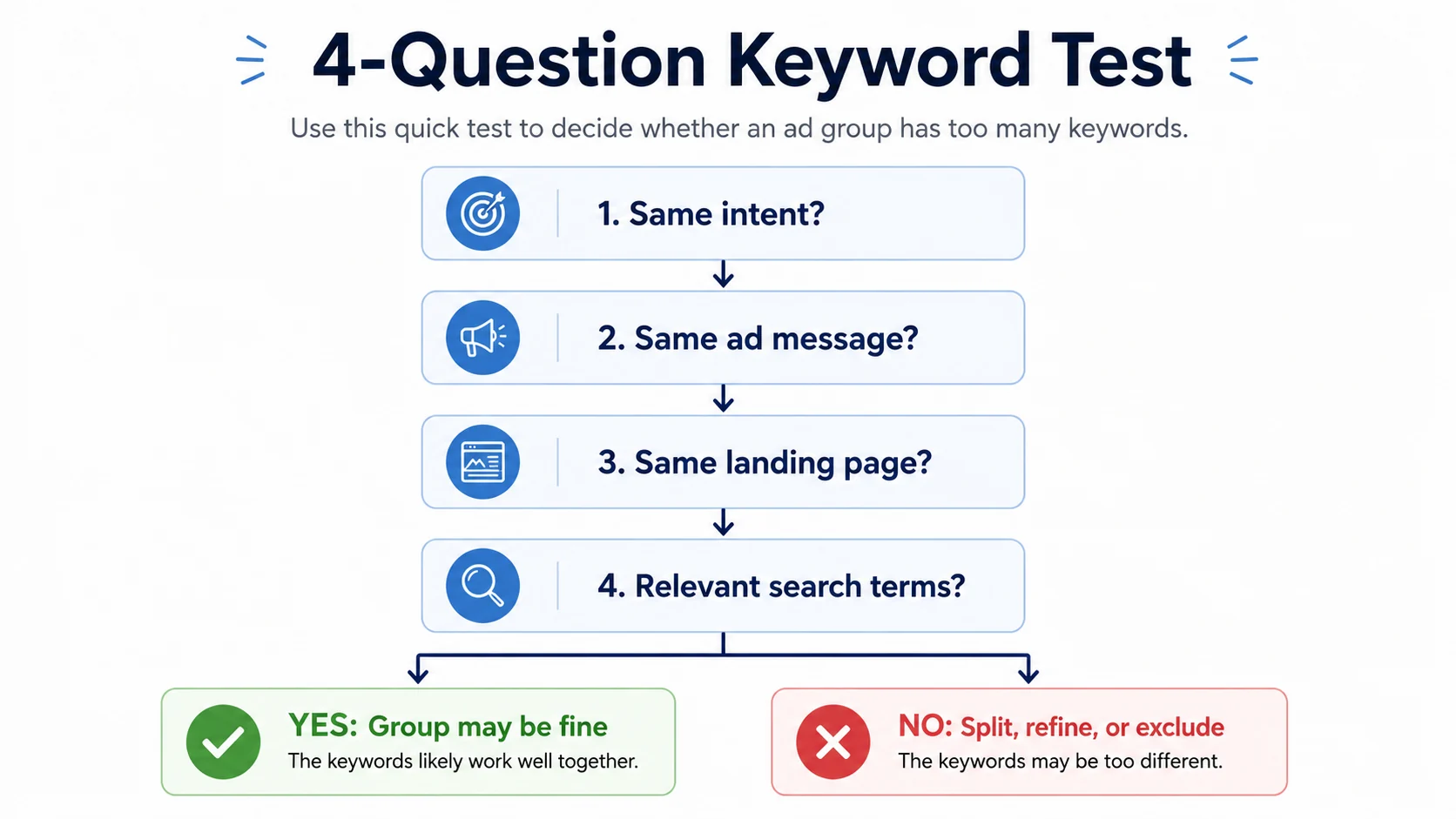
1. Do these keywords have the same basic search intent?
Would the people searching them generally be looking for the same service, product, or solution?
2. Can one strong ad speak naturally to all of them?
Not a vague advertisement. A genuinely relevant one.
3. Would the same landing page satisfy all of these searchers?
If half of the keywords require another page, you may have more than one theme.
4. Are the actual search terms relevant?
Check your campaign data instead of guessing.
If the answer to all four questions is yes, having a larger number of keywords isn't necessarily a problem.
If you repeatedly answer no, consider splitting the ad group, removing unnecessary keywords, adjusting match types, or adding negative keywords.
That is a much better way to judge your campaign than saying:
“I have 25 keywords, so I need to delete five.”
Should You Keep Adding New Keywords?
Add new keywords when they give you meaningful additional coverage.
For example, a new keyword may be useful because it:
- represents a valuable search intent you aren't currently targeting
- describes another important product or service
- appears repeatedly in your Search Terms data
- deserves its own advertisement or landing page
Don't add keywords simply because a keyword research tool produced another list of 500 suggestions.
A keyword only deserves a place in your campaign if you understand why you want to target the person searching for it.
FAQs
Is adding too many keywords bad for Google Ads?
It can be. The number of keywords itself isn't the main problem. Too many unrelated, redundant, or poorly organized keywords can make it harder to keep your ads and landing pages closely aligned with what people are searching for.
Does Google penalize you for having too many keywords?
Google does not publish a universal keyword-count threshold at which an account or ad group is penalized. Focus instead on relevance, search intent, campaign organization, actual search terms, ad quality, and landing-page experience.
How many keywords should I have in one Google Ads ad group?
There isn't one number that works for every campaign. Keep keywords together when they share a clear theme and can reasonably use the same relevant ad and landing page. Split them when the underlying search intent becomes different.
Do I need every variation of a Google Ads keyword?
Usually not. Google's current keyword matching system can understand meaning and related variations, and Google specifically says modern matching reduces the need for exhaustive keyword lists.
How can I tell whether my keywords are targeting the wrong searches?
Review the Search Terms report in Google Ads. It shows the actual searches that triggered your ads. You can use it to identify useful opportunities as well as irrelevant terms that may need to be excluded.
Final Thoughts
So, is adding too many keywords bad for Google Ads?
It can be, but don't judge your campaign by keyword count alone.
A campaign with 50 well-organized, relevant keywords can make more sense than one with 10 keywords covering completely different intentions.
Focus on the person behind each search.
Ask what they want, whether your ad addresses that need, and whether the landing page delivers what the ad promised.
Then use real Search Terms data to refine the campaign.
The goal isn't to have as many keywords as possible or as few keywords as possible. The goal is to have the right keywords organized around the right search intent.