

Yes, it is possible to make $100 a day with affiliate marketing. It is not a normal starting result, a guaranteed milestone, or a number that can be predicted from effort alone.
The honest answer depends on the commission you actually keep, the percentage of affiliate clicks that become approved conversions, the number of qualified visitors who click, the program's attribution rules, and the costs required to produce that traffic.
That is why this guide does not promise that you will reach $100 per day in three months, twelve months, or any other fixed period. It gives you the formulas and an interactive calculator so you can test the target against your own evidence.
The short answer
A $100 daily target may be achievable when a useful audience, suitable offer, reliable tracking, workable commission, and repeatable conversion process come together. Start by calculating the sales and clicks required. Then validate each assumption with confirmed program data instead of an online earnings claim.
Start With What $100 a Day Actually Means
A consistent $100 per day equals $3,000 in a 30-day month and $36,500 across 365 days. That is a meaningful revenue stream. It should be treated as a business target rather than a quick side-hustle promise.
Affiliate income is also rarely smooth. One day might produce several conversions and another might produce none. A program may display a commission immediately and reverse it later because the order was cancelled, returned, found ineligible, or attributed elsewhere.
Keep these amounts separate:
- Pending commission: a tracked amount that has not been approved.
- Confirmed commission: an amount the program has approved after its validation process.
- Paid commission: money that has reached your selected payment method.
- Operating result: confirmed or paid commission minus the costs required to earn it.
A screenshot of pending commissions does not show refunds, advertising costs, content expenses, software, taxes, or whether the result repeated. Ask which number is being displayed before treating it as evidence.
The Affiliate Income Formula
The calculation begins with effective commission. This is the average amount you keep for a confirmed conversion after expected reversals.
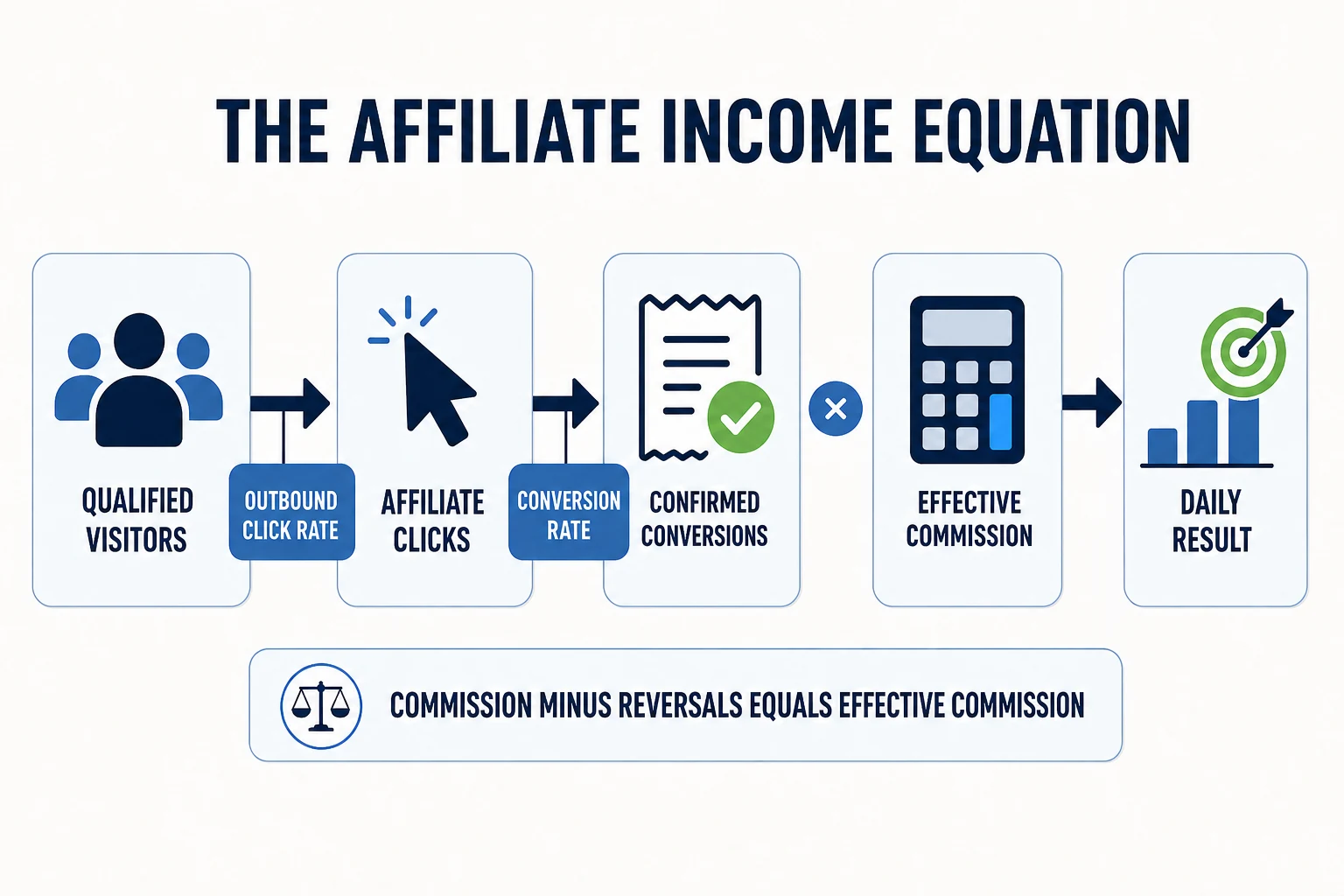
Conversions needed
Daily target divided by effective commission
Clicks needed
Conversions divided by merchant conversion rate
Visitors needed
Affiliate clicks divided by outbound click rate
For example, a confirmed commission worth $25 requires four conversions to reach $100. That does not tell you how much traffic is needed. If 2 percent of affiliate clicks convert, four conversions require 200 affiliate clicks. If 20 percent of qualified content visitors click the affiliate link, those 200 clicks require 1,000 qualified visitors.
The 2 percent and 20 percent figures in that example are hypothetical. They are not universal affiliate marketing benchmarks.
Calculate Your Own $100 Target
Use data from the program and your own analytics whenever possible. If you have no data yet, enter clearly labeled assumptions and treat the output as a question to test, not a forecast.
No email required
Affiliate Goal Calculator
Use your own program data to estimate what a daily commission target would require. The calculator does not use a supposed industry average and does not predict that you will receive this traffic or conversion rate.
This tool performs arithmetic using the numbers you provide. Tracking gaps, attribution rules, delayed approvals, program changes, taxes, and daily variation can make actual results different.
The calculator uses fractional conversions because it models an average. A result of 1.6 conversions per day does not mean part of a purchase. It means the selected target would require about 48 confirmed conversions across a 30-day period.
Do not round the required traffic down simply to make the target feel easier. Use actual tracking data, update the calculation as conditions change, and plan for daily variation.
Three Hypothetical Paths to $100
These examples show why commission and conversion must be considered together. They do not represent typical results.
| Effective commission | Conversions needed | Example conversion rate | Affiliate clicks needed |
|---|---|---|---|
| $4 | 25 daily | 5 percent | 500 daily |
| $25 | 4 daily | 2 percent | 200 daily |
| $50 | 2 daily | 4 percent | 50 daily |
A high commission does not automatically create the easiest path. The product might have a longer buying cycle, stricter approval rules, more refunds, lower demand, or greater competition. A smaller commission might come from a product that fits the audience better and converts more reliably.
Why Commission Alone Is Misleading
Merchant conversion rate
Your content can earn a qualified click, but the merchant controls the product page, checkout, price, stock, payment options, customer service, and much of the final sales experience. A generous commission attached to a weak offer may produce less income than a modest commission attached to a trusted product.
Reversals and eligibility
A tracked action may later become ineligible. Review the program's definitions for qualifying purchases, new customers, cancellations, refunds, self-referrals, coupon use, and prohibited traffic.
Attribution window
Programs use different rules to decide which affiliate receives credit and how long a click remains eligible. A customer may click your link, research elsewhere, use another affiliate's link, and purchase later. The program's attribution model determines whether you receive commission.
Payment timing
Confirmed income and available cash are not the same. Programs may approve transactions after a refund period and pay on a later schedule. A business must be able to cover its expenses while waiting.
Program risk
Commission rates, eligibility rules, product availability, and entire programs can change. Building all income around one merchant gives that merchant significant control over your result.
A Real Example of Why Terms Matter
Amazon Associates illustrates why one generic commission assumption is unsafe. Its current commission rates vary by product category, including categories that pay no standard commission and others that pay a higher percentage.
Its program rules also explain that a qualifying session can end when 24 hours pass, when the customer places certain orders, or when the customer follows another affiliate's special link. Terms, payment schedules, and eligibility conditions can change, so verify the current documents rather than relying on a remembered rate.
Amazon is only one example. Software, finance, travel, marketplaces, courses, and direct brand programs can use very different commission structures and approval rules.
Gross Commission Is Not Profit
Reaching $100 in confirmed daily commission does not necessarily mean you earned $100 in daily profit.
Possible operating costs include:
- domain registration and hosting;
- email, analytics, design, or research tools;
- writers, editors, designers, and video production;
- product samples and testing;
- paid distribution or advertising;
- contractors and technical maintenance;
- payment processing or currency conversion;
- business administration and professional advice.
Taxes also depend on your location and circumstances. The calculator intentionally does not estimate them. Use appropriate local tax guidance when the income becomes relevant.
Track costs by content asset and channel where practical. A page that generates $300 in commission after costing $500 to produce has not recovered its direct cost yet, even if the affiliate dashboard looks encouraging.
A Safer Beginner Strategy
Choose a problem you can understand
Do not select a niche only because a course lists its commissions. Choose a customer problem you can research, explain, and continue covering after the first ten articles or videos.
A useful niche usually has real buyers, several relevant solutions, enough depth for original content, and products you can evaluate responsibly. Topics involving health, legal rights, or major financial decisions require much stronger expertise and care.
Evaluate the program before the payout
Read the agreement, commission schedule, prohibited methods, payment threshold, approval period, attribution rules, and termination terms. A high headline percentage has little value if the product does not fit your audience or the method you plan to use is prohibited.
Choose one main traffic system
A beginner can use search, affiliate videos, email, social media, communities, or paid advertising when the program permits it. Trying every channel at once makes diagnosis difficult. Begin with one main discovery channel and one method of retaining contact, such as an email list you operate lawfully.
If search is your main channel, learn how specific keyword phrases reveal different problems and buying stages. Professional SEO services can support a business, but they do not remove the need for original expertise and a credible offer.
Track from the first click
Record page or video, traffic source, affiliate clicks, conversions, pending commission, confirmed commission, reversals, and costs. Use program sub-IDs or tracking parameters where permitted so you can identify which content produces useful results.
Create Content That Deserves the Click
Affiliate content should help someone make a better decision, not simply place a referral link beside a rewritten merchant description.
Useful formats include:
- comparisons that explain who each option suits;
- tutorials showing how a product solves a real task;
- alternatives for different budgets or requirements;
- cost breakdowns that reveal additional charges;
- troubleshooting based on real problems;
- original tests with a documented method;
- migration guides for people changing products;
- buying guides built around clear use cases.
If you have used the product, explain what you tested, for how long, under which conditions, and what you could not evaluate. If you have not used it, do not imply that you did. Research-based content can still be useful when its limits are transparent.
Google's affiliate guidance asks whether a site provides significant added benefits compared with the original source. Original experience, analysis, tools, comparisons, and decision frameworks give people a reason to visit your page instead of going directly to the merchant.
A structured content writing process can improve research and presentation, but publishing volume should never replace first-hand value or careful verification.
Use an Evidence Ladder, Not an Income Timeline
A fixed timeline ignores your starting audience, skill, market, offer, resources, and competition. Progress is easier to judge through evidence.
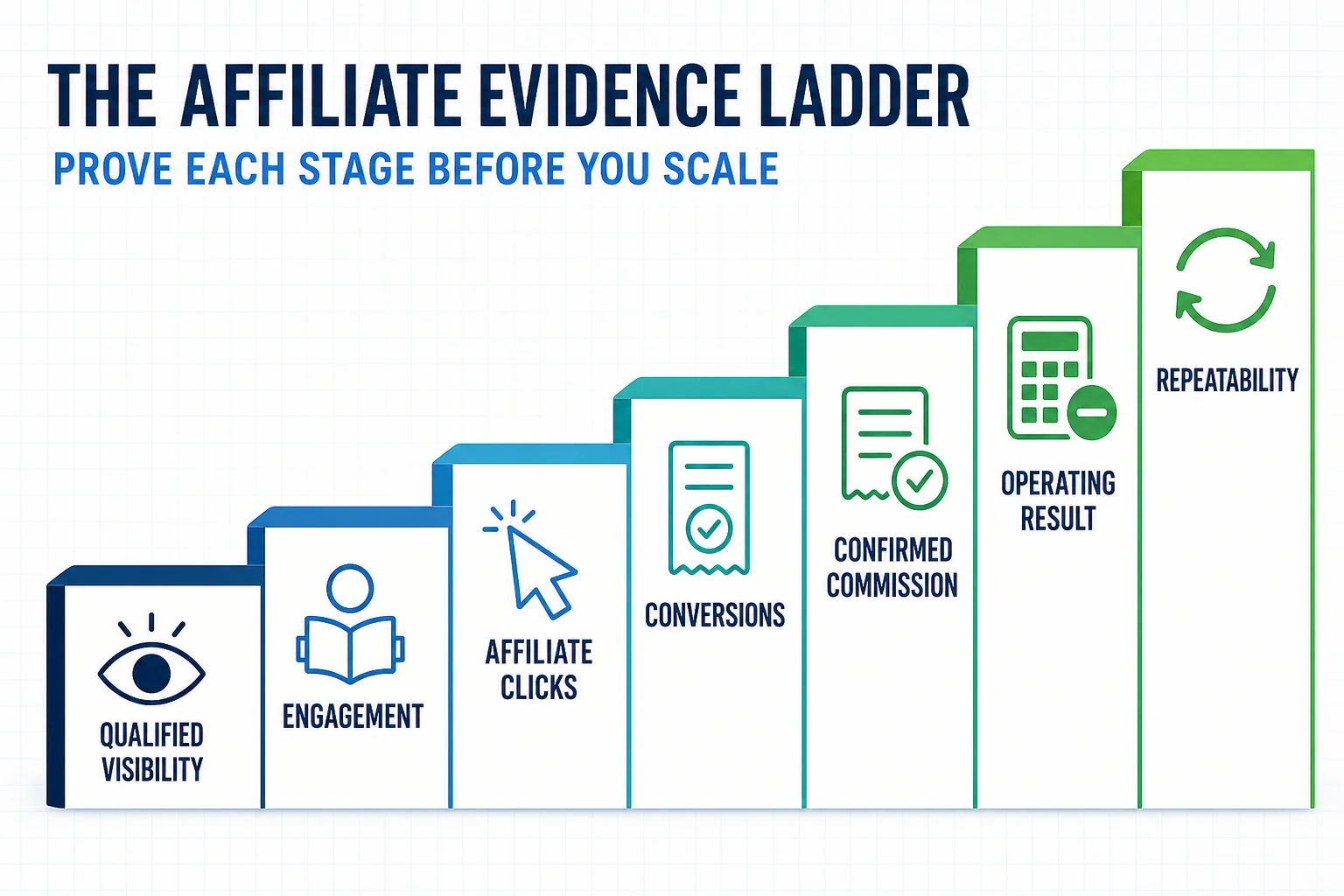
| Stage | Evidence to collect | Question answered |
|---|---|---|
| Qualified visibility | Relevant impressions and views | Can the intended audience find the content? |
| Engagement | Useful reading, viewing, or interaction | Does the content hold relevant attention? |
| Affiliate clicks | Tracked outbound clicks | Does the recommendation earn action? |
| Conversions | Tracked and approved actions | Does the merchant offer convert this audience? |
| Confirmed commission | Approved value after reversals | What is a conversion actually worth? |
| Operating result | Commission minus attributable costs | Is the system economically useful? |
| Repeatability | Results across several periods | Is performance stable enough to plan around? |
Move to the next investment level when the previous stage has evidence. Buying more content or traffic before confirming that existing visitors click and convert can magnify a weak system.
Diagnose the Stage That Is Failing
| Observed problem | Investigate first | Possible next action |
|---|---|---|
| No qualified traffic | Topic, distribution, visibility | Refine audience and discovery strategy |
| Traffic but no clicks | Intent, trust, recommendation, CTA | Improve decision value and relevance |
| Clicks but no conversions | Offer, merchant page, price, tracking | Test tracking and a better-matched offer |
| Conversions but low value | Program economics and order value | Compare suitable program terms |
| Frequent reversals | Product fit, refunds, eligibility | Review claims and program reports |
| Revenue but no profit | Content, tool, contractor, ad costs | Cut or improve costly activities |
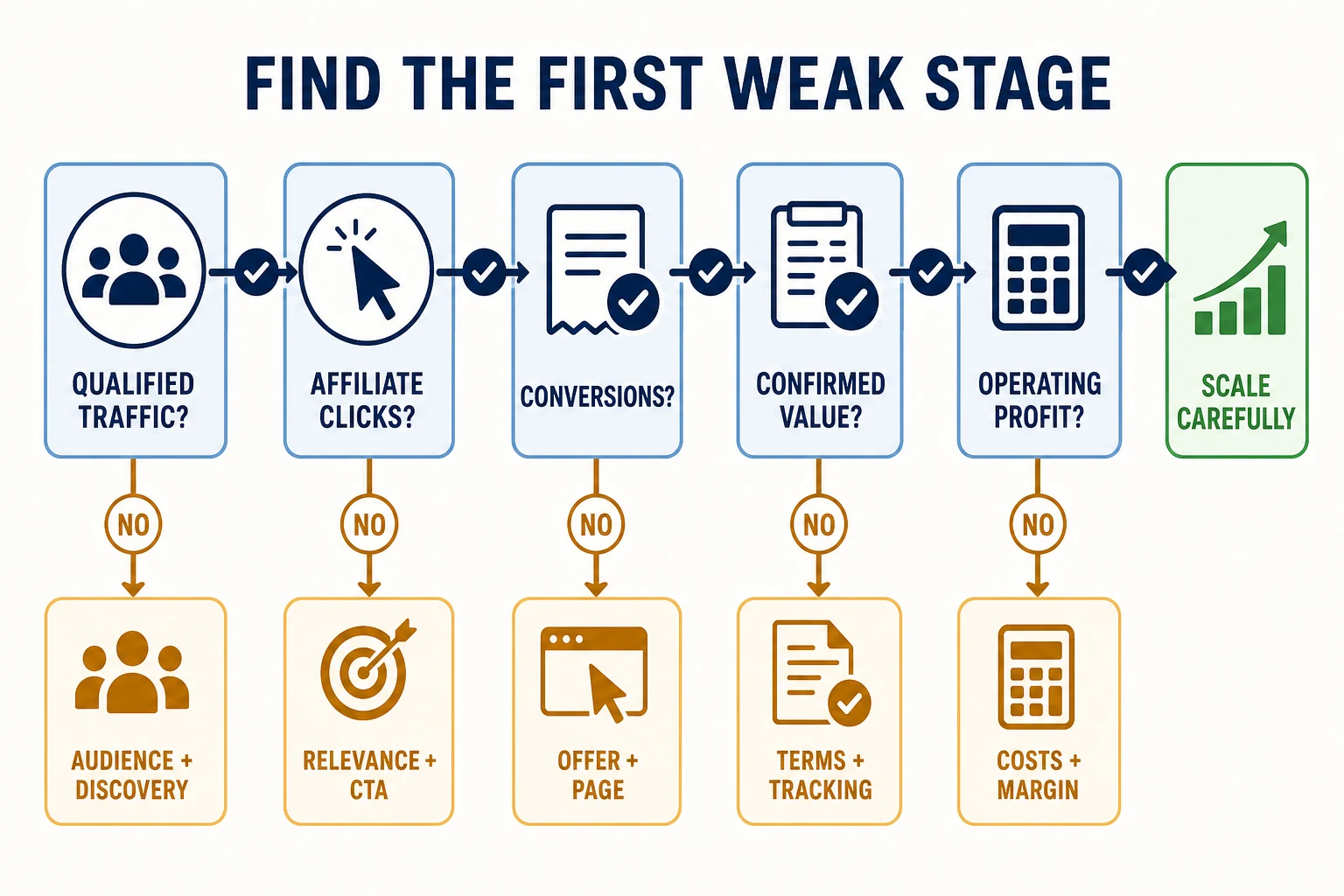
Change one meaningful variable at a time when possible. Replacing the offer, page, traffic source, and call to action together may change the result without teaching you why.
Disclose Affiliate Relationships Clearly
In the United States, the Federal Trade Commission says an affiliate relationship should be disclosed clearly and conspicuously so readers can decide how much weight to give the endorsement. Its FTC guidance says the disclosure should be close to the recommendation and explains that the words “affiliate link” alone may not communicate that the publisher receives a commission.
A plain disclosure could say:
I may earn a commission if you purchase through links in this article.
Place the disclosure where people will notice it before or near the relevant recommendation. A hidden policy page or footer may not provide enough context. Requirements vary by jurisdiction and situation, so obtain appropriate advice when needed.
Disclosure is only one part of honest promotion. Recommendations and product claims should also be truthful, supportable, and representative of what you actually know.
Handle Affiliate Links Correctly for Search
Google recommends marking paid placements and affiliate relationships with rel="sponsored". Its link guidance explains that nofollow remains acceptable, although sponsored is preferred for paid links.
This technical attribute does not make a thin page useful. Search visibility still depends on providing original value, satisfying the reader's purpose, maintaining a good website, and earning trust.
Affiliate marketing is one legitimate form of digital marketing, but the label does not protect weak content, misleading claims, or noncompliant promotion.
Recognize Courses and Income Scams
Affiliate marketing itself is not automatically a scam. The surrounding business opportunity may still be misleading.
Be cautious when a seller:
- guarantees a daily or monthly income;
- uses pending commission screenshots as proof of profit;
- refuses to explain the product, customer, costs, or traffic source;
- claims the system requires no skill, audience, work, or risk;
- pressures you to purchase before researching the offer;
- repeatedly requires more expensive upgrades;
- makes reselling the same course the main earning method;
- presents exceptional results as normal.
The FTC's scam advice warns about guaranteed income, large returns, high-pressure selling, and supposedly effortless turnkey systems. Ask what would be sold, why customers would buy it, how traffic would be acquired, and what all expenses would be.
Know When to Continue, Change, or Stop
Continue carefully when qualified visibility, affiliate clicks, confirmed conversions, and operating results are improving with understandable causes.
Change the offer when relevant visitors consistently click but the merchant does not convert, tracking is working, and the sample is meaningful.
Change the content when the right visitors arrive but do not understand or trust the recommendation.
Change the traffic approach when useful content receives no qualified discovery after reasonable distribution and improvement.
Reduce spending when tools, advertising, or outsourced production cannot be connected to useful evidence.
Stop promoting a product when you cannot recommend it honestly, complaints reveal a serious issue, or the program's terms no longer support your method.
The same proof-led thinking used in a responsible client system applies here. Build trust, measure what happens, and expand only after the evidence improves.
Final Answer
Can you make $100 a day with affiliate marketing? Yes, but possibility is not the same as probability, and a target is not a timeline.
Calculate how many confirmed conversions the commission requires. Calculate how many affiliate clicks those conversions require. Then calculate how many qualified visitors must produce those clicks. Include reversals, costs, payment delays, program rules, and daily variation.
If the required traffic looks unrealistic, the useful response is not to work blindly. Improve the economics, select a better-matched offer, strengthen the content, build a more suitable audience, or choose a different business model.
The strongest affiliate operation is not the one with the most impressive screenshot. It is the one that helps people make better decisions, discloses its incentives, understands its numbers, and produces confirmed results that remain useful after costs.
Frequently Asked Questions
Is $100 a day realistic for a beginner?
It is better treated as a later business target than an expected beginner result. A new affiliate first needs evidence that relevant people discover the content, click the recommendations, convert, and produce approved commission after reversals.
How much traffic is needed?
There is no universal answer. Divide required conversions by your observed merchant conversion rate to estimate affiliate clicks. Then divide those clicks by your observed outbound click rate to estimate qualified content visitors.
How many sales are needed?
Divide $100 by the average confirmed commission you keep per conversion. A $5 effective commission requires twenty conversions, while a $25 effective commission requires four.
Can you begin without followers?
Yes, but you still need a lawful way to reach relevant people. Search, useful community participation, video discovery, partnerships, and paid traffic where permitted can build an audience over time. No existing followers does not mean no distribution work.
Is affiliate marketing passive income?
Older content can continue producing clicks, but research, updates, tracking, compliance, product changes, website maintenance, and audience trust require ongoing work. It is more accurate to describe some assets as compounding than completely passive.
How long does it take?
There is no responsible fixed timeline. Starting audience, expertise, market, content quality, competition, offer economics, and available resources differ. Use the Evidence Ladder to judge progress instead of adopting another person's schedule.
Do you need a website?
Not every program requires a traditional website, and affiliates may use approved social or video channels. A website can provide greater control over content, search discovery, analytics, and email collection. Always verify the program's permitted promotion methods.
Does Google allow affiliate websites?
Google does not prohibit useful websites from monetizing with affiliate links. It expects commercial links to be qualified appropriately and affiliate content to provide significant added value rather than acting as a thin copy of merchant information.