
Digital marketing is a legitimate profession and business activity. Companies use search engines, advertising platforms, email, websites, and social media to reach customers, and skilled people are paid to plan, create, manage, and measure that work.
However, calling something digital marketing does not automatically make it trustworthy. A real industry can still contain unreliable agencies, misleading courses, fake job offers, pyramid-style programs, and people promising income they cannot support with evidence.
The useful question is therefore not only, “Is digital marketing legit?” It is, “Which digital marketing offer am I evaluating, and what evidence would make that particular offer credible?”
The short answer
Yes, digital marketing is legitimate. It includes real jobs, professional services, measurable campaigns, and established advertising platforms. It is not a guaranteed way to make money, and no course, agency, or job opportunity should be trusted only because it uses the digital marketing label.
First, Identify What You Are Actually Evaluating
People searching this question are often considering very different decisions. Treating them as one issue creates vague advice.
| What you are considering | Your real question | What you need to verify |
|---|---|---|
| A career | Can this become real, paid work? | Skills, responsibilities, employer, and progression |
| An agency | Will this provider use my budget responsibly? | People, process, access, reporting, and terms |
| A course | Will this teach a useful skill? | Curriculum, instructor, practice, cost, and refund terms |
| An income offer | Is the earning claim realistic? | Customer, product, costs, evidence, and revenue model |
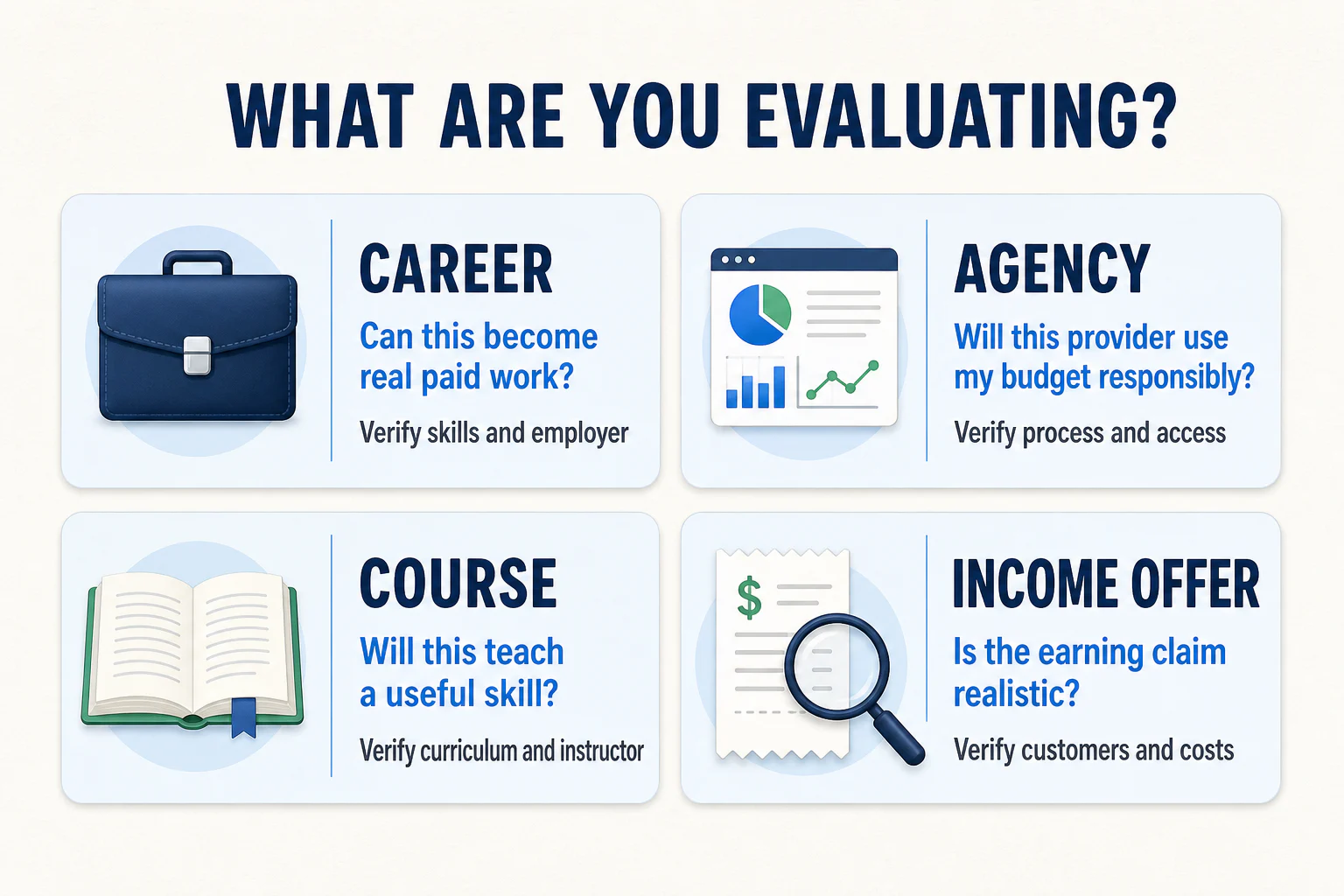
Digital marketing can be legitimate in general while a specific offer is unsuitable, overpriced, or deceptive. Separate those two judgments before you spend money, share personal information, or accept a job.
What Evidence Shows That Digital Marketing Is a Real Industry?
The strongest evidence is not a creator displaying revenue screenshots. It is the ordinary activity of businesses, employees, customers, and established advertising systems.
The 2025 IAB report, prepared with PwC, says United States internet advertising revenue reached $294.6 billion in 2025. That figure covers advertising revenue rather than the entire digital marketing industry, but it demonstrates the scale of real commercial activity across search, video, social, commerce media, and other digital channels.
The United States BLS outlook also recognizes advertising, promotions, and marketing management as established occupations. Its figures cover the wider marketing profession rather than every digital specialist, so they should not be presented as a salary promise for beginners. They do show that planning campaigns, researching markets, managing budgets, and advising businesses are real professional responsibilities.
Professional standards exist as well. The American Marketing Association describes ethical marketing in terms of integrity, transparency, responsibility, and avoiding harm in its ethics guidance.
None of this proves that every campaign will work. It proves that digital marketing is a genuine field in which specific providers and opportunities must still be assessed individually.
What Legitimate Digital Marketing Work Looks Like
Real digital marketing begins with a customer, a product or service, and a business objective. A marketer then uses suitable channels to help the right audience discover, understand, evaluate, or purchase that offer. Responsible affiliate content is one example: the commercial relationship should be clear and the recommendation should be supported by real evidence.
The work may include:
- researching customers, competitors, and search demand;
- planning campaigns and allocating budgets;
- creating landing pages, articles, advertisements, emails, or videos;
- setting up analytics and conversion measurement;
- managing search, social, display, or marketplace advertising;
- improving organic search visibility through SEO services;
- testing messages, audiences, offers, and page experiences;
- reporting what happened and deciding what to change.
The output is not always an immediate sale. Some marketing builds awareness, some captures existing demand, and some supports a longer buying process. A legitimate marketer should still explain the intended outcome, the measurement method, and the limitations of the evidence.
Why Does Digital Marketing Have a Questionable Reputation?
Several characteristics make the field attractive to both capable professionals and opportunists.
Anyone can adopt the title
A person can call themselves a strategist, coach, or agency owner without passing a universal licensing test. Titles are therefore weaker evidence than work samples, references, clear methods, and the ability to explain decisions.
Results involve uncertainty
Campaign performance depends on the offer, price, competition, website, sales process, budget, timing, tracking, and execution. This uncertainty creates room for weak providers to blame every failure on the client, while dishonest sellers promise certainty that no one can provide.
Marketing is used to sell marketing
A polished webinar, persuasive advertisement, or active social profile can make a course look successful before a buyer has examined the curriculum or typical student outcomes. Good promotion demonstrates promotional skill, but it does not automatically prove that the underlying product is valuable.
Income claims attract attention
The Federal Trade Commission warns that guaranteed income, large returns, pressure to act quickly, unverifiable success stories, and supposedly effortless turnkey systems are common warning signs in business and coaching offers. Its FTC guidance recommends understanding what you would sell, how customers would find it, how revenue would be generated, and what the expenses would be before paying.
Is Digital Marketing a Legitimate Career?
Yes. People work in search engine optimization, paid media, analytics, email, content, social media, conversion optimization, ecommerce, marketing operations, research, and related disciplines.
The realistic version of this career is different from the social media version. Beginners are normally paid for useful skills and dependable work, not merely for completing a certificate or calling themselves an expert.
An entry-level candidate can build credibility by:
- choosing one channel to study in depth;
- learning how that channel supports a business goal;
- completing a small project with permission;
- documenting the starting point, work, and result;
- learning basic analytics and reporting;
- asking for feedback from experienced practitioners;
- applying for roles that match their current ability.
A personal website, volunteer project, internship, supervised campaign, or carefully documented business experiment can demonstrate more than a collection of badges with no applied work.
Warning signs in a job offer
- You must pay before you can be hired.
- The employer cannot explain the work or who the customers are.
- The main activity is recruiting more marketers.
- The income claim is unusually high for simple, unspecified tasks.
- The recruiter uses pressure and refuses reasonable verification.
- The company identity does not match its website, email, or public records.
- You are asked for sensitive financial information before a normal hiring process.
A legitimate employer should be able to explain the position, reporting relationship, compensation, expected work, and hiring process clearly.
How to Check a Digital Marketing Agency
A legitimate agency does not need to be large, famous, or perfect. It does need to be identifiable, transparent about its work, and willing to define the relationship in writing.
Ask the agency these questions:
- Who will work on the account? Meet or identify the people responsible for strategy, implementation, and communication.
- What will you deliver? Request specific activities, deliverables, responsibilities, and expected timelines.
- How will success be measured? Agree on business-relevant measures and the limits of attribution.
- Which accounts will we access? Understand who controls advertising, analytics, website, domain, and reporting accounts.
- What do the examples prove? Ask for relevant context, not screenshots with client names and dates removed.
- What are the contract terms? Review fees, advertising spend, renewal, cancellation, ownership, and handover provisions.
- What cannot be guaranteed? A credible provider should discuss uncertainty and dependencies without becoming evasive.
Google allows account owners to grant, change, and remove user permissions through account access. A business should normally retain appropriate access to its own advertising and analytics assets instead of relying on shared passwords or an account it cannot inspect.
If you are deciding whether outside help is appropriate at all, the SEO company guide provides a separate decision framework for that choice.
Are Digital Marketing Courses Legitimate?
Some courses provide organized instruction, practice, feedback, and a useful learning path. Others combine freely available introductory information with aggressive upsells and unsupported income claims.
Price alone does not distinguish them. An inexpensive course can be poor, and an expensive course can still be unsuitable for a particular student.
Before buying, verify:
- a detailed and current curriculum;
- the instructor's relevant work and identity;
- whether sample lessons are available;
- which tools or advertising costs are separate;
- whether students complete practical assignments;
- what support and feedback actually include;
- the written refund and cancellation terms;
- whether testimonials represent typical outcomes;
- whether the seller guarantees income or employment.
A course can shorten the learning path, but it cannot remove the need to practice, think critically, communicate, and adapt to real business conditions. Free platform documentation and beginner training can help you test your interest before making a large purchase.
Is Digital Marketing a Pyramid Scheme?
Digital marketing itself is not a pyramid scheme. A business pays a marketer, employee, freelancer, or agency to perform work that helps it reach and serve customers. The value comes from the marketing service and its contribution to a real business.
Confusion begins when an offer uses digital marketing language but makes recruitment the main path to income. For example, a person buys a course and is told that the best way to recover the cost is to recruit others to buy or resell the same course.
Ask where the money ultimately comes from. If revenue depends mainly on repeatedly recruiting participants rather than providing a useful product or service to genuine customers, the label does not make the model legitimate.
Use the Value Flow Test
The Value Flow Test is a simple way to examine a job, agency, course, freelance offer, or business opportunity. Write down clear answers to six questions.
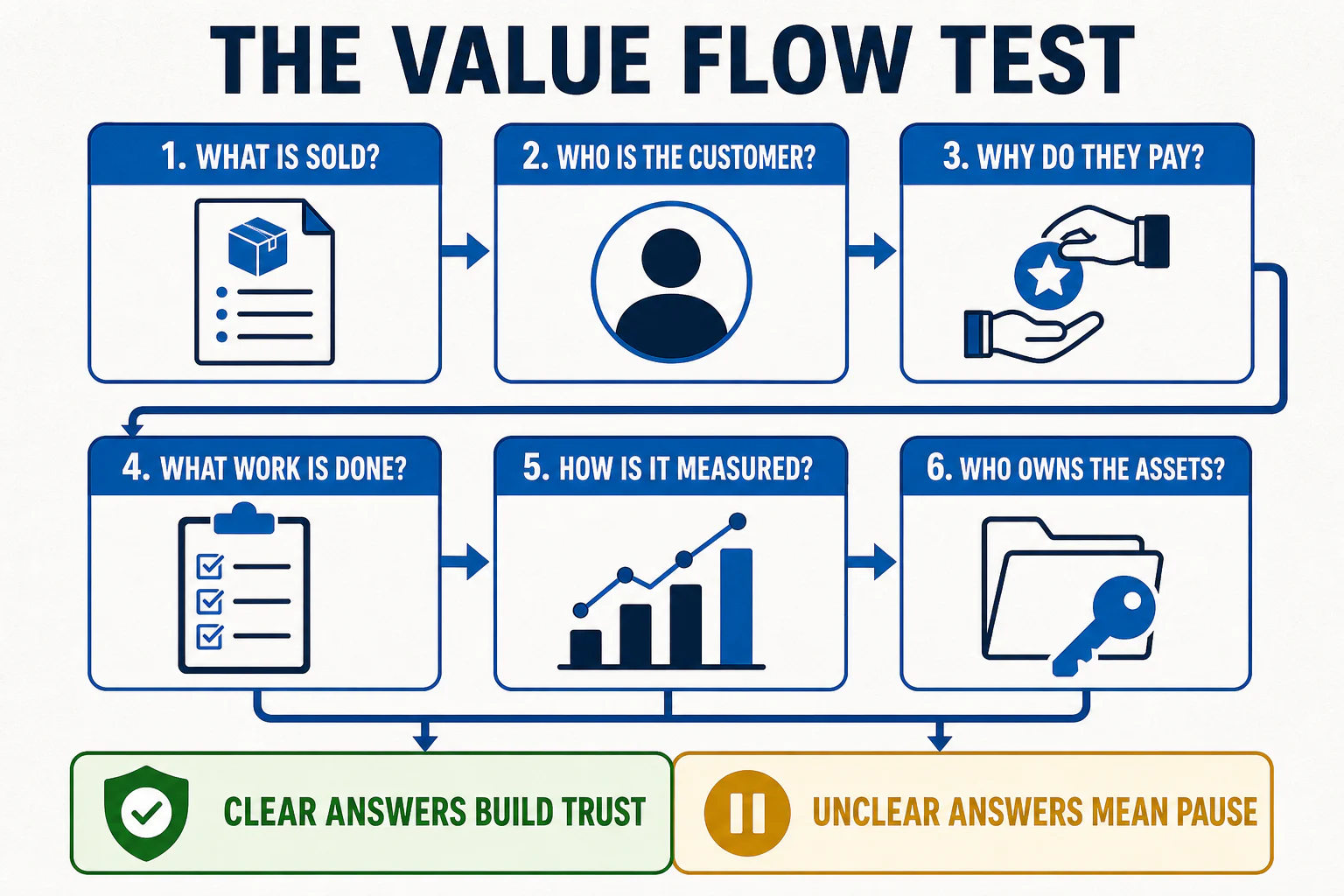
- What is being sold? Identify the real product or service, not the lifestyle used to promote it.
- Who is the customer? Name the person or organization that receives value.
- Why would they pay? Explain the problem being solved without relying on recruitment.
- What work is performed? List the actual tasks, skills, and responsibilities.
- How is performance measured? Identify the evidence that would show useful progress.
- Who owns the assets? Clarify control of accounts, content, domains, data, and creative work.
A legitimate offer should survive ordinary questions. Complexity is not automatically suspicious, but the seller should be able to explain the basic flow of value and money without hiding behind words such as automation, passive income, proprietary system, or secret method.
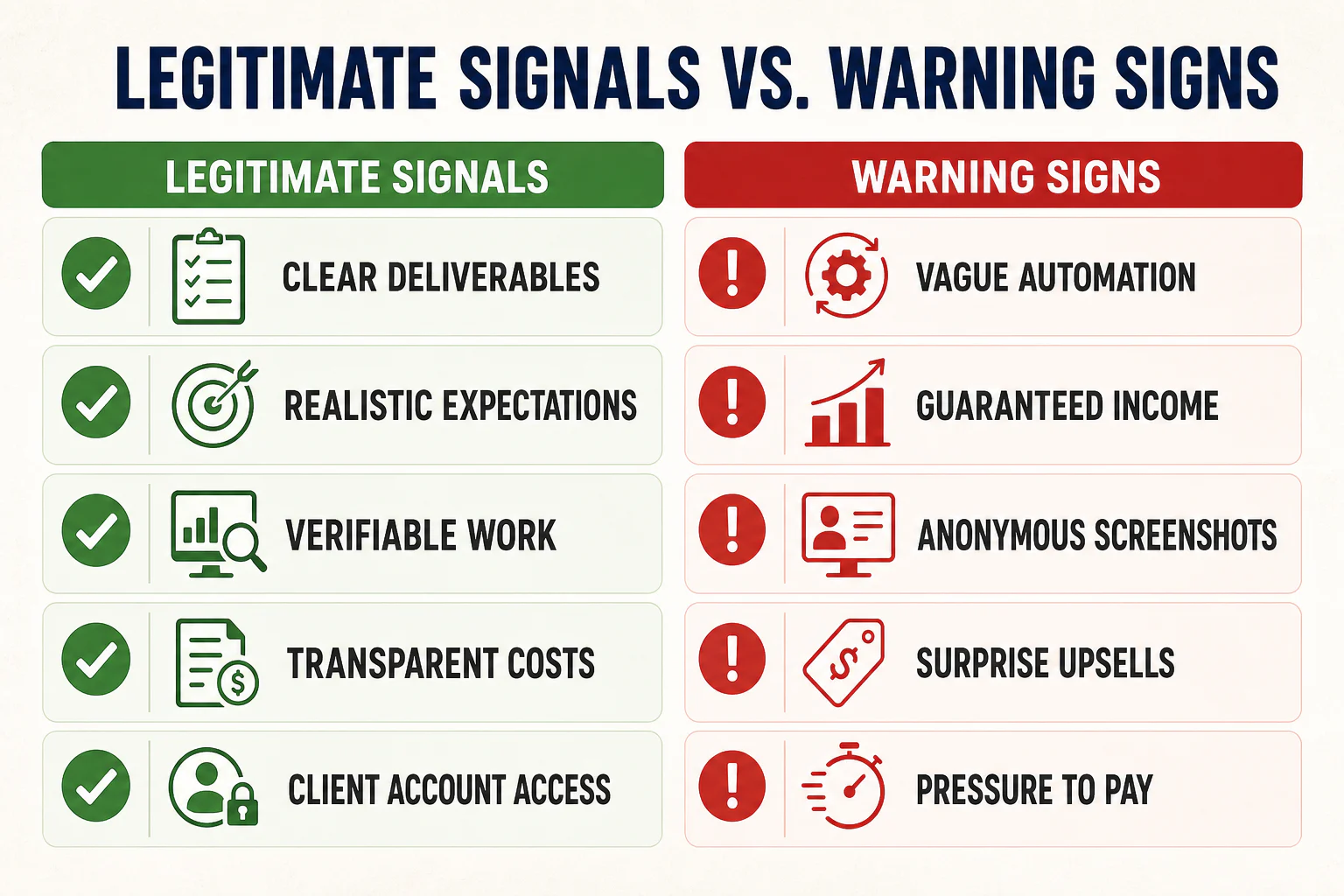
Legitimate Signals and Warning Signs
| Legitimate signal | Warning sign | What to request |
|---|---|---|
| Clear deliverables | A vague automated system | Written scope |
| Realistic expectations | Guaranteed income or rankings | Assumptions and risks |
| Verifiable people and work | Anonymous screenshots | Relevant references |
| Transparent costs | Repeated surprise upsells | Full cost breakdown |
| Customer-based revenue | Recruitment-based revenue | Revenue explanation |
| Appropriate client access | Provider controls everything | Access plan |
| Time to review | Pressure to pay today | Written terms |
A 10-Minute Legitimacy Check
You do not need to become a marketing expert before performing basic due diligence.
- Identify the legal or professional entity. Check whether the company, team, location, website, and contact details are consistent.
- Search beyond its own website. Look for independent discussion, complaints, work examples, and the history of the people involved.
- Read the entire offer. Separate the deliverables from promotional language and note every additional cost.
- Test the earnings claim. Ask what percentage of comparable people achieved it, over what period, with which expenses.
- Ask who owns what. Confirm access to accounts, data, domains, audiences, and creative assets.
- Review the exit. Understand refunds, cancellation, handover, and what happens to active campaigns.
- Pause under pressure. A sound professional offer should allow reasonable time for questions and review.
No complaints or negative reviews do not prove an offer is safe. A new operation may have little history, and reviews can be manipulated. Use several forms of evidence rather than one trust badge or testimonial.
What Legitimate Marketers Cannot Promise
A professional can promise agreed work, communication, documentation, and responsible handling of access and budget. They can explain a strategy and show why it is reasonable.
They cannot honestly guarantee:
- a permanent first-place Google ranking;
- a fixed number of sales regardless of the offer;
- profit without considering costs;
- viral reach on demand;
- a job solely because you bought a course;
- passive income without meaningful work, risk, or maintenance.
This does not mean forecasting is useless. A forecast is a planning estimate based on assumptions. A guarantee presents an uncertain outcome as certain. Legitimate professionals explain the difference.
A Safer Way to Start Learning Digital Marketing
You do not need to buy an expensive program immediately. Begin with a small, observable project.
A beginner can first review common digital marketing terms, then choose one channel to study more deeply.
- Select one channel, such as SEO, email, paid search, or content.
- Learn the basic platform rules and measurement concepts.
- Choose a real but manageable project that you own or have permission to use.
- Define one audience, action, and success measure.
- Create and run a limited experiment.
- Record the starting condition, work, result, and limitations.
- Use the evidence to decide what to study next.
For search marketing, understanding how keyword phrases connect to intent is one useful starting point. For client acquisition, focus on providing value to a real business rather than copying an online income script. A practical client system should be based on proof, relationships, and qualification.
Final Verdict
Digital marketing is legitimate. It is a broad professional field used by businesses to attract, inform, convert, and retain customers through digital channels.
What is not automatically legitimate is every job, agency, course, coaching program, or money-making offer that uses the name. Evaluate the specific opportunity by following the value, verifying the people and evidence, understanding the costs, protecting account access, and rejecting guarantees that ignore uncertainty.
A real marketer should be able to explain what they do, who benefits, how the work will be measured, and what they cannot promise. If those basic answers remain hidden, your skepticism is doing its job.
Frequently Asked Questions
Is digital marketing legal?
Digital marketing is legal, but marketers must follow the laws, platform rules, advertising standards, privacy requirements, and industry regulations that apply to their location and activity. A legitimate profession can still be practiced unlawfully or unethically by particular people.
Can beginners make money from digital marketing?
Yes, beginners can progress into paid employment or freelance work after developing useful skills. Income is not automatic. It depends on ability, evidence, communication, opportunity, location, and the value of the work performed.
Is digital marketing a good career?
It can be a good career for people who enjoy learning, communication, creative problem solving, data, customer behavior, and changing technology. It may be frustrating for someone expecting a fixed formula or immediate passive income.
Do you need a degree?
Requirements differ by role and employer. Some positions prefer a relevant degree, while others place more weight on practical skills, experience, and a credible portfolio. A certificate or degree can support an application, but neither proves performance by itself.
Are digital marketing courses worth it?
A course may be worthwhile when it offers structured, current instruction and useful practice at a reasonable cost. Evaluate the curriculum, instructor, support, total price, and claims before purchasing.
Can an agency guarantee results?
An agency can guarantee defined deliverables and professional processes. It cannot control customers, competitors, platforms, economic conditions, or every part of a client's business, so guaranteed rankings, sales, or profit should be treated cautiously.