
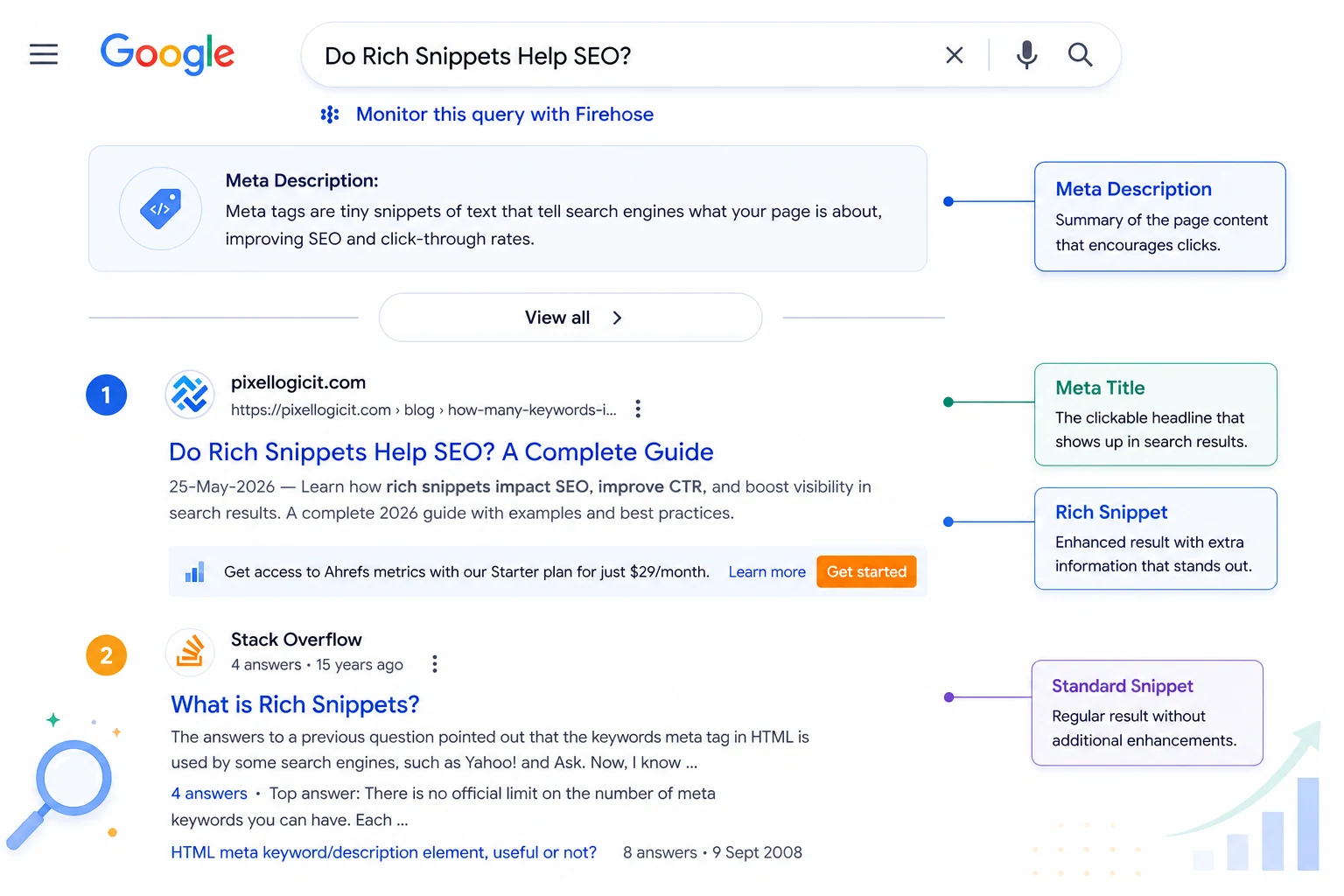
Yes, rich snippets can help SEO, but they do not directly move a page higher in Google’s organic rankings. Their main value is improving how a result appears, helping searchers understand the page before clicking, and potentially attracting more relevant visits. Structured data can also help Google interpret page information, but it does not guarantee a rich result.
That distinction matters. A page can gain more clicks without changing its ranking position, while another page may receive valid structured data but never display an enhanced result.
What Are Rich Snippets?
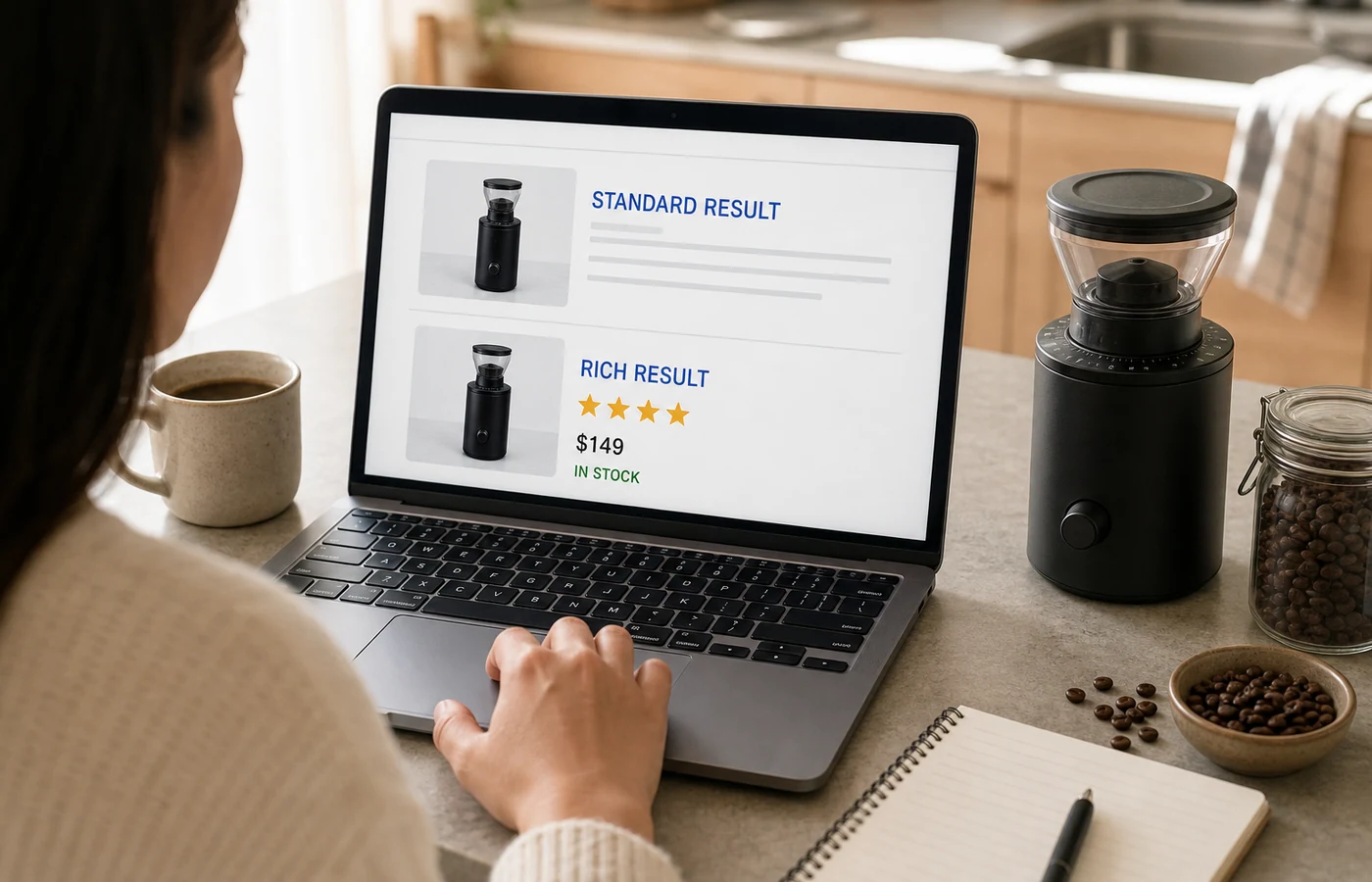
Rich snippets are enhanced versions of standard search listings. Instead of showing only a title, URL, and description, an enhanced result may include additional information such as:
- Product price and availability
- Review ratings
- Recipe cooking time
- Event dates
- Breadcrumb navigation
- Video details
- Software-app information
Google’s current documentation usually calls these enhanced listings rich results. The term rich snippets is still widely used by marketers, website owners, and SEO professionals.
Rich results are commonly created from structured data added to a webpage. Structured data is machine-readable information that identifies what the page contains. For example, it can tell Google that a number represents a product price, a date represents an event date, or a score represents an average customer rating.
Schema.org supplies the vocabulary used to describe this information. JSON-LD, Microdata, and RDFa are formats that can be used to place it on a page. Google recommends JSON-LD in most cases because it is generally easier to implement and maintain. You can create a suitable starting point with the Schema Markup Generator, then validate the result against the page’s visible content.
Structured Data Creates Eligibility, Not a Guarantee
Adding valid structured data does not force Google to display a rich result. Structured data makes a page eligible for a supported search feature. Google still decides whether that feature is appropriate for a particular query, user, location, device, and search context.
Even a page that passes the Rich Results Test may appear as a normal text result. Google explicitly states that correct markup does not guarantee rich-result display.
Do Rich Snippets Directly Improve Google Rankings?
No. Structured data is not a general Google ranking factor.
Google has directly explained that structured data by itself does not make one page rank above a competing page. It can help Google understand what a page is about and make that page eligible for additional search experiences, but adding schema markup is not the same as earning a ranking increase.
This means you should be cautious of claims such as:
- Adding schema will push a page onto the first page.
- Review stars automatically improve rankings.
- Every page with structured data outranks pages without it.
- Higher rich-result CTR will definitely produce a ranking increase.
Those statements go beyond what structured data can reliably deliver.
A page still needs relevant content, sound technical SEO, appropriate internal linking, strong page experience, useful information, and other signals that help Google determine whether it deserves to rank.
Search performance is broader than rankings
SEO is not only about moving from position eight to position four. It also involves earning the best possible result from the visibility you already have. Two pages can rank in similar positions but receive different numbers of clicks because one listing gives searchers more useful information.
For example, imagine two product pages ranking beside each other. The first result displays only a title and meta description. The second result displays its price, stock status, delivery information, and customer rating. The second result has not necessarily received a ranking advantage. It has simply given the searcher more information before the click. That can make the listing more useful and more noticeable.
How Rich Snippets Can Help Your SEO Performance
Although rich snippets do not directly increase rankings, they can support organic-search performance in several practical ways.
Greater Visibility in Crowded Search Results
Rich results may contain ratings, images, prices, dates, availability, or other details that are not present in an ordinary text listing.
These additions can make the result easier to notice. This is particularly valuable on search pages containing advertisements, shopping blocks, videos, People Also Ask questions, and competing organic results.
Greater visual prominence does not guarantee a click, but it gives the listing more opportunities to communicate value.
More Informed Clicks
A rich result can help people decide whether the page matches their needs.
A shopper can see whether a product is in stock. A reader can see how long a recipe takes. A job seeker can see important information about a vacancy. Someone looking for an event can see the date and location.
This may attract visitors who are more closely aligned with what the page actually offers.
Better Qualification of Organic Traffic
More clicks are not always the best outcome. The goal is to attract clicks from people who are likely to find the page useful. Suppose a product result shows a price of $500. A searcher with a $100 budget may skip it, while a buyer comfortable with the price may visit the page. The result may receive fewer unsuitable visits and more commercially relevant ones. That can make structured data valuable even when total traffic does not increase dramatically.
Clearer Information for Search Engines
Structured data gives Google explicit labels for information that is already visible on the page. Google says it can use this information to understand page content and gather information about entities such as products, recipes, organizations, people, and events. Structured data should therefore be treated as a layer of clarification, not a replacement for clear page copy. A poorly written or unhelpful page does not become valuable simply because it contains JSON-LD.
What the CTR Case Studies Really Tell Us

Google has published several structured-data case studies with strong results.
Rotten Tomatoes measured a 25 percent higher click-through rate for pages enhanced with structured data compared with pages without it. Nestlé reported that pages appearing as rich results had an 82 percent higher click-through rate than pages appearing without rich results. The Food Network reported a 35 percent increase in visits after converting a large portion of its pages to support search features.
These examples show that meaningful gains are possible. They do not prove that every site will receive the same improvement.
Results can vary according to:
- Existing ranking position
- Search intent
- Industry
- Device
- Query type
- Competitor presentation
- Rich-result format
- Brand recognition
- The accuracy and usefulness of the displayed information
Use case studies as evidence of potential, not as guaranteed performance benchmarks.
Rich Snippets, Featured Snippets, and People Also Ask
These terms are often confused, but they describe different search features.
| Search feature | What it is | How it is earned |
|---|---|---|
| Rich result | An enhanced organic listing with extra details such as ratings, price, dates, or images | Usually requires eligible structured data and Google’s selection |
| Featured snippet | A prominent answer box that displays text from a webpage before the standard result format | Selected automatically from indexed page content |
| People Also Ask | Expandable related questions containing answers from webpages | Selected automatically according to the query and available content |
| Standard snippet | A normal organic result with a title, URL, and meta description | Generated from indexed content and page signals |
You cannot mark a page as a featured snippet. Google’s systems decide whether a section of a page provides a suitable answer. Featured snippets can also appear inside People Also Ask results.
Structured data may help Google understand entities and page information, but adding FAQ, Article, or other markup does not guarantee a featured snippet or People Also Ask placement.
Which Pages Can Receive Rich Results?
The correct markup depends on the page’s actual purpose.
| Page content | Potentially relevant markup |
|---|---|
| News or blog article | Article or BlogPosting, plus BreadcrumbList |
| Individual product page | Product and Offer |
| Recipe page | Recipe |
| Event page | Event |
| Software or app page | SoftwareApplication |
| Video-focused page | VideoObject |
| Job vacancy | JobPosting |
| Local business information | LocalBusiness |
| User profile page | ProfilePage |
| Forum thread | DiscussionForumPosting |
| Question with user-submitted answers | QAPage |
| Review of an eligible item | Review or AggregateRating, subject to Google’s policies |
Google’s supported feature gallery should be checked before implementation because the available search experiences change over time.
A warning about outdated schema advice
Many older SEO guides recommend adding FAQPage and HowTo markup to gain large expandable search results.
That advice is no longer current for Google Search.
Google stopped showing FAQ rich results on May 7, 2026. Google had already removed HowTo rich-result support from desktop and mobile search. FAQ content can still be useful to readers, and Schema.org vocabulary may still be used by other systems, but marketers should not expect FAQ markup to generate a visible Google FAQ enhancement.
Google also phased out several less-used structured-data features in 2025, including Course Info, Claim Review, Estimated Salary, Learning Video, Special Announcement, and Vehicle Listing. Google stated that removing those displays did not affect how pages were ranked.
How to Make a Page Eligible for Rich Results

A reliable implementation process has six main steps.
1. Choose a currently supported search feature
Start with Google’s structured-data gallery, not an old plugin tutorial or outdated SEO article.
Select the feature that matches the page’s main purpose. A product page should use Product markup. A recipe page should use Recipe markup. A normal blog article should not be labelled as a product simply because the site wants review stars.
2. Match the markup to visible page content
Everything described in the structured data should also be available to visitors on the page.
Do not place a five-star rating in the markup when the visible page shows four stars. Do not include an event date that users cannot find on the page. Do not add product availability that is different from the live stock status.
Google requires structured data to represent the page’s real content. Hidden, irrelevant, inaccurate, or misleading information can make a page ineligible for rich results.
3. Include required and useful recommended properties
Each supported feature has required properties. Missing a required property can prevent eligibility.
Recommended properties are not always mandatory, but they can make the information more complete and useful.
A product page, for example, may benefit from accurate price, availability, currency, shipping, return-policy, review, and image information when the relevant documentation supports those fields.
Do not add fields merely to make the code look comprehensive. Add information that is accurate, current, visible, and relevant.
4. Validate the code
Use Google’s Rich Results Test to check whether the page contains markup that can generate a supported Google rich result.
You can also use Schema.org’s validator for broader vocabulary validation. The two tools serve different purposes:
- The Rich Results Test checks Google-supported search features.
- The Schema Markup Validator checks general Schema.org syntax and vocabulary.
Passing a test confirms that Google can identify eligible markup. It does not promise that the enhancement will appear in live search results.
5. Check Google’s indexed version
After publishing the markup, inspect the URL in Google Search Console.
The live page and Google’s indexed version are not always identical. A JavaScript issue, blocked resource, canonicalisation problem, or delayed crawl can prevent Google from seeing the markup you expect.
Google recommends using URL Inspection to verify dynamically generated structured data and confirm what its indexed systems can detect.
6. Monitor performance and errors
Check Search Console for:
- Valid structured-data items
- Warnings and errors
- Manual actions
- Search-appearance filters
- Impressions
- Clicks
- CTR
- Average position
Do not judge success only by whether a star rating appears during one personal search. Rich-result appearance can vary across queries, devices, users, and locations.
Why Rich Snippets May Not Appear
Valid markup can exist without producing a visible rich result.
Common reasons include:
- Google has not recrawled or reindexed the page.
- The markup is incomplete or inaccurate.
- The marked information is not visible on the page.
- The schema type does not match the main content.
- The page violates a feature-specific policy.
- The rich-result feature is no longer supported.
- Google considers a normal text result more useful for that search.
- The result varies by device, location, or query.
- The page has a structured-data manual action.
- Google selects another page or search presentation.
Google does not guarantee rich-result appearance, even when a page passes the Rich Results Test.
Rich results can also disappear without the page losing rankings. Google may change the result format, retire a feature, or decide that an ordinary listing is more suitable.
How to Measure Whether Rich Snippets Helped
Do not assume that structured data worked simply because the code passed validation.
Measure the outcome.
Google recommends conducting a before-and-after test on suitable pages. Choose pages with enough historical Search Console data and avoid highly seasonal or frequently changing content. Add structured data, confirm that Google detected it, and compare performance over a meaningful period. For a complete measurement sequence, see how to read an SEO report.
Track these metrics:
- Impressions: Did Google show the page more frequently for relevant searches?
- Clicks: Did organic visits increase?
- CTR: Did a larger percentage of impressions produce clicks?
- Average position: Did rankings remain stable, rise, or fall independently of the snippet change?
- Conversions: Did the additional traffic produce sales, leads, sign-ups, or another useful action?
- Search appearance: Did Search Console record the relevant supported rich-result type?
Where possible, compare similar groups of pages:
- Pages with the new markup
- Comparable pages without the change
- Performance before implementation
- Performance after Google has recrawled the pages
Avoid drawing conclusions from a few days of data. Rankings, demand, SERP layouts, competitors, and seasonality can all affect results.
Does Structured Data Help AI Overviews?
Be careful here. A stat claiming pages in AI Overviews are "3.2 times more likely" to carry FAQ schema has circulated widely, but it traces back to a source page that no longer exists, with no verifiable study behind it. Treat it as unconfirmed.
What Google has actually said is more modest: its AI features guidance states there's no special schema required for AI Overviews or AI Mode, though any structured data used should match what's visibly on the page. Structured data can still help by making content easier for machines to parse accurately, but it isn't a documented shortcut to being cited. Clear, direct, well-organized page content still does more work than markup alone.
Are Rich Snippets Worth Implementing?
Rich snippets are usually worth pursuing when all four conditions are true:
- Google currently supports a relevant search feature.
- Your page contains the information required for that feature.
- The information can be kept accurate and updated.
- The potential business value justifies implementation and maintenance.
Product, recipe, event, job, video, and software pages often have clear information that can be expressed through structured data. The return may be smaller for a basic informational page that has no supported visual enhancement beyond Article and Breadcrumb information. Structured data can still clarify entities and page structure, but expectations should remain realistic. Prioritise pages that already receive impressions. A page ranking beyond the range most users see is unlikely to gain much traffic merely because schema markup was added. If implementation becomes difficult, on-page SEO support can help align visible content, metadata, internal links, and structured data.