

You can learn a surprising amount from competitors' email marketing without secret access, private dashboards, or invasive software. Subscribe through the same public forms available to ordinary customers, record what arrives, and compare the experience over time.
The difficult part is not collecting emails. It is knowing where observation ends and assumption begins.
The short answer: choose three to five relevant competitors, create a dedicated research inbox, document their signup and email journeys, separate visible facts from possible explanations, and turn the strongest patterns into tests for your own audience.
The rule that keeps this research honest
You can see what a competitor sends to your test inbox. You normally cannot see its complete list, inbox placement, open rate, click rate, conversions, revenue, profit, segmentation rules, or A/B test results. Competitor research should create hypotheses—not claims about what is proven to work.
This guide gives you a practical workflow for collecting public campaign evidence, comparing it responsibly, and deciding what is worth testing. It also includes a downloadable workbook so the research leads to decisions rather than an inbox full of screenshots.
What Competitor Email Research Can—and Cannot—Tell You
A useful audit begins by separating three categories: what you can observe directly, what you may reasonably infer, and what remains private or unknown.
| Evidence type | Examples | How to use it |
|---|---|---|
| Directly observable | Signup promise, sender name, subject line, preheader, timing, visible offer, CTA, destination page, footer and unsubscribe experience | Record it as a fact about the journey your test subscriber received |
| Reasonable hypothesis | The brand may educate before selling, use a named sender to feel personal, or send a dedicated page to reduce confusion | Describe it with words such as may, might, or could, then design a small test |
| Not externally proven | List size, deliverability, open and click rates, sales, profit, complete segmentation, or whether a repeated tactic is successful | Do not state or imply that you know it without first-party evidence |
This distinction matters because a repeated tactic is not automatically a winning tactic. It may be successful, habitual, required by an internal process, or waiting to be replaced. Your competitor's activity gives you questions. Your own campaign data supplies the answers.
First, Decide What You Want to Learn
It is easy to subscribe to twenty newsletters and call it competitor research. A month later, you have a crowded inbox but no useful decision.
Begin with one clear question:
- How do competitors welcome new subscribers?
- How often do they promote discounts?
- What do they send before and after a product launch?
- Which customer problems and objections appear repeatedly?
- How do they move readers from an email to a landing page?
- What happens after someone creates an account or starts a trial?
- Which lifecycle journeys appear to be missing?
Your question determines what you need to collect. A welcome-journey audit needs a fresh subscription. A seasonal promotion may require several months of observation. A B2B nurture sequence may need a complete sales cycle. “Show us everything competitors do” is too broad to produce a useful answer.
Choose the Right Competitors to Monitor
Not every famous brand in your industry is a useful comparison. Build a small research set from three groups.
Direct competitors
These businesses sell a similar offer to a similar customer. They are useful for studying positioning, customer objections, offers, launch messages, and category-specific language.
Attention competitors
These brands may not sell the same product, but their messages compete for attention in the same person's inbox. A project-management company, for example, might monitor productivity newsletters read by operations managers. These brands can reveal which topics are crowded and where your voice could be different.
Reference brands
These are businesses with an email experience worth studying even if they operate in another category. Use them to examine onboarding, education, visual hierarchy, and customer reassurance—not to copy their sending frequency or promotional model.
Three to five carefully chosen brands are enough for many small teams. Add another only when it answers a question the current set cannot.
Create a Dedicated Research Inbox
Keep competitor messages away from your normal work inbox. A dedicated, company-controlled address makes the timeline easier to search, label, retain, and compare.
For each signup, record:
- the competitor and signup date;
- the exact page or form used;
- the value promised at signup;
- the country, device, and relevant customer situation;
- whether confirmation was required;
- how long it took for the first message to arrive.
Why preserve this context? Two test subscribers can receive different journeys because of location, account status, products viewed, purchase history, or campaign allocation. One inbox shows the experience delivered to one profile. It does not reveal the brand's complete program.
Remote images can also be used to record an email open or collect technical details. The UK's Information Commissioner's Office explains how tracking pixels interact with privacy rules. Depending on your email client and security policy, you may choose not to load remote images until visual inspection is necessary.
Subscribe Through Normal Public Customer Journeys
The safest research method is to behave like an ordinary prospective customer using information the business intentionally makes available.
Possible public journeys include:
- newsletter signup;
- lead-magnet download;
- webinar or event registration;
- free account, trial, or product waitlist;
- product browse or wishlist activity where permitted;
- cart activity using a legitimate test journey;
- a genuine authorised purchase.
Document the action that came before each message. Otherwise, you may mistake an abandoned-cart reminder for a general promotion or assume a post-purchase email was sent to every subscriber.
Do not impersonate an employee, customer, student, partner, or account holder. Do not bypass passwords, paid access, rate limits, or other controls. Do not solicit confidential information or use leaked credentials. Public campaign observation is not permission to access private systems.
Build a Competitor Email Timeline
An individual email shows creative execution. A timeline shows how the messages work together.
Record the following fields consistently:
| Field | What to capture | Why it matters |
|---|---|---|
| Date, time, and time zone | When the message arrived | Reveals cadence and campaign bursts |
| Journey stage | Welcome, nurture, launch, promotion, cart, purchase, or win-back | Prevents unlike messages from being compared |
| Sender and subject | Display name, address, subject line, and preheader | Shows framing before the email is opened |
| Message and offer | Main promise, problem, proof, discount, bundle, or deadline | Reveals repeated positioning and promotional patterns |
| CTA and destination | Primary action and the page it opens | Shows whether the post-click experience keeps the promise |
| Evidence and next step | Observation, pattern, hypothesis, and a possible test | Turns collection into a business decision |
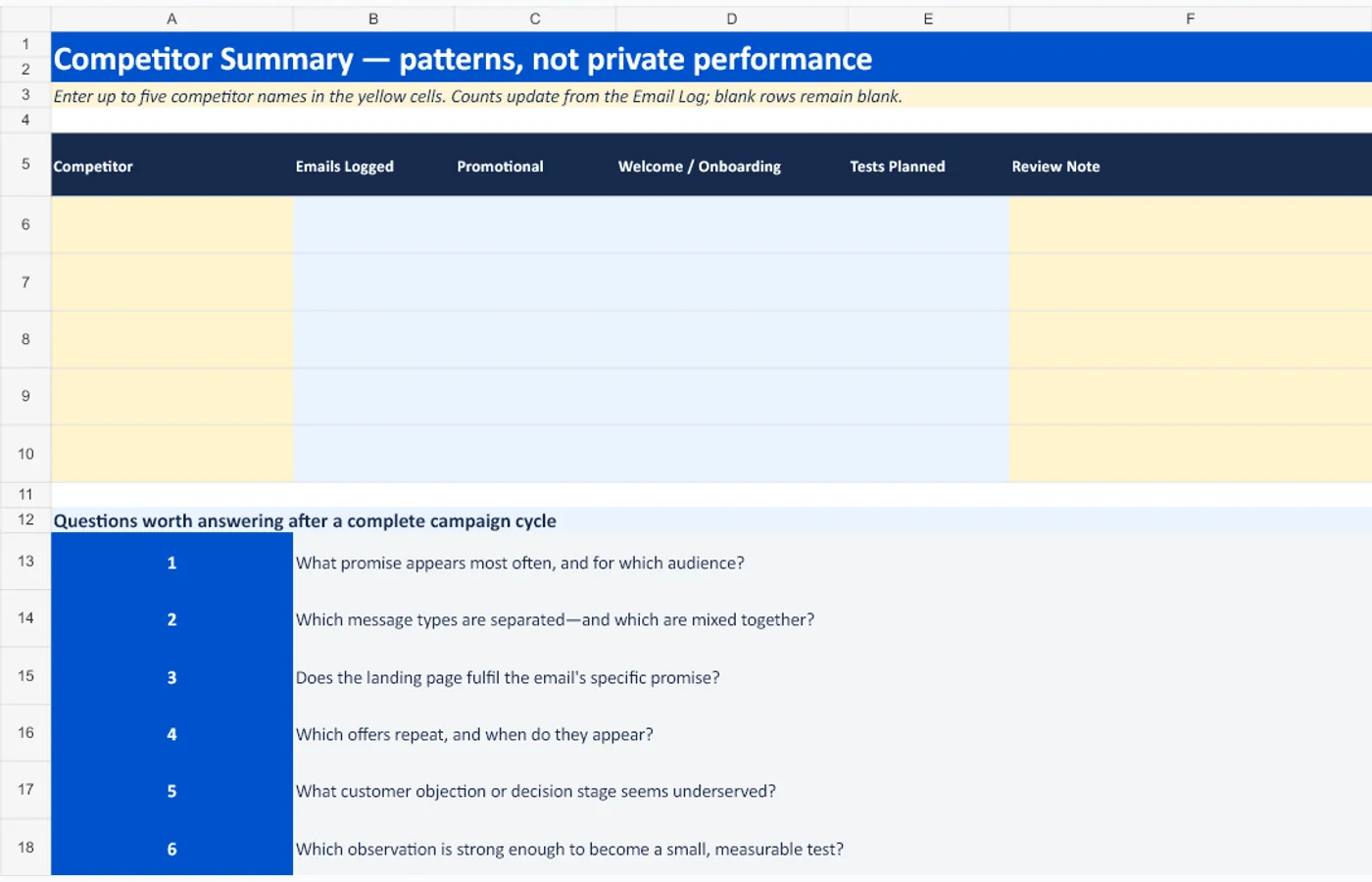
Free workbook
Competitor Email Marketing Analysis Template
Includes a guided workflow, 100-row email log, drop-down evidence labels, formula-driven competitor summary, and an experiment backlog.
Thirty days can reveal basic frequency and promotional patterns. Seasonal campaigns, infrequent B2B newsletters, and post-purchase journeys may require sixty or ninety days—or a complete sales cycle. Choose a period that can actually answer your research question.
Use the Evidence Ladder
The Evidence Ladder prevents a visible tactic from becoming an unsupported success claim.
-
Level 1
Observed
Something you directly saw: an email arrived, the subject mentioned delivery, or the CTA opened a category page.
-
Level 2
Repeated pattern
The same behaviour appeared across several messages or a complete campaign cycle.
-
Level 3
Hypothesis
A cautious explanation of why the pattern may matter and what should be tested.
-
Level 4
Proven for us
An idea validated with your own audience, campaign results, and business outcomes.
For example, “the competitor sent three educational messages before an offer” is an observation. “Education may reduce uncertainty before a sale” is a hypothesis. Only your own test can show whether an education-first sequence improves the result that matters to your business.
What to Check in Competitors' Emails
1. The signup promise
Start before the first email. Note where the form appears, what value is promised, whether frequency is stated, what information is requested, and what the confirmation page says will happen next.
Then compare the promise with the messages that follow. If a form promises weekly advice but immediately sends daily promotions, that mismatch says something about the experience. It does not reveal campaign performance.
2. Welcome and onboarding
A welcome journey often shows what a brand believes a new subscriber needs to know first. Ask how soon the first message arrives, whether each email has a distinct job, which objections appear, when the first sales request happens, and where the sequence seems to end.
Do not judge quality by message count alone. A short sequence can be clearer than a long one that repeats the same point.
3. Frequency and timing
Separate promotional, educational, transactional, and lifecycle messages. Eight emails in a month could mean eight broad promotions—or two newsletters, three campaign messages, one announcement, and two automated reminders. Those are different strategies.
Also watch for temporary bursts around launches and holidays. A Tuesday morning timestamp does not prove Tuesday is the best time. It only gives you a timing question to test with your own list.
4. Subject lines and preheaders
Record the promise, clarity, curiosity, urgency, product language, personalisation, and how the preheader completes the thought. Then check whether the email delivers what the subject promised.
Avoid copying a clever phrase. Identify its job instead. A subject may connect an ordinary product with a desired identity, address a fear, or make the next step feel easier. Use that principle to create original wording for your audience.
5. Content and positioning
Repeated themes can reveal what a brand wants to be known for: lower cost, convenience, expertise, simplicity, safety, sustainability, exclusivity, or support.
Repeated objections are also useful. If several competitors explain setup time, customers in the category may worry about complexity. Confirm that hypothesis through your own sales calls, support questions, customer interviews, and campaign data before changing your positioning.
6. Offers and promotions
Record more than the discount percentage. Note eligibility, minimum spend, bundles, free delivery, trial length, deadline, exclusions, loyalty benefits, and what the brand says before and after the offer.
A frequently repeated offer may work well, may be expected by customers, or may be compensating for weak demand. The pattern tells you what to investigate. It does not tell you the financial result.
7. Calls to action and landing pages
Open the main CTA and compare the destination with the email's promise. Is the offer visible? Does the advertised product appear immediately? Is the next step clear on a phone? Are deadlines and conditions explained?
This email-to-page continuity is often more useful than comparing button colours. If you are documenting visible campaign parameters, Pixel Logic IT's UTM builder explains how common tags are structured. Google's manual campaign documentation confirms that visible UTM parameters map to traffic-source dimensions. They may reveal naming conventions, but they do not reveal a competitor's traffic, conversions, budget, or ROI.
If the email and destination appear disconnected, review the principles behind email-to-landing-page message match before designing your own test.
8. Personalisation and segmentation signals
Record personalisation you can actually see, such as first name, location, account status, product viewed, purchase history, or membership level.
Receiving a product reminder suggests that behaviour influenced that message. It does not reveal every segment, rule, data source, or version used by the brand. A few test profiles never represent the complete system.
9. Technical clues
A footer, unsubscribe link, tracking domain, or full message header may provide clues about the sending infrastructure. Gmail's official instructions explain how to use Show original to view full email headers.
Treat these as clues, not proof. A brand may use multiple platforms or custom domains. A header cannot reveal actual deliverability, open rate, revenue, or whether the campaign worked. Knowing the tool rarely explains the strategy by itself.
A Worked Example: From Email Sequence to Responsible Test
The following example is fictional. Imagine an online skincare retailer called ClearLeaf studying another retailer's welcome journey.
Fictional example email
From: Mina at ClearLeaf
Subject: Find a routine that fits sensitive skin
Preheader: Three questions to make product selection easier.
Start with what your skin needs
A short guide explains how to choose between three original product routines without presenting a discount first.
Find your routineDestination: a fictional product-selection guide
What the analyst records
- 1
Observed: education appears before an incentive in this test journey.
- 2
Observed: sensitive-skin concerns and product choice receive prominent attention.
- 3
Hypothesis: education may reduce uncertainty before a sales message.
- 4
Test: compare an original education-first journey with the current welcome flow using purchases, revenue per recipient, replies, and unsubscribes.
The incorrect conclusion would be, “Their education-first sequence must generate more sales.” ClearLeaf cannot see that result. The responsible lesson is, “Our customers may also need help choosing; let us test that question using our own products, voice, and data.”
Free Methods and Competitor Email Tools
You do not necessarily need paid software. Choose a method based on the number of brands, the journeys you need, and how much manual work is reasonable.
| Method | Useful for | Important limitation |
|---|---|---|
| Dedicated inbox and workbook | A few high-priority competitors and specific public journeys | No history before signup and more manual organisation |
| Milled | Searching historical ecommerce promotions by brand or keyword | Milled describes itself as an ecommerce-email search engine; its archive may not contain every message, brand, or triggered journey |
| MailCharts | Ecommerce examples, brand groups, and lifecycle journeys collected by the platform | Its data reflects messages received and classified by MailCharts, not a competitor's private campaign performance |
| SendView or Owletter | Collecting monitored email streams, timelines, alerts, and team review at larger scale | Vendor-reported features do not reveal verified opens, clicks, conversions, revenue, or complete deliverability |
Coverage, pricing, security terms, retention, export rights, and platform features change. Verify them directly before purchasing. Also check the service's terms before downloading, embedding, publishing, or sharing competitor creative: access to a library does not automatically grant permission to republish its contents.
Turn Research Into an Experiment Backlog
A competitor audit has little value if it ends with screenshots. For each meaningful pattern, answer:
- What did we directly observe?
- How often did it repeat?
- What is our cautious explanation?
- Why might it matter to our customers?
- What is the smallest responsible test?
- Which metric will guide the decision?
- When will we review the result?
Example experiment card
Observation: Three competitors use educational content before promoting a consultation.
Hypothesis: Buyers may need more confidence before speaking to sales.
Test: Add one original education email before the current consultation message.
Decision metrics: qualified consultations, replies, and unsubscribes—not the competitor's activity.
Avoid changing the sender, subject, offer, design, CTA, and landing page at the same time. Competitor research should narrow the question. A controlled test should help answer it.
The principle is simple: copy the question a competitor appears to be answering—not its wording, design, or unverified answer. If you need help turning research into a distinct message, focus on original content and copywriting rather than imitation.
Keep the Research Ethical and Lawful
Checking messages offered through a public signup is different from accessing restricted information. Your research process should stay on the public side of that boundary.
Do not:
- enter private accounts or dashboards without permission;
- circumvent technical restrictions;
- misrepresent yourself to obtain confidential information;
- collect or profile named individuals without an appropriate lawful basis and privacy review;
- resubscribe repeatedly to evade suppression or opt-out controls;
- copy complete emails, images, templates, or distinctive creative work;
- publish personal, private, or confidential information;
- assume that a publicly visible email address provides consent for outreach.
The laws governing email that you send also vary by jurisdiction. In the United States, the Federal Trade Commission's CAN-SPAM guide explains requirements for commercial email, including accurate header information, non-deceptive subjects, identification, a postal address, and a working opt-out process.
In the United Kingdom, the ICO guidance on electronic-mail marketing explains consent, soft opt-in, subscriber types, identity, and unsubscribe requirements. It specifically warns that a publicly available address does not automatically mean the person consented to marketing.
Creative reuse is a separate issue. The U.S. Copyright Office's fair-use guidance explains that evaluation is case by case. A public newsletter is not automatically public-domain material. Summarise patterns, link to public examples where appropriate, and obtain permission before reproducing complete campaigns or substantial creative assets.
This is general research guidance, not legal advice. Review the law, platform terms, and organisational policies that apply to your situation.
Use a Simple 30-Minute Weekly Routine
Competitor monitoring should improve decisions, not consume the working week.
First 10 minutes: organise
- move new messages into the correct folders;
- add them to the tracker;
- record triggers and visible offers;
- flag incomplete journeys.
Next 10 minutes: compare
- separate email counts by message type;
- note recurring topics, objections, and offers;
- check for changes in positioning;
- review email-to-page continuity.
Final 10 minutes: decide
- record one useful hypothesis;
- add or update one experiment;
- remove observations with no decision value;
- identify anything requiring a longer collection period.
Review broader patterns monthly. Seasonal businesses should compare equivalent periods instead of treating one ordinary month as a complete picture.
Frequently Asked Questions
Is it legal to monitor competitors' email marketing?
Subscribing through a normal public form and analysing messages legitimately received is different from unauthorised access. However, legality depends on what you do, the relevant terms, the personal data involved, and the applicable jurisdiction. Do not bypass controls, misrepresent yourself to obtain restricted information, or republish protected material. Obtain qualified advice for a specific legal question.
Can I see a competitor's open and click rates?
Usually not. You can inspect the message delivered to your test inbox, but actual open rates, clicks, conversions, revenue, and profit are private first-party performance data. Treat estimates and vendor-defined metrics according to their documented methodology.
How many competitors should I track?
Three to five carefully selected brands are enough for many small teams. More monitoring creates more work and can pull your strategy in inconsistent directions. Add a brand only when it fills a clear research gap.
How long should I monitor competitor emails?
Thirty days is a practical starting point for normal frequency and promotion patterns. Use a longer window for seasonal campaigns, launches, long B2B cycles, post-purchase messages, re-engagement, or brands that send infrequently.
Should I use my normal business email address?
A dedicated company-controlled research inbox is easier to organise and keeps campaign tracking away from normal work. Document the signup profile and do not use deceptive information to enter restricted journeys.
What is the best competitor email tool?
The best method depends on scale. Use direct subscriptions for a few important brands, public archives for historical discovery, and a monitoring platform when the number of brands and journeys makes manual collection impractical. Verify current coverage, security, terms, export rights, and pricing before choosing.
Can AI analyse competitor emails?
AI can classify messages, summarise repeated themes, and help organise a large collection. It cannot see private campaign results, and its explanation of why a competitor did something may be wrong. Keep human review and label AI-generated explanations as hypotheses until your own evidence supports them.
Can I copy a competitor's subject line or design?
The safer and more useful approach is to identify the customer problem or communication principle, then create original work for your audience. Copying weakens differentiation and may create intellectual-property concerns.
Final Answer: How Should You Check Competitors' Email Marketing?
Start with one research question, a dedicated inbox, and three to five relevant competitors. Subscribe through normal public journeys, record each message in context, and compare complete timelines rather than isolated subject lines.
Keep four levels separate:
- what you directly observed;
- what repeated over time;
- what you believe may explain it;
- what your own campaign testing has proved.
Your competitors' emails can show you what they are doing for the customer profile you observed. They cannot show you what will work for your business.
Use the competitor email marketing analysis template to build your evidence timeline and experiment backlog. Then let your customers—not your competitors—decide which ideas deserve a permanent place in your strategy.
Research patterns. Create original work.
The goal is not to imitate the loudest brand in the inbox. It is to identify useful questions, build a clearer customer experience, and validate decisions with your own evidence.
Research and tool references reviewed on August 21, 2026.