

Marketing strategies often change because the conditions behind them change. Customers develop new priorities, competitors alter the category, products and prices move, channels introduce new rules, measurement becomes less certain, and performance evidence challenges earlier assumptions.
But there is an important correction to make. Many changes described as a new marketing strategy are actually changes to a campaign, channel, budget, message, or creative asset. Those are tactical or plan-level changes. A true strategic change reaches deeper into decisions about which customers to serve, what value to offer, and how marketing will help achieve the business objective.
Good marketing is therefore neither rigid nor restless. It protects the choices that still have evidence and changes the smallest level necessary when an assumption stops being true.
The practical answer
A marketing strategy should change when a central assumption about the objective, customer, problem, value proposition, economics, or route to market is no longer supported. If the central choices remain sound, change the plan or tactic instead.
What Is Actually Changing?
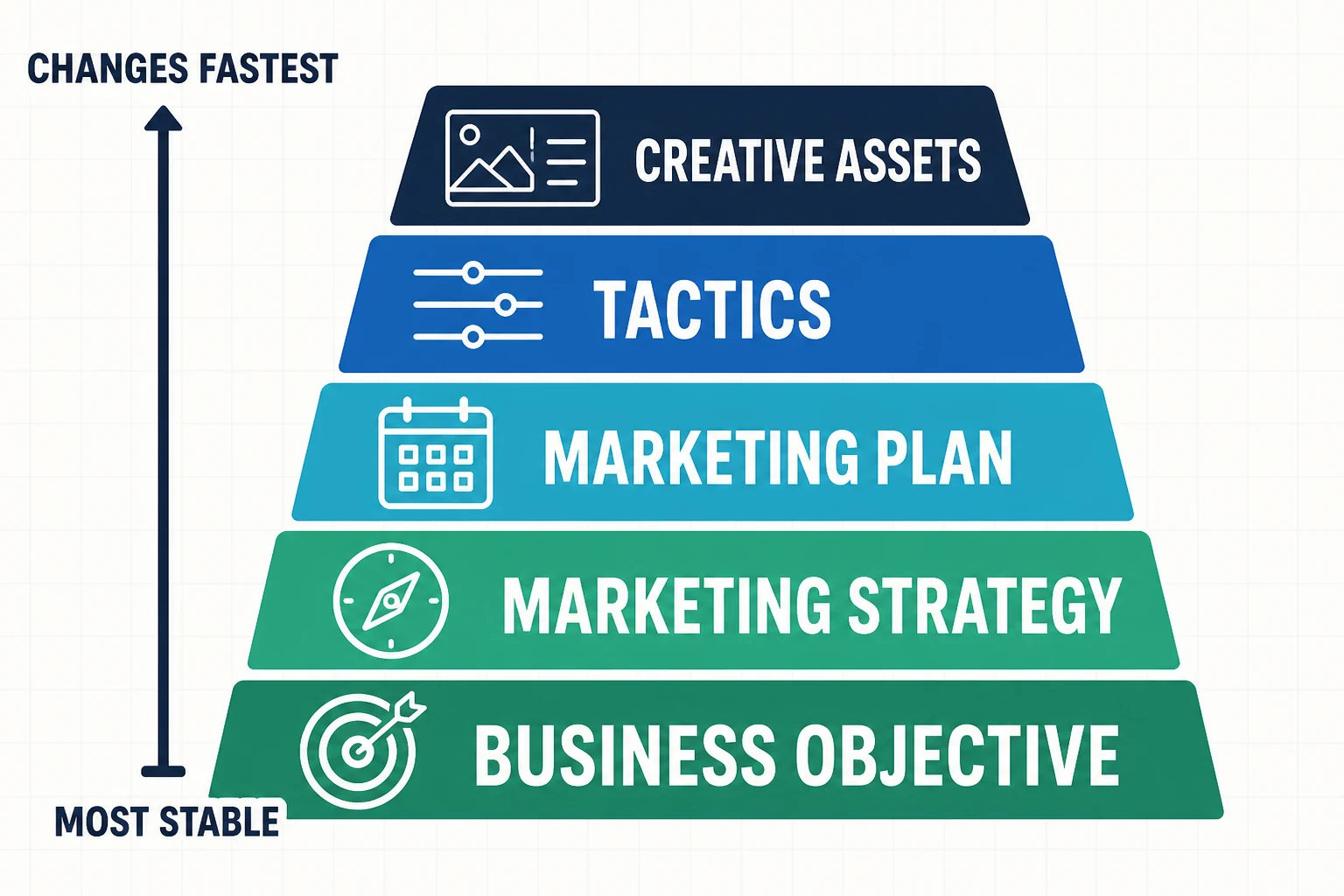
The word strategy is often used for almost every marketing decision. That makes it difficult to diagnose a problem. Separate the layers before deciding what to replace.
| Layer | Question answered | Typical examples | Change pattern |
|---|---|---|---|
| Business objective | What commercial outcome matters? | Growth, retention, margin, market entry | Usually the most stable |
| Marketing strategy | Who will we serve, with what value, and why can we win? | Audience, problem, position, value proposition | Changes when a central assumption fails |
| Marketing plan | How will resources execute the strategy? | Channel mix, budget, sequence, responsibilities | Reviewed periodically |
| Tactics | What specific action will we take? | Targeting, bidding, landing pages, email journeys | Changes more frequently |
| Creative assets | What will the audience see or hear? | Headlines, images, videos, subject lines | Often changes fastest |
Suppose a business still wants qualified local leads from homeowners who need urgent repairs. Replacing an underperforming advertisement is not a new strategy. Choosing to stop serving homeowners and pursue commercial property managers would be a strategic change because the customer, buying process, message, and route to value all change.
This distinction matters because strategic changes are expensive. They can affect the product, sales process, operations, website, content, and measurement system. Tactics should be allowed to move without making the entire business relearn its market every month.
Eight Reasons Marketing Approaches Change
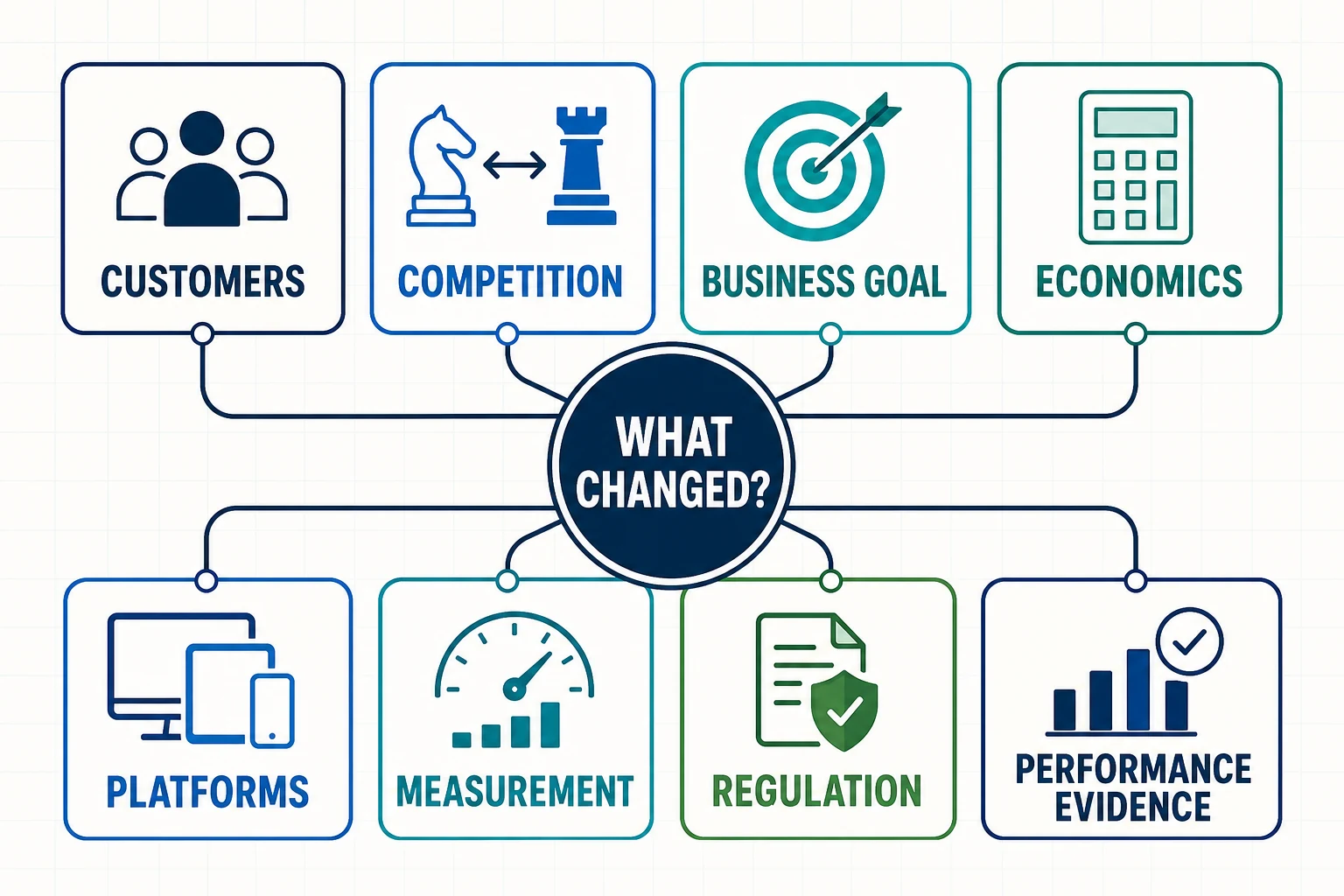
1. Customer needs and behavior change
Customers may discover products differently, compare more alternatives, delay a purchase, prefer self-service, demand stronger evidence, or use different language for the same problem. A message that once matched the buying situation can lose relevance even when the product has not changed.
Search behavior can provide one useful signal. Google's Trends data is based on an anonymized, categorized, and aggregated sample of searches. It is normalized for time and location, so it can show changes in relative interest but should not be treated as an exact search-volume report or a complete picture of demand.
The wording of demand matters too. Different keyword phrases can reveal different problems, levels of awareness, and buying stages. A change in language may require new content and targeting before it requires a new business position.
2. Competitors change the category
A competitor may introduce a lower price, a faster delivery model, a stronger guarantee, a clearer niche, or a more convenient purchase experience. The important question is not whether the competitor changed. It is whether that change altered what customers expect or made your current difference less meaningful.
Do not copy a visible campaign without understanding the underlying decision. Public advertisements and competitor emails can show messages, offers, timing, and journeys, but they do not reveal profitability, customer quality, hidden costs, or strategic intent.
3. The business objective changes
Marketing follows the business objective. A company prioritizing rapid customer acquisition may accept a different channel mix and payback period than a company protecting cash or improving retention. A new product launch, capacity limit, geographic expansion, investor requirement, or profitability target can change what marketing must accomplish.
This is one of the clearest reasons for a genuine strategy review. If the destination changes, the audience priority, offer, budget, and success measures may also need to change.
4. The offer or economics change
Price, margin, fulfilment cost, refund rate, sales capacity, repeat purchase, and conversion value determine which acquisition methods are workable. A campaign can produce leads and still damage the business if too few become profitable customers.
This is why channel metrics should connect to an operating result. The same principle appears in affiliate economics: revenue or commission alone does not describe costs, reversals, or repeatability.
5. Platforms and discovery systems change
Search engines, advertising networks, marketplaces, inbox providers, and social platforms change features, policies, formats, ranking systems, and automation. These changes can affect visibility, cost, control, or the kind of creative required.
Google says significant broad core updates happen several times a year. Its guidance also says most website owners may not notice them and should assess whether content remains helpful and reliable instead of searching for a quick technical reversal.
A platform change is therefore a trigger to investigate, not automatic proof that the strategy is wrong. The customer problem and value proposition may remain sound while content quality, campaign settings, or channel dependence need attention.
6. Privacy and measurement change
Marketing decisions depend on what can be observed and how credit is assigned. Privacy choices, tracking restrictions, browser behavior, consent settings, attribution models, and technical configuration can change reported performance without producing an identical change in actual customer demand.
Apple's privacy guidance requires permission for specified tracking across apps and websites owned by other companies. Google Analytics also explains that technology, regulation, consent choices, missing parameters, processing intervals, and implementation issues can affect data completeness and attribution. Its Analytics guidance recommends attention to data quality before marketing decisions are made.
When a report changes unexpectedly, first ask whether customer behavior changed, measurement changed, or both.
7. Regulations and trust expectations change
Marketing messages must remain lawful, truthful, and suitable for the channel and audience. Requirements around endorsements, reviews, privacy, environmental claims, financial promotions, health claims, and advertising to children can affect what a business may say and how relationships must be disclosed.
The United States Federal Trade Commission revised its Endorsement Guides to address practices including social media endorsements, virtual influencers, incentivized reviews, and disclosure tools. The official FTC update illustrates why a marketing process must monitor applicable guidance instead of assuming last year's execution remains compliant.
8. Evidence disproves an assumption
Sometimes the environment did not cause the change. Better evidence revealed that the original belief was weak. The chosen audience may not value the difference, the channel may attract poor-fit leads, the offer may create friction, or the sales process may fail to convert genuine demand.
This is a healthy reason to change. A strategy is a set of choices made under uncertainty, not a promise to defend every assumption forever. The discipline is to identify which assumption failed and avoid changing unrelated parts of the system.
External Trigger or Internal Problem?
A visible symptom can have several causes. Use competing explanations before choosing an action.
| Observation | Possible external cause | Possible internal cause | Check first |
|---|---|---|---|
| Search traffic falls | Demand, results, or ranking systems changed | Content became less useful or technically inaccessible | Queries, pages, dates, indexing, competitors |
| Advertising cost rises | Auction competition or seasonality increased | Targeting, creative, or conversion rate weakened | Impressions, clicks, conversion quality, margin |
| Email engagement falls | Inbox or audience routines changed | Content became repetitive or poorly segmented | Delivery, audience, topic, click quality |
| Sales fall | Economic, seasonal, or category demand shifted | Offer, price, proof, checkout, or follow-up failed | Stage-by-stage conversion and customer feedback |
| Attribution changes | Privacy or platform reporting changed | Tags, parameters, definitions, or settings broke | Implementation and source data |
The purpose is not to create an excuse for weak results. It is to prevent a false diagnosis. Changing the strategy cannot repair broken tracking, and fixing a tag cannot repair an offer customers no longer want.
When a Tactical Adjustment Is Enough
Keep the strategy when the customer, problem, value proposition, and economics still have evidence. Adjust execution when the issue is narrower.
- Refresh a creative after attention or response declines.
- Clarify a call to action when visitors engage but do not proceed.
- Improve a landing page when the advertisement attracts the right people.
- Change bids or exclusions when paid traffic quality varies.
- Adjust an email journey when the offer is right but timing is poor.
- Move a limited budget when one channel produces stronger qualified demand.
For paid campaigns, Google provides Google experiments that split traffic or budget between a base campaign and a proposed change. The exact test design depends on the platform and available data, but the principle is useful everywhere: compare a focused change against a clear control when practical.
The same focus helps avoid the problems discussed in our Google Ads guide. Adding more elements is not always an improvement. Relevance and interpretability matter more than activity.
When the Strategy May Need Reconsideration
A strategy review is justified when evidence challenges a central choice rather than a single execution detail.
- The objective changed: marketing is now being asked to create a different business outcome.
- The customer changed: the selected segment no longer has the expected need or buying ability.
- The problem changed: customers now solve it differently or consider another problem more urgent.
- The value weakened: the product no longer provides a meaningful reason to choose it.
- The economics failed: realistic acquisition and delivery costs cannot produce a workable result.
- The route closed: a critical channel became permanently unsuitable and no reasonable substitute reaches the same audience.
A strategic change should name the assumption that failed. “Social media stopped working” is too broad. “The selected customer now requires peer proof and a longer evaluation process, so a direct-response message no longer matches the purchase” is a strategic diagnosis that can guide a new choice.
When Not to Change the Strategy
Frequent change can destroy the very evidence needed to learn. Avoid a broad reset based only on:
- one bad day or week without a meaningful comparison;
- a competitor's visible campaign with unknown economics;
- a new tool, platform feature, or popular format;
- a vanity metric disconnected from customer or business value;
- an analytics change that has not been technically verified;
- a test too small or too short to answer its stated question;
- pressure to copy a business serving a different market.
Adaptability does not mean reacting to every signal. It means knowing which signals could invalidate a decision and collecting enough evidence to respond proportionately.
The Smallest Responsible Change Process
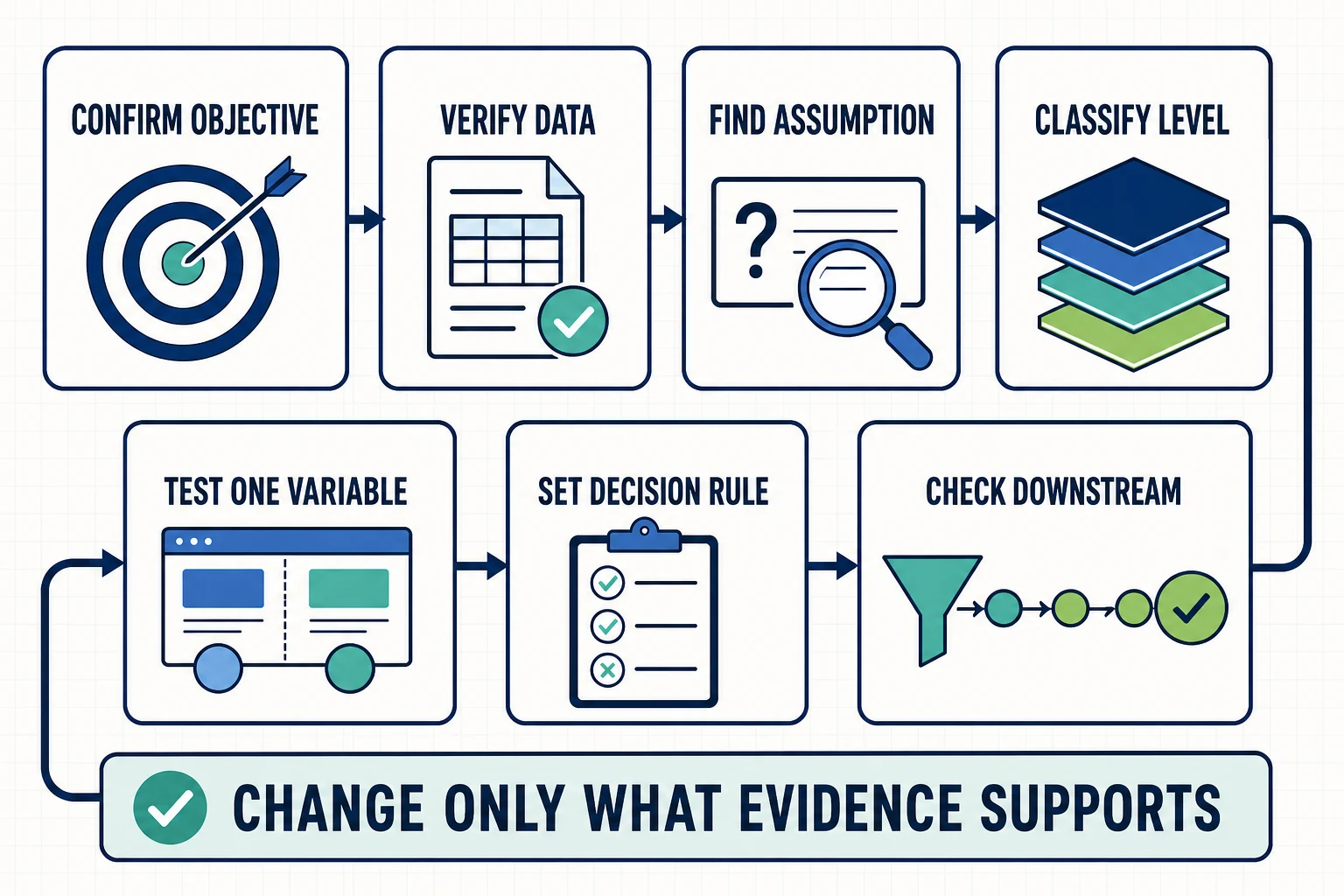
1. Confirm the objective
State the business outcome, audience, time horizon, and constraint. “Improve marketing” is not a decision target. “Increase qualified consultations without raising acquisition cost beyond the available margin” is more useful.
2. Verify the evidence
Check tracking, attribution settings, definitions, processing delays, site changes, sales records, and comparison periods. Use customer conversations and operational data alongside channel reports.
3. Find the broken assumption
Write what you believed and what evidence now conflicts with it. This turns a vague performance problem into a testable diagnosis.
4. Classify the level of change
Decide whether the evidence points to a creative asset, tactic, marketing plan, offer, or strategy. Start at the lowest level capable of addressing the cause.
5. Test one meaningful variable
Changing the audience, offer, page, creative, budget, and follow-up together may change the result without revealing why. Isolate a meaningful variable when the channel, cost, and sample allow it.
6. Define the decision rule beforehand
Choose the success metric, guardrail, minimum evidence, and next action before seeing the result. This reduces the temptation to reinterpret an inconvenient outcome.
7. Record the downstream effect
A change that raises clicks but reduces lead quality is not automatically successful. Monitor revenue, margin, customer quality, fulfilment, retention, complaints, and brand trust where relevant.
Check the Appropriate Level of Change
Use the questions below as a structured first pass. The result is not a substitute for customer research or financial analysis, but it can prevent a premature strategic reset.
Private and instant
Marketing Change Checker
Answer seven questions to identify the smallest responsible level of change. This is a planning aid, not a guarantee that a particular action will improve performance.
The checker uses only the answers in this browser session. It does not collect or send your responses.
Three Examples of Proportionate Change
Example 1: A local service business loses paid leads
Clicks and costs are stable, but fewer visitors request a consultation. The business still serves the same local problem and sales calls confirm that demand exists.
First investigation: landing-page speed, form errors, call tracking, offer clarity, proof, and follow-up. The evidence currently points to conversion execution, not a new market strategy.
Example 2: An ecommerce product loses margin
Advertising still produces purchases, but fulfilment, returns, and auction costs leave little operating value. The campaign dashboard appears healthy because it does not include every cost.
First investigation: contribution margin by product, return reasons, repeat value, offer structure, and customer quality. Pricing or product economics may need repair before more traffic is purchased.
Example 3: A content website loses organic traffic
Several pages decline after search results and competing content change. Some queries also show weaker demand, while the best original resources retain engagement.
First investigation: query-level demand, affected page groups, indexing, content usefulness, competitor value, and conversions from remaining visitors. Update or consolidate weak content based on the diagnosis. Do not automatically change the whole brand or publish unrelated topics.
What Should Stay Stable?
A responsive business still needs continuity. The following principles should remain stable unless strong evidence or a business change requires otherwise:
- Truthful claims: performance pressure does not justify misleading customers.
- Customer respect: privacy, consent, accessibility, and fair treatment are not optional tactics.
- Evidence standards: use consistent definitions and decision rules.
- Brand promise: execution may vary while the promised value remains recognizable.
- Commercial discipline: connect marketing activity to customer and operating outcomes.
Legitimate digital marketing is not defined by whether it uses the newest channel. It is defined by whether the work creates honest, relevant value and can be evaluated responsibly.
A Practical Review Rhythm
There is no universal review calendar. Purchase cycles, campaign volume, seasonality, risk, and data availability differ. Use a rhythm that separates monitoring from strategic decision-making.
| Review level | Purpose | Useful questions |
|---|---|---|
| Operational monitoring | Detect delivery, tracking, cost, or quality problems | Is anything broken or outside its guardrail? |
| Campaign review | Compare tactics and diagnose funnel stages | What changed, where, and for which audience? |
| Plan review | Reallocate resources and sequence work | Does the channel mix still execute the strategy? |
| Strategy review | Retest central assumptions | Are the objective, customer, problem, value, and economics still sound? |
| Event-triggered review | Respond to a material external or business change | Which assumption did this event affect? |
A high-volume campaign may support faster tactical decisions than a low-volume business with a long sales cycle. Do not borrow another company's calendar without considering how quickly your own evidence becomes meaningful.
Final Answer
Why do marketing strategies often change? Because the objective, customer, market, offer, economics, technology, rules, and available evidence do not remain fixed.
However, the most important lesson is that not every change is strategic. Creative assets and tactics should adapt more often than the core customer and value choices. Begin by verifying the data, locate the broken assumption, and change the lowest level capable of solving the problem.
A stable marketing strategy is not one that ignores reality. It is one whose central assumptions still have evidence. An adaptive strategy is not one that follows every trend. It is one that changes deliberately when those assumptions stop being true.
Frequently Asked Questions
How often should a marketing strategy be reviewed?
Review central assumptions on a rhythm appropriate to the business and whenever a material event affects the objective, customer, problem, value proposition, economics, regulation, or route to market. Monitoring campaigns more frequently does not mean rewriting the strategy at the same frequency.
Is changing tactics the same as changing strategy?
No. A tactic is a specific action such as testing an advertisement, landing page, email, or bid. Strategy defines the customer, value, position, and route to the business objective. Tactics can change while the strategy remains intact.
When should a business stop using a marketing channel?
Consider leaving or reducing a channel when verified evidence shows that it cannot reach the right audience, comply with applicable rules, support measurement, or produce a workable customer and operating result. Test a proportionate alternative before moving the full budget when practical.
Do algorithm changes require a new marketing strategy?
Not automatically. An algorithm change may require diagnosis, content improvement, campaign adjustment, or less dependence on one channel. A strategic reset is justified only when it invalidates a central assumption about how the business can reach and serve its chosen customer.
Can a strategy change without changing the brand?
Yes. A business can revise audience priority, channel mix, offer structure, or route to market while preserving its name, values, and recognizable promise. A brand change should solve a specific positioning or identity problem, not merely signal activity.
How do you know whether a marketing change worked?
Define the expected effect, success metric, guardrails, evidence requirement, and next decision before applying the change. Evaluate downstream customer quality and commercial value, not only the closest channel metric.