


If you search for Crew CloudySocial, you may expect to find one simple explanation. Instead, the results tell several different stories. One article calls it a social media management platform. Another describes it as a collaboration workspace for marketing teams. Some connect the term with community engagement between creators. Other pages say that “Crew” simply means the writers and editors behind CloudySocial.com. The confusion is understandable because even CloudySocial.com's own pages do not present one completely consistent picture.
So, what is Crew CloudySocial? The most useful answer is that Crew CloudySocial is currently an ambiguous online term connected with CloudySocial.com. The main CloudySocial website visibly works as a technology and digital-content publication, complete with articles, categories and an “About the Crew” section. At the same time, another page on that same website describes Crew CloudySocial as a social media management tool with scheduling, analytics and team features. Understanding that difference makes the rest much easier.
What Is Crew CloudySocial?
There are two main ways the term is used online. The first refers to the crew behind CloudySocial.com. CloudySocial has an actual “About the Crew” page. It describes the site as a source of technology insights covering topics such as hardware, software, AI, machine learning, DevOps and data science. The page currently identifies Greg Minison and Brandon Smith as editors. In that context, Crew CloudySocial simply means the people involved with the website's content.
The second meaning is very different. Several online articles describe Crew CloudySocial as a social media management and team-collaboration platform. The features commonly associated with this interpretation include content scheduling, shared calendars, analytics, approval workflows, team roles and management of several social accounts. CloudySocial.com itself also has an article making many of these software claims. That is why neither interpretation should simply be ignored.
Why Is Crew CloudySocial So Confusing?
Part of the problem comes from the name itself. “Crew” sounds collaborative. “Cloudy” suggests cloud software. “Social” sounds like social media. Put those words together and the name feels like something you would expect to see on a SaaS homepage. But when you visit CloudySocial.com's main public website, the structure looks much more like an online publication.
Its navigation currently includes sections such as Hardware, Gear & AV Components, Tech Help, Social Media, About the Crew and Contact Us. The homepage is filled with published articles and author bylines. That creates a gap between the brand impression created by the name and the website experience a visitor actually sees.
There is another issue too. Once one website publishes a detailed explanation of an unfamiliar term, other websites can repeat, expand or reinterpret the same information. Eventually, several pages may appear to support a particular explanation even when they are not providing independent evidence. This appears to be one reason the Crew CloudySocial search results have become so mixed. Several current ranking pages now explicitly warn readers to distinguish repeated claims from directly verifiable information.
What Does the CloudySocial Website Actually Show?
It helps to start with what can be observed directly. CloudySocial.com is an active content website. It publishes articles across technology, social media, hardware and related digital topics. It has an “About the Crew” page. It displays named editors and author bylines. It has category pages and normal publication-style navigation. Those points are relatively straightforward. What becomes less straightforward is the software side. CloudySocial.com also contains an article titled “Crew CloudySocial: The Ultimate Social Media Management Tool.”
That article describes Crew CloudySocial as a platform for managing social accounts, scheduling posts, reviewing analytics and collaborating with team members. It also discusses customizable content calendars and connecting multiple social profiles. So there really is first-party content describing software. The question is how much of that software offering can be independently confirmed through the rest of the public site.
Is Crew CloudySocial a Social Media Management Platform?
Online articles frequently describe it that way. The software interpretation usually centres around a common problem: managing social media becomes messy when more than one person is involved. A writer creates the post. A designer prepares the image. A manager reviews the copy. A client may need to approve it. Someone else finally schedules the content. When all of this happens through emails, chat messages and spreadsheets, information can quickly become scattered.
The supposed Crew CloudySocial platform is presented as a way to bring those steps into one workspace. Current ranking articles commonly associate it with shared calendars, content reviews, team permissions and publishing workflows. These are reasonable features for collaborative social media software. The important distinction is that reasonable does not automatically mean verified.
Features Commonly Associated With Crew CloudySocial
Here are the main capabilities mentioned repeatedly across the current search results.
Content Scheduling
Scheduling is one of the most common claims. The basic idea is that users prepare content in advance and choose when each post should be published. CloudySocial.com's own Crew CloudySocial article says users can plan and schedule content ahead of time. For a business managing several social channels, that type of system could reduce daily manual posting.
Shared Content Calendar
Several ranking articles describe a visual calendar where content can be organized by date, platform or publishing status. CloudySocial's own article also refers to customizable content calendars with drag-and-drop organization. A shared calendar is especially useful when several people contribute to the same campaign.
Team Collaboration
Another repeated idea is collaboration. Instead of sending a draft through several email threads, team members could theoretically work around the same piece of content inside one workspace. CloudySocial.com's article says team members can be invited and assigned roles. Some third-party coverage goes further, describing separate contributor, editor, viewer or administrator roles. Those more detailed role structures should be treated as reported features unless confirmed through current product documentation.
Approval Workflows
Approval is one of the more useful ideas found across competitor articles. Imagine a small marketing agency. A writer drafts an Instagram caption. A designer adds the image. An account manager checks it. The client approves it. Only then does someone schedule the post. An approval system can make that sequence easier to follow. Current third-party descriptions frequently connect Crew CloudySocial with this type of draft-to-review-to-publish process.
Analytics and Reporting
CloudySocial.com's own Crew article says the platform provides analytics covering engagement, reach and content performance. Analytics would be a natural part of any serious social management tool because businesses need to know which posts attract attention and which do not. However, detailed public documentation showing the depth of these analytics is less obvious from the main website experience.
Multiple Social Accounts
Another claimed benefit is managing several profiles from one place. The first-party Crew article says users can connect social accounts and manage several profiles together. Again, the idea makes sense. But anyone choosing software for business use should confirm the exact supported networks rather than relying on general feature summaries.
Claimed Features vs What Is Clearly Visible
This is the distinction most articles should make more clearly.
| Directly visible or documented | Commonly described but worth further verification |
|---|---|
| CloudySocial.com website | Operational SaaS dashboard |
| Technology articles | Full social scheduling system |
| Social Media category | Advanced analytics suite |
| About the Crew page | Current third-party integrations |
| Named editors/authors | Exact role and permission system |
| Crew CloudySocial software article | Current subscription pricing |
| General descriptions of scheduling and analytics | Independent security certification |
| Publication-style homepage | Verified customer numbers |
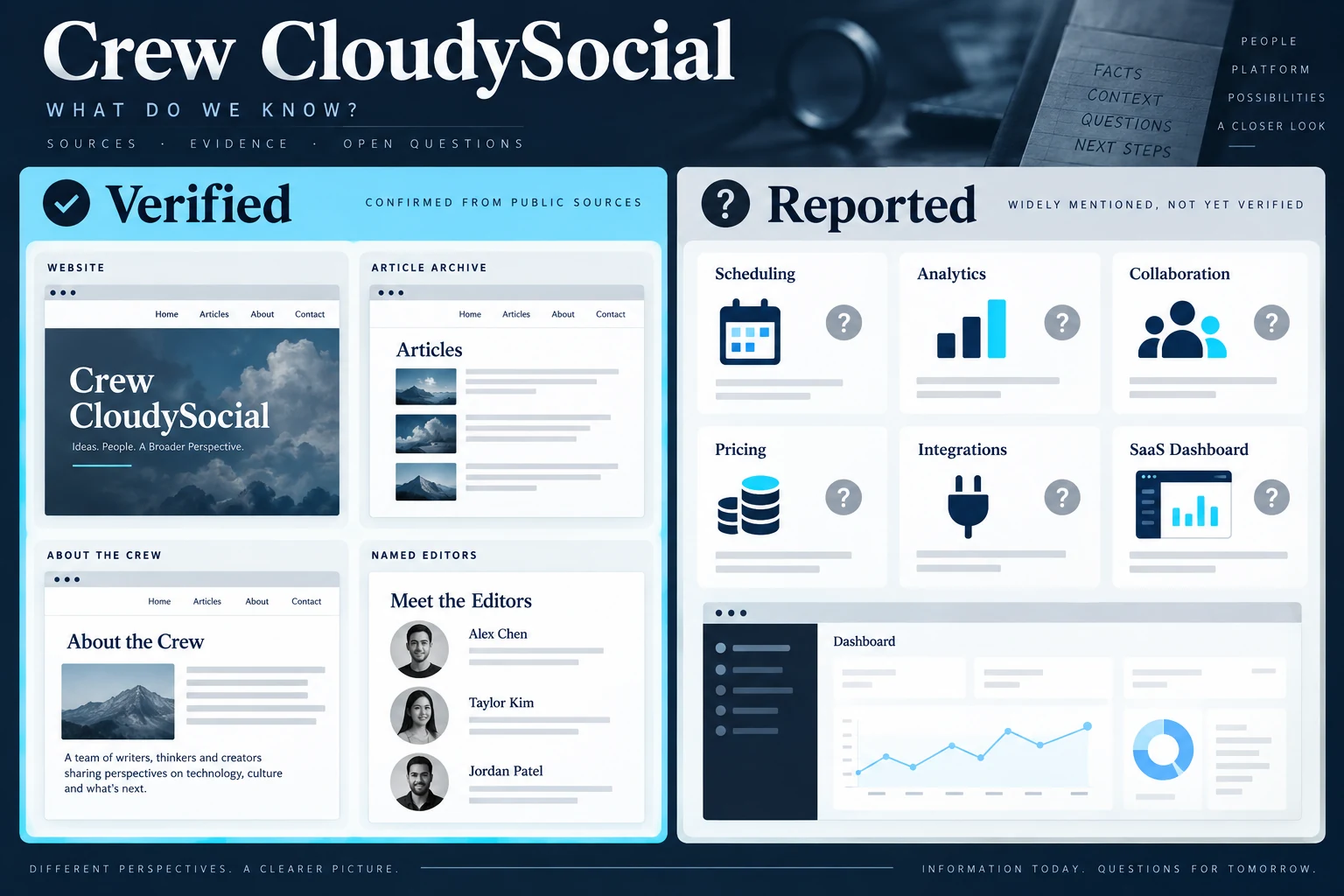
The right column does not mean those features are necessarily false. It means that a reader considering the service should confirm them through a current product interface, pricing page, documentation or direct provider information before making a business decision. That is a much stronger approach than treating every repeated online description as proven.
Who Is the “Crew” Behind CloudySocial?
CloudySocial's first-party About page currently highlights Greg Minison and Brandon Smith. Greg Minison is described there as an editor focusing on cloud technologies, artificial intelligence and machine learning. Brandon Smith is described as an editor working with areas such as DevOps and big data.
The broader website also displays additional author names on individual articles. This strengthens the simplest interpretation of the word “crew”: it can literally refer to the people producing and editing the site's content. That meaning should not be overlooked simply because software-focused descriptions rank for the same keyword.
Is Crew CloudySocial an Engagement Community?
A third interpretation appears in some search results. Under this version, Crew CloudySocial is described less like software and more like a community where creators help each other's content receive attention. That might involve members interacting with each other's posts or sharing content within a group.
One current ranking page devotes a substantial section to this interpretation and treats it as different from the team-collaboration version. However, this meaning has weaker direct support from the core CloudySocial pages reviewed here. For that reason, it is better understood as one interpretation found in the wider search ecosystem, not automatically as the primary definition of Crew CloudySocial.
What Is Crew.CloudySocial.com?
Another variation you may see is Crew.CloudySocial.com. Because it looks like a subdomain, readers may assume it is a separate application or login system. Some articles connect that phrase with staff coordination, schedules, messages, tasks and internal teamwork.
But names that look similar should not automatically be treated as the same product. If you encounter a login page, service or subdomain using the CloudySocial name, check the full URL carefully. You should also make sure that any login or integration you use is actually linked from a verified first-party source before entering account credentials.
Is Crew CloudySocial Legit?
This question needs to be divided into two parts. Yes. CloudySocial.com is an accessible website with published articles, categories, author names, navigation and an About the Crew page. Are all online claims about Crew CloudySocial confirmed?
No. The current search results contain conflicting descriptions. Some pages describe a sophisticated collaboration platform. Others describe an editorial crew. Others discuss community engagement. Even first-party CloudySocial pages create a mixed picture because the website looks primarily editorial while one of its articles explicitly presents Crew CloudySocial as software. So the website's existence and every claim made about a supposed product are two separate questions.
Is Crew CloudySocial Safe?
There is not enough public evidence in the material reviewed to make a broad technical security judgment about a standalone Crew CloudySocial software product. That does not mean it is unsafe. It simply means security should be checked in the same way you would check any unfamiliar service that asks for access to business or social media accounts.
Before connecting an account, look for:
- A clear privacy policy
- Current terms of service
- Transparent information about the operator
- Secure account authentication
- An explanation of requested permissions
- Information about how account tokens are stored
- A way to remove integrations
- Current support contact information
- Independent product reviews where available
If a platform asks for more account access than its function seems to require, investigate before proceeding.
Who Could Benefit From the Software Concept?
Teams coordinating frequent social content may benefit from this workflow concept, but they should still verify the actual product before comparing providers.
Even though some product details remain uncertain, the workflow described in Crew CloudySocial articles addresses real problems.
Marketing Agencies
Agencies often manage several clients at once. A shared calendar, approval process and controlled publishing system can reduce mistakes and make client reviews easier.
In-House Social Media Teams
A company with writers, designers and managers may benefit from having one place where everyone can see what is being prepared.
Freelancers Managing Several Clients
Freelancers frequently juggle different brand voices, posting dates and approval requirements. A central workspace could help keep those accounts separate.
Small Businesses
A business owner who works with a part-time marketer or external agency may want clear visibility into what is scheduled without having to search through messages. These use cases explain why the idea behind Crew CloudySocial attracts attention, even while the exact product identity remains unclear.
Who Probably Does Not Need This Type of System?
A solo creator managing one or two profiles may not need complicated approvals, user roles or team workflows. Native scheduling features or a simpler social media tool may be enough. The same applies to businesses that mainly need advanced reporting rather than collaboration. The right solution depends on the actual problem you are trying to solve.
How Should Crew CloudySocial Be Compared With Established Tools?
A sound marketing strategy compares tools against a documented workflow, not a repeated feature list.
Some competitor articles compare Crew CloudySocial with well-known social management products. That comparison should be made carefully. Platforms such as Buffer, Hootsuite, Later and Sprout Social have established product pages, pricing information, documentation and identifiable software interfaces. For Crew CloudySocial, public information is currently less straightforward. Instead of asking whether Crew CloudySocial is better than Hootsuite, compare only what can be verified.
Why Repeated Search Results Can Be Misleading
Crew CloudySocial offers a useful lesson in online research. Imagine five websites all say that a tool has a particular feature. At first, that sounds like five confirmations. But what if four pages copied or paraphrased the fifth? You still have only one original claim. This matters with obscure products, unfamiliar companies and trending search terms. One of the strongest patterns in newer Crew CloudySocial articles is therefore not a feature at all. It is an emphasis on verification. Several current ranking pages now separate statements they can directly confirm from claims repeated elsewhere. That is the right approach.
How to Verify Crew CloudySocial for Yourself

You do not need advanced technical knowledge.
- Start with the official website.
- Look at the homepage and About page.
- Then look for a dedicated product page.
- Check whether there is a real sign-up or login flow.
- Find the pricing page.
- Look for documentation covering supported networks and integrations.
- Check the privacy policy before connecting accounts.
- Look for product screenshots or demonstrations.
Search for independent reviews from people who have actually used the service. If customer numbers, awards or major-company adoption are mentioned, look for evidence outside the original article. This process takes only a little longer, but it can separate useful information from repeated assumptions.
What Is the Most Accurate Definition of Crew CloudySocial?
Based on the current evidence, the safest definition is: Crew CloudySocial is an ambiguous term associated with CloudySocial.com. It clearly relates to the site's editorial crew, while some first-party and third-party articles also use the name for a social media management or collaboration platform.
The full software offering described online is not as clearly documented through the site's main public-facing structure. That definition may be less exciting than calling it an “all-in-one revolutionary social media platform.” But it is more useful. It tells readers what can actually be seen while still acknowledging the software descriptions that exist.
This evidence-first approach also applies to unfamiliar claims across digital marketing. Verify the owner, interface, policies, permissions, and support path before relying on a service for business accounts.